The Microbrewed Beer of the Month Club

Past Newsletters

Vol. 12 No. 10

Bringing You The Best Domestic Microbrews for 12Years Now!!

Brewery
Beers Featured
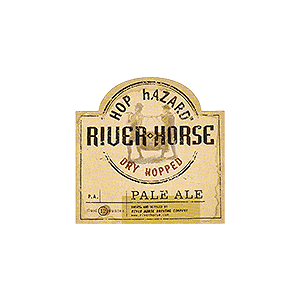
River Horse Brewing Company Hop Hazard Pale Ale
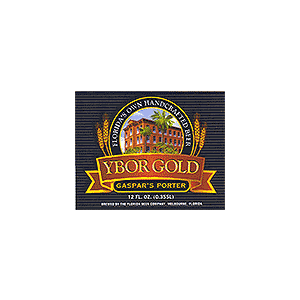
Ybor City Brewing Company Ybor Gold Gaspar's Porter
River Horse Brewing Company Triple Horse Belgian Ale
Ybor City Brewing Company Ybor Gold Brown Ale
Ridgeway Brewing Company (England) Ridgeway Bitter
Hradec Kralove Brewery (Czec Republic) LEV Lion Pale Double Bock

River Horse Brewing Company

Ahhh, New Jersey—home of innumerable diners, Tony Soprano, and a resident accent that sounds nearly as intellectual as Frenchie’s from Grease. These may be a few of the features that you associate with “Joy-zee,” but the Garden state is actually home to a number of great microbreweries. The River Horse Brewing Co., located in Lambertville, New Jersey, is housed in an old brick building that once was an oyster-cracker factory. Whether this means that the facility was used to crack oysters or make oyster-flavored crackers is a mystery that sweet lady NJ has been unwilling for decades to reveal (ok you caught us, we were too lazy to look it up).

Located along the bank of the Delaware River, the brewery is one of New Jersey's oldest and fastest growing. Incidentally, “River horse” is a nickname for the hippopotamus. “So what”, you say? The ancient Egyptians believed in the beer god, Seth, who appeared in the image of a hippopotamus. Pretty neat, huh? Another quick tidbit for your next round of impromptu “I’m a beer connoisseur and I’ll prove it;” beer is believed to have been first brewed in ancient Egypt. While being a slave laborer indentured for life to build the great pyramids at Giza couldn’t have been easy, it seems somehow less grueling a task when you consider that those fellas may have had a chance to grab a cold one between beatings.

OK, let’s leave ancient Egypt and let the sweet taste of microbrewed New Jersey beer bring us back to modern times… With the pair of finely crafted malty nectars we’ve sent you, we think you’ll agree that our expert panel has made you an offer you can’t refuse.
For more information about the brewery and scheduled tours, call (609) 397-7776 or check out their web site at http://www.riverhorse.com/.

Hop Hazard Pale Ale

Hop Hazard Pale AleStylistically, this beer rides the line between an aggressively hopped Pale Ale and an IPA. The ABV is a bit low for an IPA, but the hop presence is rather elevated to be considered a standard Pale Ale. Expect a highly aromatic hoppy nose with grassy, citric, fruity and floral varietals expressed (quite a robust combination of hoppy elements at work here!) Also note a caramel malty sweetness also present with a peppery undercurrent. Look for the flavor to begin with caramel notes and peppery hops, with hoppy bitterness and floral tones quickly taking center stage, only to subside back to a balanced finish. A great hoppy session beer, we enjoyed this with grilled chicken served in spicy diced tomato garlic & artichoke heart sauce.

Serving Temperature: 40-50° F
Int’l Bittering Units: 34
Alcohol by Volume: 5.5%
Suggested Glassware: Pint Glass
Malts: Caramel, 2 Row, Munich, Victory
Hops: Chinook, Cascade, Goldings, Fuggle

Triple Horse Belgian Ale

At 10% ABV, this is one of the biggest domestic beers we’ve featured. This exceptional beer incorporates elements of various Belgian styles, from the spicy, orangey notes and slight sourness in a Belgian Witbier, to the clove-like sweetness of a Wheatbock, to the dryness found in a Belgian Strong Dark Ale. Take an extra moment to take in the Belgian aromas of banana, melon & peach. Look for a breaddy malty character in the flavor, with a rounded malty sweetness, notes of cloves, nutmeg, coriander and an earthy finish similar to Belgian farmhouse ales. Expect an extraordinarily lengthy bitterness in the finish that works to balance the sweetness. Recommended partnering: Mediterranean cuisine and/or gorgonzola cheese.

Serving Temperature: 50-55° F
Int’l Bittering Units: 17
Alcohol by Volume: 10.0%
Suggested Glassware: Tulip, Snifter or Oversized Wine Glass
Malts: Pilsen, Caramel, Wheat
Hops: Hallertau, Saaz, Goldings
Additional Spices: Nutmeg, Coriander

Ybor City Brewing Company

In the late 1800s, Ybor City, FL was the cigar capital of the world (cigars anyone? Visit www.monthlyclubs.com for info on our Premium Cigar of the Month Club). Its location near the coast made shipping supplies up from Cuba relatively simple, and it served as a major conduit between the famed Cuban cigar market and the U.S. demand to have them. In 1886, Vincente Martinez Ybor led the migration of the Cuban cigar industry to a small region located in the Tampa metropolitan area. Ybor City became a bastion for immigrant workers seeking to leave the violent revolutions in Cuba. For over 40 years, the industry flourished, however, with the hit of the depression in 1929, coupled with the popularity boom of American cigarettes, the cigar industry rapidly declined.

Naturally, many of the factories were closed, abandoned, and torn down. However one building, the Seidenberg and Company cigar factory, built in 1894, withstood the test of time. Now, you may ask, “What does this have to do with my microbrewed beer of the month?” Well, move ahead 100 years from the date that Seidenberg opened its doors at this location in 1894 and that is when the Ybor City Brewing Company first opened its doors (1994) in this exact same brick building.

Not only is the brewery site rich with history, the company president, Humberto Perez, is a third-generation brewer whose grandfather founded one of the largest breweries in Venezuela—Cerveceria—about 75 years ago. And like the cigar factory practices, this brewery employs similar traditions; all the brewing is done by hand. Not a single step of the process is automated! Today they brew a vast line up of Floridian beers, under the larger company name of the Florida Beer Company. Other brew lines include Key West, Hurricane Reef, and La Tropical, for a total of over 13 quality beers.

For more information about the brewery and scheduled tours, call (813) 242-9222, or visit their website at www.floridabeer.com.

Ybor Gold Gaspar’s Porter

Ybor Gold Gaspar's PorterIn the late 18th and early 19th centuries, the legendary pirate Jose Gaspar purportedly sailed the waters of West Florida, terrorizing the region. A society columnist with the Tampa Tribune is credited with creating a pirate-inspired festival in 1904 that came to be known as Gasparilla. An annual tradition since 1904, it begins when the world’s only fully-rigged pirate ship sails into the heart of Tampa. Unloading its crew of 700 pirates, the vessel docks and the unruly plunderers known as “Ye Mystic Krewe of Gasparilla” take over the City of Tampa and storm the local boulevards. Ybor Gold Gaspar’s Porter was created for the event and... Oh no! Here they come!! *Crash*Boom*(plundering noises). “Arr Matey, ye can be expectin’ malts to storm yer nose first, with slightly spicy hops a followin’ and a smoky note gallivantin ’ with notes o’ plum. This be a porter a might maltier than yer used to Matey, with its syrupy, roasted malt character. Its flavor’s quite smoky and full of yer roasty malts, arr, and it also has a perfumy, floral note, like me favorite beauties oft do. Thar be a plenty of yer dark chocolate flavors rushin’ in at finish with a mightily-hopped, bitter finish that ends smooth and smoky. If ye don’t like this beer, yer just as tasteless as the bilge rats below deck, farin’ as we pirates be concerned…”

Serving Temperature: 46-54° F
Int'l Bittering Units: 35.0
Alcohol by Volume: 5.8%
Suggested Glassware: Pint Glass or Mug
Malts: 2-Row Pale, Munich, Caramel, Dark Chocolate
Hops: Northern Brewer, Goldings, Liberty

Ybor Gold Brown Ale

Ybor’s Brown Ale is an English-style brew with a distinctively nutty, caramel flavor whose superiority has not gone unnoticed: it took the silver medal at the 1998 World Beer Championships. A complex aroma is comprised of peppery hops sitting atop a solid malt backbone along with earthy, musty notes as well as some dark, stout-like scents and an undercurrent of peat. Got all that? Give it a sniff—they’re all in there. The flavor is also complex, with hops and malts both well stated and a smokiness present toward the finish. Minor notes of coffee and chocolate are present as well, along with a nuttiness that becomes very pronounced as this beer warms. A slightly bitter finish also leaves behind a litany of flavors blending nut, peat, chicory, pepper and bitter hops. A great match for light-to-medium-bodied, slightly peppery cigars, which is appropriate for this beer considering its roots. Excellent with Thai peanut chicken.

Serving Temperature: 44-48° F
Int'l Bittering Units: 19.0
Alcohol by Volume: 5.3%
Suggested Glassware: Pint Glass
Malts: 2-Row Pale, Munich, Caramel, Chocolate
Hops: Nugget, Fuggles

Ridgeway Brewing Company—South Stoke, Oxfordshire, England (South Central England)

About 30 miles west of downtown London you’ll find our first featured international brewery; the Ridgeway Brewing Company stands as a proud Phoenix that has risen from the ashes of the revered Brakspear Brewery. Sometimes there’s just no sense to life… such is the sentiment many craft beer drinkers—UK citizens and others—felt when they heard that this venerable establishment, where the most famous and perhaps best Bitter in England had been made for centuries, was being sold off to make room for an upscale hotel. The year was 2002, and for an establishment that had been in operation since 1779, the situation was a real heartbreaker. Thankfully, the master brewer at Brakspear was determined not to let his craft come to an end. Peter Scholey set out on his own, setting up shop as the Ridgeway Brewing Company, not far from the site of the original brewery.

The Ridgeway Brewery is named for the ancient road—passable now only on foot—that meanders through the southwest of England. The now patchy stone surface of the Ridgeway was laid by Britain’s oldest inhabitants, the Druids, thousands of years before the Romans set down their own routes through the region. It is the oldest road in the British Isles and Europe. It runs for nearly 100 miles, passing Stonehenge as well as Peter Scholey’s relatively modern home. It would seem the name represents Scholey’s intent to keep British history alive and well as he connects old-world brewing with modern brewmaster’s innovation.

The beer we’ve elected to feature is a classic English Bitter—the first beer to bear the new Ridgeway name—a clear indication of the brewery’s pride and purpose as they launch their new flagship. One of the core definitive British styles, Bitter is irrefutably English… In the south of England, they refer to their prized ale as ‘Bitter’; when it first appeared on the scene, it was distinguished by a crisp, refreshing hop bitterness that was unlike other ales of the time. The marks of a good bitter are superb drinkability, fullness of flavor and lightness in body and alcohol content. Keep in mind, this is the ale that would be consumed pint upon pint, for hours on end as the night wore on in British pubs. It mustn’t be too filling, nor too intoxicating. Ridgeway Bitter nails the style perfectly.

Ridgeway Bitter

Ridgeway BitterA perfect embodiment of what the Brits call a ‘session ale’, Ridgeway Bitter is an incomparable example of the great tradition of English “Bitters”. That being said, it’s managed to become a new classic while distinguishing itself as entirely unique. Ridgeway’s master brewer Peter Scholey uses the famed UK Challenger hops, but then adds a very new hop, Boadicea, in the late boiling stage. Peter says that the Boadicea is perfect as a ‘late copper’ bittering hop, as it lends a terrific spicy hop quality to the beer (it’s also the world’s first aphid-resistant hop varietal). To be sure it comes out right, Peter personally selects the Boadicea hops that go into Ridgeway Bitter not only from a specific farm, but from a particular patch of ground on the farm. A favorite of English craft brewers, Maris Otter malt supplies the backbone. The result is perfect balance: a wholesome, slightly sweet, bready maltiness offset by a strong but subtle hop bitterness in the nose and on the palate. Look for the unique floral characteristics of the Boadicea hops—most notably perfumed flower with leafy notes of lemongrass (nearly like hibiscus). The finish is a balanced blend of dry maltiness and notes of minerals and zesty, lemony hops.
Selected as the best bitter in the world by Men’s Journal magazine (July 2005), this bitter goes well with most foods: try fish & chips or a cheddar and ham sandwich on a sourdough roll.

Serving Temperature: 45-50° F
Alcohol by Volume: 4.0%
Suggested Glassware: English Pint Glass

Hradec Králové Brewery (Pivovar Hradec Králové)— Hradec Králové, Czech Republic (North Central Czech Republic, a.k.a. Eastern Bohemia)

There are more than 300 small breweries in the Czech Republic, which has a total area just smaller than the state of South Carolina. With a populous of about 8 million people, that’s quite a few breweries per capita. Not surprisingly then, the Czech Republic boasts the highest per capita beer consumption figures in the world.

The Czechs consider beer part of their daily life; they will often drink beer with breakfast, lunch, and dinner; after work, or before it, and often during it (on lunch break, of course!) This heritage of beer drinking has a long history behind it. The Czechs have nearly a millennium of beer-brewing experience under their belts. Local agricultural conditions are ideal for growing hops, and their cultivation in Bohemia has been chronicled as far back as 859 A.D., while the first evidence of their export dates back to 903 A.D.. These hops were exported to Germany via the Elbe River to the Hamburg hops market in 1101, and to this day the world still cherishes Bohemian (aka Czech) Saaz hops.

Spawned from this stronghold of brewing is this month’s 2nd featured international beer, brewed by Pivovar Hradec Králové in Eastern Bohemia. Hradec Králové means “Queen’s Castle” and the town had been the summertime retreat for Czech Royalty for centuries. In 1844, the many breweries located throughout the town were brought together in one small brewery, located right next to the classic Gothic cathedral in the town square, officially forming the Pivovar Hradec Králové. The brewery’s primary beers have all been awarded high praise and respectable accolades. The LEV Black Lion, a classic Czech “tmave”, or “dark” beer, was awarded the Gold Medal in the “Beer of the Czech Republic 2000”. It is a rich, sweetly malted brew with distinct coffee notes, finishing with a light fruity hop finish. The LEV Lion Lager was also a Gold Medal winner in the “Beer of the Czech Republic 2000” (a good year for the brewery to say the least). It is a premium quality, hand crafted full-bodied pilsner style lager, with an unmistakably Czech, crisp and clean, hoppy, dry finish. All very well made beers, we selected the LEV Lion Pale Double Bock to celebrate the start of Spring.

LEV Lion Pale Double Bock

The U Fleku microbrewery in Prague has been in operation since 1499 and is still in operation to this day. Put that in historical perspective by considering that Columbus discovered the new world just seven years prior! Considering this historical context, the LEV Lion beers produced by Pivovar Hradec Králové are relatively new additions to the beer world, arriving some time after the brewery was founded in 1844. Yup, a trio of real youngsters alright. Like many youngsters, the LEV Lion Pale Double Bock is a bit mischievous—it carries a somewhat misleading title. This is not a traditional double bock like any ending in the beer lexicon suffix “-ator” such as Ayinger’s Celebrator or Paulaner’s Salvator. But the word “bock” has come to mean many things in the world of beery vocabulary, representing anything from the traditional, 7-8% ABV, ultra malty bocks of southern Bavaria to light and crisp pilsner-like 5% ABV lagers. LEV Lion is an example of this latter category. The “bock”, in our estimation, refers to the subtle complexity present in its flavor, a result of a unique brewing recipe much like a Maibock. This is a bright, golden beer with a frothy, dense head. The nose is loaded with light hops scents, but dominated by notes of apple and pear. We found this beer to be smooth, light-to-medium-bodied, with crisp grain and gently fruity flavors. The finish is mildly bitter and quite crisp, with a long-lasting aftertaste that develops further spicy, herbal notes. The LEV Lion Pale Double Bock will go well with a variety of foods including grilled salmon, Caesar salads, or fried chicken.

Serving Temperature: 45° F
Alcohol by Volume: 5.15%
Suggested Glassware: Flute or Pilsener Glass

C&H Internationals Logo Since 1994
Join Our Club
Gift Memberships

Membership Renewals
Reorders
Home Page
More Information
Current Selections
Past Selections
Testimonials
Other Gourmet Clubs
Corporate Gifts
Wedding Gifts
Brewery Search
Style Guide
Beer Fun Section
Industry Resources
Festivals
Print a Gift Card
Send a Virtual Brew
Refer a Friend
Send a Hint
E-Promos
Contact Us
Link to Us

1 - 800 - 625 - 8238
(Outside US call: 949-206-1904)
P.O. Box 1627, Lake Forest, CA 92609