Past Newsletters
May 2006
Brewery
|
Beers Featured
|
| Tuckerman Brewing Company | Headwall Alt |
| Atwater Block Brewery | Atwater Dunkle |
| Tuckerman Brewing Company | Pale Ale |
| Atwater Block Brewery | Atwater Rost |
| Camerons Brewery (England) | LongLeg |
| St. Sylvestre Brewery (France) | Gavroche |
Tuckerman Brewing Company
Ahh, the sweet joy of discovery. It's a much beloved consequence of what we do here at the club. Searching the country for small-batch brewed microbrewed beer may sound like the ultimate job, but guess what—ok, it is… We're not even going to try to cover up the fact that we love our jobs here. That being said, it can be quite a task to find craft-brewed brewers who create beers worthy of being featured in the club while also making enough to supply our members. We recently discovered the Tuckerman Brewing Company of Conway, New Hampshire and found their production scale and high quality beers the perfect match (though it should be said, we just about maxed out their available supply!).
Small batch brewing at its best—that's how we sum up this tiny operation. Literally a five-person microbrewery, they brew each batch by hand with that special brand of brewers' TLC we so admire. They've got a lot to be proud of—their beers are not only extraordinarily palatable, they're very unique in flavor. After tasting these malty nectars, we think you'll agree that there's something very distinctive about the Tuckerman beers. Their creativity has led to development of traditional style beers with their own stylistic stamping. Reflecting their pride, each bottle bears the text "Brewed & Bottled by Kristen & Nik," the resident brewers at Tuckerman B.C.
Founded in January of 1998, they spent six years brewing in a modest, 4,000 square foot, modified garage. Recently, they moved to a facility two and a half times that size to meet current (and projected) demand for their distinctive brews. In December of 2004 they began distributing out of state for the first time, to their southern neighbors in Massachusetts, and in May of 2005 distribution expanded to Vermont. At present, their beers are not found outside of this tri-state region—unless, that is, you're a member of the Beer of the Month Club!
These folks brew great beer—each batch brewed with care and skill. We're happy to say we've managed to procure enough Tuckerman Headwall Alt, currently a limited edition seasonal available ONLY in New Hampshire, as well as their Pale Ale, to supply our thirsty Beer of the Month Club Members!
For more information about the brewery and scheduled tours, call (603) 447-5400 or check out their web site at http://www.tuckermanbrewing.com/.
Named for headwall of the Tuckerman Ravine in New Hampshire—a place many believe witnessed the birth of extreme skiing—this beer likewise is a redefinition of the standard. Traditional Altbiers are Germany's equivalent to the ales of England. While Germany specializes in lager beers, they too brewed ales early in their brewing history. These beers tend to be cold-conditioned, similar to lagers, in order to produce an exceptionally smooth, clean-tasting beer. Kristen & Nik's interpretation evokes impressions of traditional altbier as well as American-style brown ale. Expect big caramel and milk chocolate notes to greet the nose first, followed by bitter notes detected amidst grapefruity & citrusy hop resins, with the slightest note of white pepper. On the palate, look for a mild sweetness with a grainy profile and breaddy malt tones, balanced by moderate bitterness and piney, citrus-edged hops. Note how the hop flavors gracefully balance the chocolaty, slightly porter-ish flavor in the finish. For an unusually tasty treat, pair this with a burger, topped with baked brie.
Serving Temperature: 42-50° F
Int'l Bittering Units: 37.0
Alcohol by Volume: 4.6%
Suggested Glassware: Stange (a tall, slender cylindrical glass)
Malts: Canada Pale Ale 2-row, Weyermann Rye, Weyermann Carafa II, Best Maiz Munich II
Hops: Cascade, Horizon, Hallertau, Hersbrucker
Note: Dry hopped with whole leaf Cascade hops
Tuckerman Brewing Company's flagship beer is their interpretation of an American style Pale Ale. Brewed using English and Belgian specialty malts and four different domestic hops, it's also dry hopped and bottle conditioned, creating a beer with a strong malt character and a floral yet spicy hop quality. A great example of American creativity and experimentation, this tasty brew is quite distinctive. Immediately note the Belgian malts on the nose as they lend their sweet, inviting character to the slightly bitter bouquet. Look for a flavor profile that combines the softening & sweetening effects of the Belgian malts with classic pale ale flavors to produce a very inviting, highly accessible brew. This beer finishes lightly-to-moderately bitter, with some floral hop tones mingling with caramel and Belgian malt flavors, wrapped in a breaddiness that lingers for quite a while along with a honey-like note that develops late.
Serving Temperature: 48-54° F
Int'l Bittering Units: 28.5
Alcohol by Volume: 5.2%
Suggested Glassware: Pint Glass or Stein
Malts: Canada Pale Ale 2-row, Best Maiz Munich II, Caramel Munich
Hops: East Kent Goldings, Cascade, Horizon, and a variety of Noble Hops (season dependant)
Note: Dry hopped with whole leaf East Kent Goldings
Atwater Block Brewery
The Atwater Block Brewery is located in the heart of Detroit's Rivertown district near the banks of the Detroit River (in other words, at the water, or, as they say, 'at-water'). Housed in a reconditioned 1916 warehouse, the 18,000 square foot brewery features a state-of-the-art Kasper-Schulz German brewhouse. However, having a German brewing facility doesn't necessarily mean that authentic German-style brews are magically going to bubble forth. Using traditional German brewing methods is an obvious necessity, and Atwater does just this, enabling them to deservedly boast their traditionalist nature and authenticity. Notable among their genuine Bavarian techniques is the practice of Kräusening, the Old Bavarian practice of blending in fresh wort (the unfermented concentrated liquid created early in beer production) at the end of fermentation to give the beer a secondary fermentation in the conditioning tanks and the bottle (incidentally, our 2nd featured brewery, the Tuckerman Brewing Company, employs this technique as well). This process not only allows carbon dioxide levels to build up slowly in the beer, but also smoothes out the flavor over weeks of conditioning. The largest brewers in the United States moved away from this practice years ago, opting instead to adopt 'more efficient,' 'faster' processing methods. Thankfully, our featured breweries this month still practice this important step. Also in accordance with tradition, all of the Atwater beers are produced exclusively with German malts and the finest hops available.
In addition to the brewery, the location has a 170 seat restaurant featuring a 60 foot bar with two-story glass walls that give patrons a direct view of the brewhouse, enabling guests to see where the magic happens—getting an inside look at where their Great American Beer Festival medal-winning beers are born.
Today, the Atwater Block Brewery is one of only three breweries in Michigan's largest city of Detroit—a surprisingly low number for a state that has more than 60 breweries! What's more, they make their own wines as well. Along with tasty meals that complement their own home-made brewings, they provide the total package to lucky visitors.
For more information about the brewery & brewpub—and scheduled tours—call (313) 877-9205 or check out their web site at www.atwaterbeer.com.
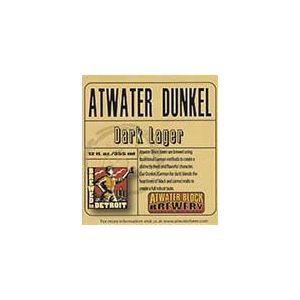
We've admired this beer for years, and in fact, have featured it before. We didn't really think they could improve upon the original, but then we tried the new recipe… and son-of-a-gun is it ever smooth! Dunkel is the German word for 'dark'; Munich Dunkel lagers don't have the opaqueness of a stout—their darker color and name arose as a contrast to lighter-colored styles such as Helles lager (helles means "light" in German). Neither variety is overly sweet; their focus is on the malt-flavors, with an underlying hop bitterness playing a supporting role. Expect healthy doses of roasted caramel and a trace of chocolate, mixed with a bread-like scent and a pronounced creaminess that comes from the use of Munich dark malts. Packed with subtle roasted malt flavors and moderate sweetness (from the five varieties of barley used), this is a good representation of the style; note the characteristic absence of excessive bitterness and heaviness present in many dark beers. This versatile beer pairs well with fried mushrooms, vegetarian chili, roast chicken, or spicy lobster or crab.
Serving Temperature: 48-52° F
Int'l Bittering Units: 24.0
Alcohol by Volume: 5.4%
Suggested Glassware: Pint Glass, Mug or Stein
Malts: Munich, Pils, Caramel, Chocolate, Black
Hops: Perle, Hersbrucker
The German word for Rost (pronounced "roast", meaning 'rust' or 'red') suggests a rich, amber brew with a balance between the roasted barley and select German hops. We found it to be notably creamy (similar to their Dunkel) with floral notes and an herbal, tea-like nuance in the background. Expect slightly sweet, toffee-toned malts. The sweet start is followed by a firm malt & grain backbone with some citrusy hop notes. The bitterness is fairly late-breaking as it sneaks in and holds the palate quite firmly. Look for citrus hop impressions to resurface as the hop bitterness fades. This is a great beer to enjoy with mild-to-moderately-spiced chicken wings, spritzed with just a bit of lemon.
Serving Temperature: 44-50° F
Int'l Bittering Units: 20.0
Alcohol by Volume: 5.0%
Suggested Glassware: Pint Glass, Mug or Stein
Malts: Munich, Pils, Caramel
Hops: Perle, Hersbrucker
Camerons Brewery—Hartlepool, England (Northeastern England)
In most nations of the world, it is lager beer that is king. The reverse is true in England, though it should be said that there too, lagers have experienced a steady rise in popularity, in part kicked off by the warm summers of the 1970s. Admirably, the palate of the British beer drinker remained largely unsatisfied by the bland tastes of many "watered down" lager beers, and the ales prevailed. Incidentally, the craft brewing revolution of the U.S. shares this ale-savoring spirit, as the majority of microbreweries specialize in the brewing of a variety of ales rather than lagers.
The British brewery we are featuring this month is located along the northeastern coast of the country, in a portside town called Hartlepool, which holds the unfortunate distinction as the first British town to be bombed by the Germans in 1914 during WWI. The Lion Brewery has been established in Hartlepool for over 150 years and has been the home to the famous Camerons' brews since 1865. Prior to 1865 it was owned by William Waldon, who purchased it in 1852 for its pure water, drawn from an artesian well. This same well supplies the modern brewery today, and has been integral to producing beer at the site since the first brewery, Nimmo's, was established there way back in 1826. All told, we're talking nearly 180 years of brewing at this site! The present Lion Brewery was constructed in 1892, and by 1894, Camerons became a limited company owning no less than 50 pubs. For the next 91 years, Camerons Lion Brewery roared amidst growing popularity. Sadly, in 1985, the economy of Hartlepool experienced a major decline, and the brewery changed hands between various corporate owners, ultimately ending up under the control of one of the UK's largest brewing conglomerates (the craft brewery-swallowing beast known as Witbread—less affectionately referred to as Twitbread by some—which itself was ultimately cannibalized by the larger than life mega-conglomerate Interbrew).
In April 2002 The Lion Brewery was purchased by Castle Eden Brewery and a new company was formed—Camerons Brewery Limited. Castle Eden mustered the motivation for the purchase upon discovering that Witbread had plans to close and demolish the historic brewery. This prompted a move of self-sacrifice on the part of Castle Eden, as they brokered a deal to sell off one of their breweries to a housing development corporation, using the money from the sale to help fund the purchase of Hartlepool's Camerons brewery, gallantly safeguarding the future of brewing at the site, and releasing the Lion Brewery from the death grip of corporate ownership. Proudly, the Lion roars again, as a small craft brewery that produces the smallest batches produced by Northeastern England's only independent regional brewing operation.
For more information about the Lion Brewery, check out the following web site: http://www.cameronsbrewery.com.
We're on a bit of a kick it seems; this is our second English "session ale" in as many months. Like the Ridgeway Bitter featured last month, this beer is well-balanced and particularly easy to drink. However, this beer is not a bitter, per se; it's more of an English Pale Ale—the distinction lying mostly in the aromatic hoppiness present in this brew. So why feature another English session ale? The first reason: timing. It's May—summer's here, and having an easy-going beer to share with friends at summertime gatherings is, well, just plain necessary in our humble opinions. The second reason: education and exposure. These days, many of the microbrewed beers available domestically are demonstrating a trend toward bigger, higher ABV, massively hopped beers. Some brewers and drinkers have felt that these beers focus on novelty and intoxicating power, drifting away from being "real ales" with flavor. They comment that it's easy to make a high ABV beer that's flavorful, but a lower alcohol beer that is sumptuous, flavorful and well-balanced is a true challenge. LongLeg English Fuggles Hop Ale is an example of an easy-drinking, well-balanced, lower ABV beer (truthfully, 4.8% ABV isn't all that low, but in the context of the big beer trend, and an ale that proudly announces its hop content (see label image and text), this beer might surprise you in its mild-mannered nature). Here's what to expect: caramel and fresh doughy malt sourness accentuated by the citrusy fuggles hops' notes, with a note of ripened apricot. The flavor is rather creamy, with caramel notes and bread flavors, finishing with dough, tangerine & a tinge of apple on the palate. Bitterness is light-to-moderate as it warms, and develops a bit late—beyond the swallow—on the sides of the tongue. Pair with mild cheddar and sourdough bread.
Label note: In 19th century England, "Long-leg" was a term used to describe a hop-picker who used stilts to reach the very top of the vines, where the most flavorful hops could be found.
Serving Temperature: 45-50° F
Alcohol by Volume: 4.8%
Suggested Glassware: English Pint Glass
Saint Sylvestre Brewery (Brasserie De Saint-Sylvestre)—Saint Sylvestre Cappel, France (Flanders Region—Northern France, along the Belgian border)
Our second featured international brewery comes from the difficult to define region of Flanders. You may have enjoyed beers from Flanders before and observed that these were from Belgium. The region of Flanders was defined before the modern day borders of France and Belgium were drawn, and in fact, the area spans the intersection of these two nations. The remarkable Flemish beer we've selected for you is from the French side of Flanders, brewed in a lovely, picturesque town called Saint Sylvestre Cappel. Today, their local brewery stands as one of merely 30 left in Flanders—a true survivor (at the beginning of the century, there were 2000 breweries in the whole of Flanders!)
We regard the beers of Brasserie De Saint Sylvestre as some of the best in all of France. We have the Ricour family of brewers to thank for these remarkable beers. Today, the brewing is done by the talented Serge Ricour, a 3rd generation brewer who, along with his brother Francois and under the tutelage of their father Pierre (who learned the trade from his father, Rémy), has seen the brewery's praise and distribution soar. With three generations of artisinal master brewers—how can you go wrong?
According to files held at the local town hall, brewing at the Saint Sylvestre Brewery predates the French Revolution of the late 18th century, although the exact date it was founded is unknown. However, the Ricour family did not get in to the brewing business until 1920, when Rémy Ricour purchased the brewery from his uncle Marcel Bacquaert, who passed along his brewing knowledge just as it was taught to him by the former family of owners, who had brewed there continuously since 1860. In 1939, at the age of 16, Rémy's son Pierre joined the brewery full time as the only Ricour family member until accompanied in 1983 by his fresh-out-of-brewing-school sons Francois and Serge. Over the past 23 years the brothers have greatly expanded the distribution of the brewery's wares and have created a number of truly amazing beers, such as Gavroche. Serge developed this recipe in 1997, and we've been tremendous fans of it since first discovering it about a year ago—now we'd like to share it with you. Enjoy!
For more information about the brewery, visit their website: http://www.brasserie-st-sylvestre.com.
Named after Victor Hugo's Les Miserables young pick-pocketing character, Gavroche likewise comes in an innocuous package but might leave you a little lighter on your feet (a barely detectible 8.5% ABV can sneak right up on ya and steal your very wits). Immediately note the aroma of this very attractive brew, with notes of tart berries—notably raspberries—with a juiciness similar to fresh apricots. Look also for a honeyed scent, with an accompanying sourness and subtle lactic note. These latter two components are the result of wild yeast commonly employed by brewers in the Flanders region. We found the flavor to be full and stunningly complex. The initial flavors present a cavalcade of melon (subdued cantaloupe) and berry (raspberry and blueberry). The sweetness presented by these is promptly tamed by a dry bitterness and distinctly farmhouse-style earthiness, but is resurrected as distinct notes of ripened apple skins. Notice the unique interplay between soured berry tartness and hoppy bitterness that marries perfectly for a composition that is exclusive to this beer. In the finish, lactic and tart berry notes evolve to a distinctly bitter earthy hoppiness that balances a flux of grains, berry juiciness, cloves, a touch of ginger, and lightly toasted malts. As it warms, the flavor profile evolves even further. What a treat! We recommend pairing this beer with a roasted chicken salad with mandarin oranges and feta cheese. Delicious!
Serving Temperature: 45-53° F
Alcohol by Volume: 8.5%
Suggested Glassware: Tulip or Oversized Wine Glass