Past Newsletters
Vol. 12 No. 9
Bringing You The Best Domestic Microbrews for 12Years Now!!
Brewery |
Beers Featured |
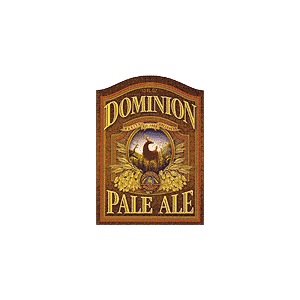
| Old Dominion Brewing Company | Dominion Pale Ale |
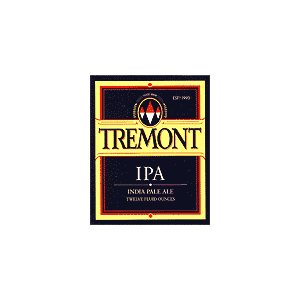
| Tremont Brewery | Tremont IPA |
| Old Dominion Brewing Company | Dominion Lagar |
| Tremont Brewery | Tremont Ale |
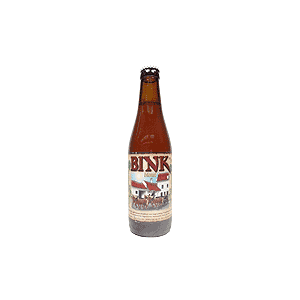
| Kerkom Brewery | Bink Blonde |
| Kerkom Brewery | Bink Bloesem |
Old Dominion Brewing Company
The name “Old Dominion” is a nickname for the state of Virginia, given by England’s King Charles II in 1663 when he added the colonial state to his dominions of Ireland, Scotland, and France. This regally-appointed sobriquet was adopted by the founders of our first featured brewery, The Old Dominion Brewing Company back in 1989, when they officially became the Washington area’s first microbrewery.
Despite their success, the brewery still maintains a vehement commitment to producing beer on the micro scale. They’ve managed to enjoy success but retain their “micro” spirit by brewing a large variety of beer styles, rather than mass-producing a few of their products. They actively brew an impressive roster of 31 ales and lagers, including many traditional seasonal specialties. All told, they’ve brought home over 12 medals from the Great American Beer Festival. Ranked one of the 20 best breweries in the U.S. in 1998 by Gourmet Food and Wine magazine, and Smart Money’s choice in 2000 as one of the five best breweries in the country!
The brewery is located just 3 miles north of Washington’s Dulles Airport, an easy drive from D.C. With their on-site brewpub, it’s a great place to visit if you are ever in the D.C. area. Hey, a visit to the brewery/brewpub is indeed worth a trip to our nation’s Capital! (Just avoid hunting with Dick Cheney while you’re there!)
For more information about the brewery and scheduled tours, call (703) 724-9100 or check out their web site at www.olddominion.com.
Notice the strong hop character in the aroma, flavor and finish as the complex blend of hops contribute to all three of these very important beery components. Expect an aroma that is dominated by orange and grapefruit peels, with a sweet caramel malt background. The flavor profile begins with a peppery hop bite that quickly slips toward a creamy smoothness and light caramel flavors that are sweet, but never cloying. Finishing smooth and abundantly bitter, the finish is dry and long-lasting. A great beer to pair with peppercorn steak or leg of lamb.
Serving Temperature: 48-55° F
Int’l Bittering Units: 46
Alcohol by Volume: 7.23%
Suggested Glassware: Pint Glass
Malts: Munton’s 2 Row Pale, Munich, Caramel
Hops: Horizon, Tettnang, Cascade, Columbus
Look for a classic grainy lager aroma with sweetly floral hops and a touch of German mustiness from the use of German yeast. Expect a smooth brew with medium body and a robust, mouthfilling presence. We found the somewhat lemony-hop profile evoked wheat-like flavors similar to a German wheat beer. The hops are restrained, as a notable grain and bread flavor from the malts take center stage. The finish is characterized by a very natural-tasting graininess with ever-so-light spices from the faintly lemony hops. Enjoy with steamed clams, light on the lemon.
Serving Temperature: 40-45° F
Int’l Bittering Units: 12
Alcohol by Volume: 5.7%
Suggested Glassware: Pilsner Glass or Flute
Malts: Weyerman Pilsner, Munich, Carapils
Hops: Perle, German Hersbrucker, Tettnang, Saaz, Hallertau
Tremont Brewery
The Tremont Brewery started right around the same time our beer club began over 12 years ago, and we’re not sure why it’s taken us so long to feature a few of their beers, but hey, better late than never, right? The brewery, which began construction in November 1993 in historic Charlestown, Massachusetts, was named for the original three hills of Boston. Originally, through the center of the peninsula that was Boston, rose what was called the Trimountain, a series of three hills known as Mount Vernon, Beacon Hill and Pemberton Hill (a corruption of the term Trimountain was “Tri-Mount”, and ultimately, “Tremont”). Much like their pronunciation, these three hills would ultimately be “rearranged” to created what is modern day Boston.
By 1867 Boston’s population had greatly expanded and the swelling census numbers meant that the initial settlement of 786 acres, just wasn’t going to cut it. The original landscape of the peninsula was far narrower than today. How to expand land and widen the peninsula? Level them big Tremont hills and start landfill projects, that’s how! If you’ve been to Boston’s ‘Back Bay’ or ‘South Boston’ neighborhoods, you’ve stood atop these landfills. 200 years ago, a visit to the place where these towns stand would have meant taking a dip in the Charles River and Boston Harbor.
The Tremont Brewery’s beers bring us back to a time when traditional English ales dominated the states. Even before the leveling of the Trimountain, the new colonies still produced traditional British ales. Today, many pale ales and IPAs have been redefined using American ingredients and audacity, resulting in stylistic changes. The Tremont Brewery formulated and maintains their recipes to evoke old English styles. What you get is a blend of authentic English-style ales that also manage to incorporate American ingredients. The results are more than pleasant for each of the five brews they currently make (in addition to those featured this month, they also produce a Winter Ale, a Summer Ale and a big-bodied Barley Wine).
For more information about the brewery and scheduled tours, call (800) 347-1150 ext.7164 or check out their web site at www.tremontale.com.
A great example of a buttery, British IPA, with distinct fruity notes from the various hops (look for notes of the following: Clementine oranges, grapefruit, a touch of grapes and apples). The fruitiness is quite bold, so if you’ve been looking for a good example to hone your nose for fruits from hops, this is the beer to sniff. The flavor profile is a traditional, “old school” IPA from the UK, and true-to-style, it maintains a very easy-drinking nature. Good with lightly spiced beef or chicken dishes.
Serving Temperature: 45-52° F
Int'l Bittering Units: 51
Alcohol by Volume: 5.8%
Suggested Glassware: Pint Glass or Mug (clear)
Malts: Pale Ale, Crystal, Torrefied Wheat
Hops: Cascade, Styrian Goldings, UK Fuggles
The red and white two-toned triangles on the label represent the tri-mountain terrain of old Boston. The obvious diacetyl note in the nose (a distinctly buttery flavor) signals this is a true-to-style English Pale Ale. Note the butterscotch sweetness and the citrusy hops. The butterscotch flavors are quick to start and are balanced by a moderately-lived, straightforward bitterness. Expect an increasingly floral hoppiness as it warms and a rounded, creamy bitterness with buttery tones and slightly aromatic hoppy floral tones (with very subtle hints of lavender) in the finish. Try this with a peppery Monterey or sharp cheddar cheese (visit www.cheesemonthclub.com for details on gourmet cheeses we offer our members).
Serving Temperature: 45-55° F
Int'l Bittering Units: 36
Alcohol by Volume: 4.8%
Suggested Glassware: Pint Glass
Malts: Pale Ale, Crystal, Chocolate, Torrefied Wheat
Hops: Cascade, Tettnang, UK Fuggles, East Kent Goldings
Brouwerij Kerkom (Kerkom Brewery)—Sint-Truiden, East Flanders, Belgium (Northeastern Belgium)
This month’s featured beers come from the countryside of East Flanders, Belgium, from a small family farm amidst Belgium’s best pear and cherry orchards. But within this pastoral setting there stirs the unrest of a man who has committed himself to a brave and noble mission to enact change in his country. Saddened by the decreasing interest in traditional, hoppy Belgium beers, Marc Limet decided to do something about it. Like a number of other small farmhouse brewers in Belgium, Marc felt compelled to move from amateur brewing to a more commercial operation to counter the disturbing trend of dumbing down in Belgian brewing. Unlike larger Belgian breweries, Marc can commit the time required to create true-brew works of art without the use of corn sugar, artificial fruit flavors, or other cheap ingredients. In so doing, he keeps alive the great brewing spirit and traditions of this beer-loving nation.
Marc Limet’s brewery, known as Brouwerij Kerkom, is essentially an extension of the home he has made with his wife Marina. Their on-site pub feels like a welcoming nook of their home; a place where folks from all over Belgium will gather throughout the year to enjoy these acclaimed farmhouse beers. The Kerkom tradition is not new, however. Brewing has been going on under this name since 1878, when the original Kerkom Brewery was founded after Evarist Clerinx left his studies of medicine to become a brewer. He purchased an old café known as “La Rennaissance” and rebuilt it as a brewery. In 1932, 12 years after the brewery reopened (German occupiers claimed the brewery during the First World War), Evarist’s son Paul took up the craft.
Having survived the Second World War, brewing continued as a family affair when Jean Clerinx joined the brewery, but times were tough. During WWI there were 127 breweries in the region. By 1965, there were only 13 left. Tastes had changed, and local breweries had closed in droves. Today, only 6 of the original 127 pre-WWI-era breweries are still active—the Kerkom Brewery is one of them.
In 1968, Jean Clerinx too decided to cease brewing operations at Kerkom. After his retirement in 1988, he started up a small brewery that created beers using old-world, traditional methods. In 1999, Marc Limet, masterbrewer and hop-hero took up as Kerkom’s owner and brewer. He has since put 100% of his efforts into bringing the character and flare back to Belgium’s locally-brewed beers by creating new beers with old-world composition.
For more information about the brewery, check out their website at www.brouwerijkerkom.be. You’ll also find information there about bicycling routes through this beautiful region—where you can ride roads that cut between orchards and fruit plantations in the famed region of Haspengouw. Just follow the “appelroute” to get to the brewery. What a great way to recharge after a bike ride through the Flemish countryside!
The product of a man driven to bring the hops back to Belgian beers, Bink Blond is a dry-hopped salute to the old beers of the region. As Marc puts it “this is just the way most Belgian beers used to be.” The first of the Bink beers (more on the name “Bink” below), this unfiltered brew is created using only water, malted barley, hops and Belgian yeast. A secondary fermentation in the bottle enhances the complexity of this beer (you may notice thick pieces of sediment in your glass if you rouse the layer of yeast at the bottom of the glass when pouring. If you prefer not to have this, pour your beer very gently, and leave about the last ½ inch in the bottle). On the nose, look for a subtle creaminess that mingles with noticeable malt grains (akin to freshly-baked bread) and a characteristic earthy mustiness derived from the Belgian yeast. Also expect un-spiced, floral hop tones in the aroma, resulting from Marc’s heavy-handed use of hops both in the boil and the fermenting tank. Flavor-wise, look for notes of pear that dive in and out among the caramel malts, with a fruitiness like tropical punch that develops quite early. A perfumy quality ensues as floral- and citrus-toned hops mix. Despite the prevalence of the hops, their spiciness is minimal. The flavors are balanced and delicately rounded out by a firm hop-bitterness, and a final yeasty mustiness comes in at the finish. Enjoy with moderately-spiced Thai noodles or grilled whitefish, or tangy Edam cheese.
Serving Temperature: 45-50° F
Alcohol by Volume: 5.5 %
Suggested Glassware: Tulip or Snifter
A seasonal beer brewed only during the spring and summer months, this is not an easy beer to come by. Brewed with five types of malt, Belgian hops & yeast, honey from Sint-Truiden and syrup from pears grown locally in Vrolingen, this is a truly authentic Belgian offering that is a celebration of the harvest. This beautiful dark brown Belgian ale presents a big Belgian yeastiness and expectedly heavy notes of fruit with an impression of maple syrup. The nose features notes of pears, honey and even peaches. Now have a sip; it’s quite full-bodied, with a complex development of flavors that take quite a while to fully emerge. Expect notes of honey and caramel, with a note of molasses at the start. Caramel flavors widen through the middle, as notes of bread and sweet malt join in, along with some clove. The pear flavors are evident, but not overly bold, and the overall fruitiness is offset by slight hop bitterness and spry carbonation. Look also for a late-developing note of white grapes. This beer finishes very smooth, as its lush texture rolls across the tongue. A slight bitterness tames the sweetness and prevents it from being cloying, but sweet is the definitive final impression, with a Belgian yeastiness (with some notes of cloves) shining through at the end of the finish. Enjoy alongside a cheese plate featuring St. Nectaire, Comte, Emmental and Asiago.
Serving Temperature: 45-55° F
Alcohol by Volume: 7.1%
Suggested Glassware: Pint Glass, Tulip or Oversized Wine Glass