Past Newsletters
September 2006
Brewery
|
Beers Featured
|
| Otter Creek Brewing Company | Oktoberfest |
| Pennsylvania Brewing Company | Penn Pilsner |
| Otter Creek Brewing Company | Stovepipe Porter |
| Pennsylvania Brewing Company | Penn Dark Lager |
| Herold Brewery (Czech Republic) | Bohemian Black Lager |
| Herold Brewery (Czech Republic) | Bohemian Granát Lager |
Otter Creek Brewing Company
The Otter Creek Brewing Company is located in the beautiful little college town of Middlebury, Vermont. They shipped their first keg of beer back in 1991, which has us wondering, are the kegs at local college parties filled with Otter Creek brews, and if so, is it too late to go back to college? Clearly, local demand grew quickly; in just four years they outgrew their original site and moved into a 15,000 square foot, state-of-the-art brewery.
Their original brewery was conceived of in 1989 by Lawrence Miller, an avid homebrewer. Middlebury was chosen as the brewery site as much for its quality of life as for its excellent water obtained from the pristine Otter Creek River (hence their name). Larry knew from extensive travels and studies throughout Europe that good quality water would be critical as he developed his brand of beers, each brewed with a focus on old-world brewing methods.
In a move that made them the largest producer of certified organic beers in the nation, Otter Creek began a partnership with the Panorama Brewing Company in 1998 by producing Wolaver's Certified Organic Ales. The Panorama Brewing Company was founded by Morgan and Robert Wolaver in 1997 and was inspired by the Wolaver family's farming history. Their rich farming heritage spans three generations-right back to the early 1900s when Robert and Morgan's grandfather, Oliver "Wolly" Wolaver, began farming the family's land in Tennessee. For nearly 100 years the Wolaver family has cultivated a harmony with nature and embraced qualities such as hard work, pride and respect for the earth, which explains their drive to engage in sustainable farming and brewing.
In May of 2002, the Wolaver family purchased the Otter Creek Brewing Company, but Otter Creek remains a family owned Vermont company and produces all Otter Creek and Wolaver's brands for distribution throughout the country.
For more information about the brewery and scheduled tours, call (800) 473-0727 or check out their web site at www.ottercreekbrewing.com.
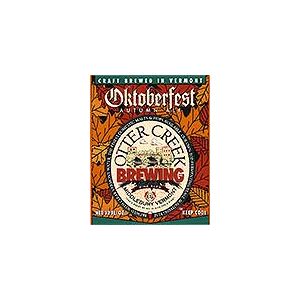
One of Otter Creek's more than 16 outstanding brews, the brewery's Oktoberfest is only available from August through November. We're sending it to you just in time to enjoy during your Oktoberfest activities. What-don't have any planned yet? Check the internet-it is very likely there's an Oktoberfest going on near you! The Otter Creek Oktoberfest is a tasty interpretation of a German Marzen style beer. This amber/copper colored lager presents a thick, creamy, off-white head; very inviting right at first glance. Immediately note a nose dominated by a sweet caramel maltiness. We also picked up a slight toastiness and a hint of nuttiness. Look for a distinct and complex sweet malt flavor with a dry, mild hop finish. Celebrate this Oktoberfest mit Sauerbraten oder Kartoffelbrei mit Jägerschnitzel! Prost!
Serving Temperature: 40-45° F
Int'l Bittering Units: 19.0
Alcohol by Volume: 4.75%
Suggested Glassware: Pint Glass (high volume preferred), Glass Mug, or Stein
Malts: 2-Row, Munich, Carapils, Caramel
Hops: Chinook, Hallertauer, Tettnang
Otter Creek's Stovepipe Porter is a traditional porter that is available year 'round. It is a deftly balanced beer that represents the style very well, presenting a bold spicy smokiness that is followed by a light roasted coffee finish, with a slightly herbal hop aroma. It is quite nearly black in color, with garnet highlights. While it's good from start to finish, our panel most admired this beer's remarkable balance between roasty, smoky elements and the crisp, surprisingly clean finish. This brew is excellent with a hearty stew or as a complement to mild or dark chocolate, or just an afternoon libation.
Serving Temperature: 52-58° F
Int'l Bittering Units: 43.0
Alcohol by Volume: 4.8%
Suggested Glassware: Pint Glass or Stein
Malts: 2-Row, Munich, Caramel, Chocolate, Roasted
Hops: Chinook, Cascade, Willamette
Pennsylvania Brewing Company
Many Americans haven't really had the experience of tasting what beer was really intended to be (let's just say that Budweiser, Coors & Michelob are definitely NOT what the beer gods had in mind when they handed down the secrets of beer brewing!) Luckily, our Beer of the Month Clubs are here to serve and educate. If you know someone who might enjoy getting their hands on some true, real, definitely non-imitation, genuine, authentic, legitimate, actual, honest-to-goodness beer, consider giving them a gift that expands their cultural horizons-a subscription to one of our Beer of the Month Clubs! Visit our website at www.monthlyclubs.com to get a gift subscription started today and play your part in spreading one of the most enjoyable cultural mores to your fellow man (and woman).
Note: if you don't agree that drinking beer and learning about the multitudes of styles and varieties of malty brew out there is an example of a cultural experience, then be warned that you should put this newsletter down before it grows hands and slaps you in your blasphemous mouth!
Tom Pastorius, a Pittsburgh native of German descent, discovered beer while stationed in Germany, a country that considers its "bier" as much a staple as bread. Once his service days ended, Tom returned to the states and earned his masters of business administration degree at Penn State University. He later returned to Germany for some time, residing there during the 1970's and living as the locals do by incorporating beer as a regular part of his diet. But upon moving back to the states in 1981, he began longing for good German beer. "Beer tastes better over there," he said. "I just missed the beer."
Dissatisfied with commercially available beverage choices, and in need of a job, Pastorius decided to start his own brewery. In 1986, he started a real estate venture to purchase a nearly 150-year-old abandoned brick and stone brewery for $225,000. A three-year, labor-intensive $4 million restoration followed, and thus, the first microbrewery in Pennsylvania was born. Talk about going to great lengths to get great beer! Tom's goal to brew authentic German beers quickly became a reality, and these days he is considered a pioneer in the microbrewery renaissance. This year marks their 20th anniversary!
For more information about the brewery and scheduled tours, or their attached restaurant, call (412) 237-9400, or visit their website at www.pennbrew.com.
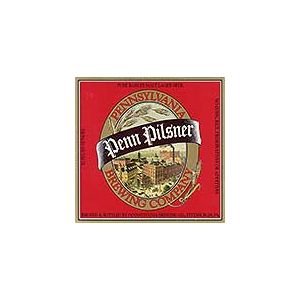
Winner of the Beverage Testing Institute's 2001 Gold Medal, Penn Pilsner was introduced in 1986 as Pennsylvania's first entrant in the Microbrewery revolution and since then has become a favorite of thousands of their local supporters. First impressions are everything and this one is awesome! Notice the clean golden straw hue coupled with a jagged cottony head that adheres to the glass. The flagship brand of Pennsylvania Brewery is made with 2-row and caramel barley malts, imported Hallertau hops and absolutely zero preservatives. Look for a subtle trace of sweet honey in the nose with an assertive hop finish. This Vienna-style lager combines full body with a noble hop aroma. Overall, an extremely smooth and enjoyable brew that would be a solid accompaniment to any early fall barbecue with friends. Heck you can even enjoy this one with strangers!
Serving Temperature: 44-46° F
Int'l Bittering Units: 28.0
Alcohol by Volume: 5.0%
Suggested Glassware: Pilsner Glass or Flute Glass
Malts: 2-Row Pilsner, Caramel
Hops: Hallertau Perle and Hallertau Tradition (both imported from Germany)
A gold medal winner at the 1999 Great American Beer Festival, the 2000 World Beer Cup, and the 2001 World Beer Championships, this fine microbrew is a beer lover's gem. Note an amber to dark brown hue and good head retention in this complex lager. 100% imported Hallertau hops contribute lightly to the aroma and stick around right to the finish in this beer, but the most prominent feature on the nose is this beer's sweet malty aroma. This full flavored lager blends a rich malty coffee, toasted espresso, and nut-like flavor into a breaddy finish that could easily double as both drink and meal. Look for a dry finish with overtones of hop bitterness and a bold flavor stemming from the Munich and black malts used to brew it. Overall, a delicately crafted lager that will compel you to quickly pop open another one! Excellent with roast beef on Pumpernickel, topped with provolone and a bit of Russian dressing.
Serving Temperature: 46-54° F
Int'l Bittering Units: 24.0
Alcohol by Volume: 5.3%
Suggested Glassware: Pint Glass or Pilsner Glass
Malts: 2-Row Pilsner, Munich, Black
Hops: Hallertau Perle and Hallertau Tradition (both imported from Germany)
Herold Brewery (Pivovar Herold)-Breznice, Czech Republic (South Central Czech Republic)
The history of beer brewing in the Czech Republic is much older the country's current borders. Chronicled evidence reveals that hops from the region were exported as far back as 903 A.D., and that hop growing regions had been established by as early as 859 A.D.. Bohemian hops were so prized that at one point, the penalty for cutting and exporting the hops for cultivation elsewhere was punishable by death. The first Czech brewery was built in 1118, in bold disobedience of an order by the Bishop of Prague banning brewing (the violation of which carried excommunicative consequences). The order was annulled by Pope Innocent IV when King Wenceslas negotiated the repeal on behalf of his people. Bringing beer to the people! Certainly, he earned his title "Good King Wenceslas". How ironic that he was slain by his drunken brother.
Until the 16th century, brewing was not practiced in large breweries, but rather in the kitchens and pantries of town houses. Ultimately, the noble classes began to run various sorts of business at their estates, and this shifted brewing out of local homes and into palaces and castles, which typically possessed their own on-site breweries. The beer brewed in these breweries was sold in local public houses for the serfs to enjoy-and enjoy they did; brewing became huge business, adding to the fortunes of noble families through the centuries.
One of these once regal brewing facilities is located in a castle in the town of Breznice, located about 40 miles due south of the Czech capital, Prague. The ancient tradition of brewing in this town goes back to at least the 15th century and is chronicled in a 1454 document that names Mikes Vanek, a maltster (one who produces malted barley and/or wheat), as the Breznice village mayor. The castle at Breznice dates back to at least 1415 and the first documented reference to a brewery traces to the year 1506 (hence the date on the Herold beer labels). That makes this year their 500th anniversary, which is an astonishing milestone if you think about it! They are one of the oldest functioning breweries in the Czech Republic.
The small brewery of the castle, now called Pivovar Herold, lies in what was originally a Gothic structure that was ultimately expanded and redesigned in renaissance and baroque styles. The estate has been owned by numerous noble families, and under them, the brewery was in nearly constant use and revitalization, even with its tumultuous turnovers. Despite the various takeovers and new owners, beer brewing remained a critical tradition (even when taken over by a devout Catholic who added to the castle a new chapel and had a Jesuit seminary constructed nearby).
Sadly, subsequent political climates negatively affected the brewing industry. Under Communist rule, the brewery was seized yet again-taken over by the state, with very little capital invested into it or any of the nation's breweries during the period. As with so many other trades, the communists simply produced the product and squeezed as much money as possible out of the industry by minimizing self-investment. However on the upside, beer was very cheap-and legal. This helped establish beer drinking as perhaps the single most popular hobby among Czech men. One of the Czech Republic's most famous beer drinkers, the protagonist of Jaroslav Hasek's novel "The Good Soldier Svejk" proclaimed that the government that raises the price of beer is destined to fall within one year. In 1984 the Communists almost doubled the price of beer, and though off by four years, his prognostication was fulfilled.
Interestingly, there was a paradoxically positive consequence of Communist ownership: the lack of investment in the facility. Without major modernization over the years, the Herold Brewery still makes beer the old-fashioned way, using only traditional methods, equipment and ingredients. While subsequent owners have modernized certain components of the brewery, Pivovar Herold still makes most of its own malt, in the Pilsner style, from local barley-highly uncommon for most commercial breweries operating today.
When Communism collapsed, the state's properties were slowly permitted to return to private ownership, and the Herold Brewery again became a privately held entity. In 2004, the brewery's management was taken over by a new director, David Porteous, who set a new direction for Herold's development, driven by a desire to distance their business practices from those of the globalized market and return to the craft-brewing tradition of Breznice's roots. As he states "to be sure, the rationale behind the activities of the small breweries is to retain true love for their work." We'll raise a pint to that!
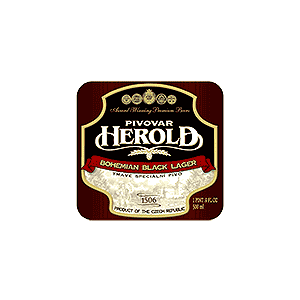
Our first featured international beer is an example of a Black Lager. German varieties of this style are often referred to as Schwarzbier (Schwarze means black in German). However, the brewers have intentionally distinguished the brew from German examples by including the term 'Bohemian' in the title. Expect a deep, nearly black color adorned with a wonderfully creamy, chocolaty-brown head. The aroma is particularly pleasant on the nose, full of sweet malts, roasted chocolate and coffee scents. The flavor of this medium-bodied beer also presents ample notes of chocolate and coffee, with a nearly syrupy malt taste as well. You'll notice a potently hopped, dry finish presenting additional hints of toasted, sweet chocolate, with some smokiness in the background. Many beer fans out there who are used to drinking Czech lagers will be surprised by the malty, roasted character of this impressive and complex Czech lager beer-quite a contrast from the world famous Pilsner style that originated in 1842 a mere 30 miles away in the town of Pilsen. Enjoyable on its own or with a variety of barbequed meats, bean soups, or venison. Or, instead of a food partnering, pair with a robust, aged maduro cigar-such as the Trilogy Tri-Press Maduro featured in this month's Cigar of the Month Club. Not a member? You don't know what you're missing! Craft-brewed beer and cigars are excellent together-check out our website at www.monthlyclubs.com for more details and remember-the holidays are approaching, and our clubs make amazing gifts! You're enjoying the benefits of membership right now-why not share the wealth?
Serving Temperature: 45-50° F
Alcohol by Volume: 5.2%
Suggested Glassware: Pint Glass or Pilsner Glass
So where does the name Herold come from? It was selected from the symbol of the herald, or spokesman of the king, seen on the coat of arms present at the brewery at the Breznice castle. It's appropriate because the brewery has historically been an integral part of the castle, and it's clever since the name has virtually the same meaning in most northern European languages. Given the royal heritage of the brewery, and the caliber of this beer, we agree that it suitably represents its noble past! Herold Brewery's Bohemian Granát Lager is likewise a recipe from the past-it was debuted in the 19th century, but was discontinued in favor of other, lighter beers. We're thrilled to say our Beer of the Month Club members are the first in the US to taste this beer-our distribution to you represents the US market's debut of this authentic Bohemian brew. Expect a deep garnet color topped by a creamy tan head. Swirling the beer in the glass rouses malty, chocolate-laden notes that are offset by the spry aromatics of a traditionally hoppy, almost grassy, Czech Saaz hop character. The flavor is rich and robust, with caramel and sweet malt flavors, accentuated by a faint note of brown sugar and pear-like fruitiness, all nicely balanced by substantial hoppy bitterness. Enjoy alongside steak served with caramelized onions.
Serving Temperature: 42-48° F
Alcohol by Volume: 6.0%
Suggested Glassware: Pint Glass or Pilsner Glass