Past Newsletters
May 2008
Brewery |
Beers Featured |
| Smuttynose Brewing Company | Robust Porter |
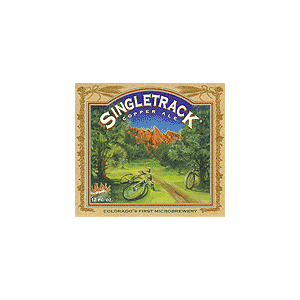
| Boulder Beer Company | Singletrack Copper Ale |
| Smuttynose Brewing Company | Portsmouth Lager |
| Boulder Beer Company | Buffalo Gold Ale |
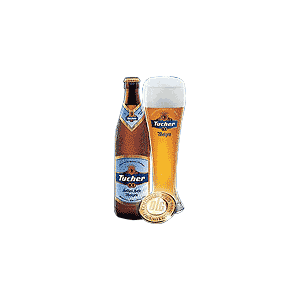
| Brauerei Tucher Bräu (Germany) | Tucher Helles Hefe Weizen |
Staatliches Hofbräuhaus (Hofbräu München) (Germany) |
Hofbräu Original |
Smuttynose Brewing Company
Smuttynose Brewing Company opened their doors 1994 in Portsmouth, New Hampshire. No, the unusual name doesn't refer to something 'dirty', despite what some may think. The brewery takes its name from Smuttynose Island, one of the isles of Shoals, a small nine-island archipelago just off the coast of New Hampshire and Southern Maine. Legend has it that mariners in the 1600s named the island for the nose-shaped 'smutch' of seaweed on the southeast corner of the island.
The brewery was founded by Peter Egelston, who, years earlier opened one of the two original New England brewpubs (The Northampton Brewery in western Massachusetts), as well as the Granite State's first brewpub (The Portsmouth Brewery). His 'beer career' started in 1986 when his sister Janet and her boyfriend convinced Peter to quit his teaching job in Brooklyn, New York and move to Massachusetts to open a brewpub. Peter stayed in Massachusetts until 1991, at which point he opened the Portsmouth Brewery. You might think that with two successful brewpubs under his belt, Peter would have begun looking to expand by setting up a production microbrewery, but in fact, he sort of stumbled into starting Smuttynose B.C. As Peter puts it himself, "There was a small brewery that had opened here in Portsmouth and went out of business, and the bank auctioned off their assets. I attended the auction without having any intention of purchasing anything. Of course, I ended up purchasing this building full of brewing equipment."
We're glad Peter was in a buying mood that day because the Smuttynose beers are truly world class. Trust us, you'll quickly get through the ones we've sent you, and you'll want more. If you don't have the good fortune to live within their distribution area, don't sweat it, we got you covered: you can reorder brews featured in the club by contacting us at 800-625-8238 (while supplies last).
For more information about the brewery or scheduled tours, call (603) 436-4026, or visit their website at www.smuttynose.com .
This hearty, mahogany-colored ale is brewed to evoke the dark, full-bodied ales that were a favorite of dockworkers and warehousemen (aka porters) in 19th century London—though we suspect this version's got a slightly more aggressive character and deeper complexity than those lost to time. Expect a dark brown brew with nearly purple highlights in light, capped with a dark tan head. On the nose, look for whiffs of star anise, black licorice, woody aromatics like cedar & pine (from the cascade hops), and major notes of chocolate and coffee. The flavor begins with a subtle chocolate expression, quickly flooded by a woody, very dry, almost chalky bitterness, which persists for quite a while. Interestingly, much of the flavor profile of this beer actually develops in the finish: expect notes of chocolate to emerge from the bitterness, giving way to cappuccino, chicory, black licorice, dried plums and singed molasses. Robust indeed. Try with chocolate pudding & pound cake, or cubes of mild cheddar.
Serving Temperature: 45-49° F
Int'l Bittering Units: 43.0
Alcohol by Volume: 5.7%
Suggested Glassware: Pint Glass or Thistle
Malts: Carastan, Crystal, Special B, Chocolate, Carafa
Hops: Cascade
Named after the brewery's hometown on the occasion of its 375th anniversary, Portsmouth Lager is a full-flavored, medium-bodied continental-style beer, deep golden in color. Note an aroma of fresh barley grains, dough, and grassy, sweet-lemon hop notes, rounded out by plain saltwater taffy and a modicum of vanilla and very subtle peat-like note. Goes down very easy, this lager presents a subtle fruitiness with touches of floral bitterness and hoppy grassiness. Look for moderate hop bitterness in the finish—lemony & grassy notes—with staying power. Lets you know you're actually drinking a beer. Nicely done. Want to know our opinion? Of course you do… Everyone in America who only likes "lesser" fizzy, yellow beers should try this beer to see what real beer is really about. This pre-prohibition style Munich Helles lager has true character & presence. Pair with herb and mustard basted pork chops.
Serving Temperature: 38-44° F
Int'l Bittering Units: 20.0
Alcohol by Volume: 4.5%
Suggested Glassware: Pint Glass or Mug (clear)
Malts: 2-Row Pale, Aromatic, Munich, Acidulated
Hops: Saaz
Boulder Beer Company
Colorado: A great place for microbrewed beer—no doubt. Wonder where it all started? The Boulder Beer Company, established in 1979, was (and is) Colorado's first microbrewery. As one of the oldest in the country, they paved the way for others to follow. Founded by two college professors, David Hummer and Stick Ware, their primary goal was to produce beers in the traditional style of the robust ales of Europe. And they weren't afraid to move a few goats around in order to achieve that dream, neither! (The original brewery site was a small farm northeast of Boulder, and the brewhouse did in fact share space with a few goats—the "goat shed" they called it. Lucky college-town goats! We can hear them now… "bleat… the bleatin' freeeee beeeeeehhhrrr's o-oveeer heeeeere, buuuuudddy…")
Five years later, as a result of increased popularity (with people, not goats), they moved their one-barrel brewing system to their current facility in Boulder. In 1990 the publicly traded Boulder Brewing Company was purchased by Gina Day and Diane Greenlee, who renamed it the Boulder Beer Company. These two local ladies, along with Brewmaster David Zuckerman, decided to upgrade the entire brewery. Among other things, this included expanding their small tasting room into a full service restaurant and pub. In 1993, the brewery acknowledged the regional influence of its brands by officially changing the company name to Rockies Brewing Company.
In 2005 they decided to return to their roots by officially changing their name back to Boulder Beer Company and launching their annual birthday party slash fundraising event: "The Goatshed Revival!". If you're anywhere near Boulder on August 23rd this year, get there for a great time and a great cause (among other charities, proceeds go to Habitat for Humanity).
For more information about the brewery and scheduled tours, call (303) 444-8448 or check out their web site at www.boulderbeer.com .
True to its name, this beer presents a nice caramel-copper color with an off-white head beginning thick & settling to an everlasting covering. Note the mainly caramel malt aroma with a bit of floral hops in the background, as well as a hop-spicy edge. On the nose, look for honey-ish notes, toffee and light hints of toasted malts. Expect toasty flavors with firm bitterness—note the character of the bitterness: short-lived and front-heavy rather than living in the shadows and emerging in the finish. We enjoyed the bready, toasty finish, and the mild citrus notes that linger in the finish. Pair this one up with friends, family and good times.
Serving Temperature: 40-45° F
Int'l Bittering Units: 30.0
Alcohol by Volume: 5.0%
Suggested Glassware: Pint Glass
Malts: British Caramel, U.S. 2-Row Malted Barley, U.S. Flaked Rye, U.S. Carapils
Hops: Nugget, Tettnang
Buffalo Gold Ale is brewed using 3 different hop varieties including nugget, Willamette, and cascade to give this beer it's multi-tiered—yet subtle—hop character. Another winner recommended by the Beverage Testing Institute, this beer is deep golden in color, medium-bodied, and lively thanks to full carbonation. Note a distinctively hoppy nose with lemony & subtle tea-like notes as well as a slight mustiness from the yeast. The flavor presents moderately bitter-citrus hop tones mingled with toasted pale malts. As it warms, look for subtle notes of cherry skins to develop—giving a very subtle baked cherry bread character. Pair with a fully loaded Cobb salad or a Chicken Parmesan sandwich.
Serving Temperature: 36-41° F
Int'l Bittering Units: 22.0
Alcohol by Volume: 5.0%
Suggested Glassware: Pint Glass
Malts: U.S. Caramel Malt, U.S. 2-Row Malted Barley
Hops: Nugget, Willamette, Cascade
Brauerei Tucher Bräu—Nuremberg, Germany (Southeastern Germany)
Germany's Franconia region has a well known winemaking history, but the region around Nuremberg, home to our first featured international brewery, has dry soil not suitable to the growing of grapes. Consequently, the German vintner's industry never really gained solid footing there. Wheat-growing fields, on the other hand, have traditionally been abundant, as has a local thirst for sustaining, liquid refreshment. Thus was born a great tradition of regional wheat beer brewing. In fact, the region is home to one of Germany's oldest and most prolific brewing heritages.
Brauerei Tucher Bräu (Tucher is pronounced "took'er") was founded in Nuremberg over 335 years ago. It began as an integral member of the wheat-beer brewing force in 1672 and for part of its history was owned by Bavaria's royal family. An ancient patrician family who settled in Nuremberg in the 11th century, the Tucher family (or "Freiherrlich von Tucher'schen Familie" for you German purists out there) took over in 1855. Though the brewery has had several owners in the 153 years since (never shedding the Tuchers' good name), it became a family business again in 1994 when a member of the Bavarian brewing dynasty Inselkammer took over (this is the family responsible for the celebrated Ayinger beer brand).
You're probably already familiar with the fundamental Bavarian beer purity law known as the Reinheitsgebot of 1516, which mandates that all beer be made with only water, malt, hops and yeast. It's an edict that has guided not only German brewers, but many of the craft brewers in the American microbrew revolution. Fascinatingly, Nuremberg had its own pure-beer law established in 1303, more than 200 years before Bavaria's more well-known Reinheitsgebot! With brewing history like that, it's quite the understatement to comment that Nuremberg's brewers are well-versed in the virtues of beery bliss. Speaking of beery bliss—what are you waiting for? Summer weather is calling—so crack open that Tucher Helles Hefe Weizen and enjoy. Prost!
This beer is an old Bavarian beer specialty. Helles Hefe Weizen, literally translated, means "light wheat with yeast." You may be familiar with the term "dunkel," (pronounced dune-kuhl) which means "dark"—the counterpoint to light, helles beers. This beer is the perfect warm-weather beer due to its crisp, clean and refreshing, thirst quenching nature. To fully enjoy the flavors of this beer, we encourage you to pour about 2/3rds of the bottle into the appropriate weizen glass, then vigorously swirl the remainder in the bottle to rouse and collect the sedimentary layer at the bottom of the bottle, then finish your pour. Seriously, Tucher Bräu holds a patent on the process of keeping cloudy, yeasty beers stable—all so you can enjoy this bottled beer as if it was drawn from a just-tapped keg—so don't undermine their efforts or deprive yourself of your daily dose of B-vitamins, you'll be getting a good dose of them from that yeast. Look for notes of melon, wheat (surprise!) and banana on the nose, with just a touch of clove spiciness and a hint of peach skins. Expect a firm wheat twang upfront with muted apple & nearly-ripe banana notes, and a late-breaking, very subtle bitter melon-character (like biting too deeply into a watermelon wedge and getting a nibble of the inside rind), moving to a remarkably thirst-quenching, slightly spicy, mildly bitter, dry finish. For the perfect weekend breakfast treat, pair with weissewurst. Good morning, world! You could do this on the weekdays, too, assuming you take public transportation to work and don't have any morning face-to-face meetings… Also works well with wiener schnitzel or mild Indian dishes.
Serving Temperature: 42-47° F
Alcohol by Volume: 5.2%
Suggested Glassware: Weizen glass
Staatliches Hofbräuhaus (Hofbräu München)—Munich, Bavaria, Germany (Southeastern Germany)
Oktoberfest was born in Munich, right at the footsteps of this month's second featured brewery, Staatliches Hofbräuhaus, better known as Hofbräu München. Arguably the world's most famous 'public house', this beloved establishment has a truly rich brewing history, which we'll delve into here. Pour yourself a pint of Hofbräu Original and read on.
Once upon a time, the beers of Munich were deemed "less than satisfactory" for then Duke of Bavaria, Willhelm V. As a result, his demanding household ordered that beer be imported from the town of Einbeck in Lower Saxony. In order to reconcile cost and pleasure, Willhelm's chamberlain and counselors suggested that a ducal brewery be built. The Duke was delighted (wouldn't you be?), and on the very same day, recruited a monastic brewmaster to plan and supervise construction of the brewery that would be known as Hofbräuhaus. Talk about doing things right! It pays to be a Duke…
Willhelm's son and heir, Maximilian I had different tastes in beer. Preferring Weissbier (white beer) to the then popular Braunbier, and possessing a savvy business sense, he restricted all other private breweries from brewing Weissbier, creating a regal monopoly that would not only financially support his court, but would ensure no less than 400 years of experience in Weissbier brewing for Hofbräu München.
But alas, ducal tastes can be fickle, and by 1613 the court was complaining that Braunbier and Weissbier were not strong enough; they longed for the good old fortified beer from Einbeck. A rather concerned brewmaster got to experimenting and produced the first Munich beer made with Einbeck methods. This "Maibock", as it was called, would not only satisfy the court, it proved to be the salvation of the city when in 1632, during the Thirty Years' War, the occupying Swedish army only abstained from plundering and burning the city when appeased with 344 pails of Maibock beer brewed in the Hofbräuhaus brewery. A similar crisis was averted back in 1994 when our beer panel stormed their local brewpub demanding a respite from weak, yellow, fizzy lager.
In 1810, when Ludwig, son of King Maximilian I Joseph of Bavaria married Theresa of Saxony-Hildburghausen, a massive soiree was held. The date was October 17th, and the highlight was a climactic horse race held in a meadow outside the town. A raging success, the king agreed to a request to name the site "Theresienwiese" (Theresa's Meadow) in honor of the bride, and to repeat the festival every year. Thus, the Oktoberfest was born. But what about Oktoberfest beer? Well, two years after the original festival, the royal brewers decided to offer His Majesty a truly special brew, bolder in flavor and higher in alcoholic content than beers served at the previous two festivals. The beer was none other than the world-famous Oktoberfestbier from Hofbräu München.
For more information about the brewery, check out their website—which has tons of pictures and heaps of info about this historically significant brewery: www.hofbraeuhaus.de/. And do plan a visit if you can, you won't be disappointed!
The water used for brewing Hofbräu München beers is drawn from their ancient well which runs nearly 500 feet below beery-hallowed Bavarian ground. This water was deposited in the foothills of the Alps before the Stone Age! On the nose, expect that characteristic German mustiness that we know and love, notes of fresh-cut grass, hay, a touch of lemon zest, a kiss of caramel, and freshly cracked/milled grains. Look for a lightly fruity presence to mingle with distinct notes of biscuits & dough, followed by a pleasant grassy, lemony noble hop finish. Only gently bitter—but enough to balance the malt sweetness. Seriously, a beer everyone should try, from novices to know-it-alls. Serve it up with grilled bratwurst stewed in sauerkraut.
Serving Temperature: 40-45° F
Alcohol by Volume: 5.1%
Suggested Glassware: Flute, Pilsener Glass, or dump a few into a wicked-big stein