The Microbrewed Beer of the Month Club

Past Newsletters

January 2008

Brewery
Beers Featured
Otter Creek Brewing Company Pale Ale
Left Hand Brewing Company Deep Cover
Otter Creek Brewing Company Copper Ale
Left Hand Brewing Company Sawtooth Ale
Kulmbacher Brewery (Germany) Pilsner
Kulmbacher Brewery (Germany) Eisbock

Otter Creek Brewing Company

The Otter Creek Brewing Company is located in the beautiful little college town of Middlebury, Vermont. They shipped their first keg of beer back in 1991, which has us wondering… are the kegs at local college parties filled with Otter Creek brews; and, if so, is it too late to go back to college?

Their original brewery was conceived of in 1989 by Lawrence Miller, an avid homebrewer. Middlebury was chosen as the brewery site as much for its quality of life as for its excellent water obtained from the pristine Otter Creek River (hence their name). Larry knew from extensive travels and studies throughout Europe that good quality water would be critical as he developed his brand of beers, each brewed with a focus on old-world brewing methods.

In a move that made them the largest producer of certified organic beers in the nation, Otter Creek began a partnership with the Panorama Brewing Company in 1998 by producing Wolaver's Certified Organic Ales. The Panorama Brewing Company was founded by Morgan and Robert Wolaver in 1997. For nearly 100 years the Wolaver family has cultivated a harmony with nature and embraced qualities such as hard work, pride and respect for the earth, which explains their drive to engage in sustainable farming and brewing.

In May of 2002, the Wolaver family purchased the Otter Creek Brewing Company, but Otter Creek remains a family-owned Vermont company and produces all Otter Creek and Wolaver's brands with artisanal craftsmanship.

For more information about the brewery and scheduled tours, call (800) 473-0727 or check out their web site at www.ottercreekbrewing.com.

Pale Ale

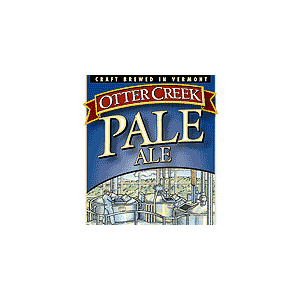
Otter Creek Brewing Company Pale AleOtter Creek's Pale Ale is a filtered, golden-amber ale brewed with pale malts and huge doses of Cascade hops. Immediately note a big, almost exotic raw hop character in the nose which dominates any malt undertones. We found the body to be much more balanced than the nose would indicate, offering both a sweet maltiness balanced nicely with a slightly citrus, floral hop character. Note a slightly sweet, dry, clean finish. Consider pairing this up with a Pork Tenderloin in Garlic Sauce or Spicy Italian Sausages with peppers and onions and you won't be disappointed!

Serving Temperature: 43-50° F
Int'l Bittering Units: 40.0
Alcohol by Volume: 4.5%
Suggested Glassware: Pint Glass (preferably English)
Malts: 2-Row, Crystal
Hops: Cascade

Copper Ale

Otter Creek's Copper Ale is inspired by the Altbiers of Northern Germany. It's a medium-bodied, amber ale brewed with a proprietary house yeast strain. Look for a sweetbread nose balanced nicely by a pleasant, citrusy hop spiciness. Expect similar notes in the flavor, focusing on lightly sweet malts, with a flourish of apricot as it warms, capped by a balancing, mild bitterness. Overall, a very balanced ale that's easy to drink yet packed with flavor. Try it with wiener schnitzel and dumplings.

Serving Temperature: 40-45° F
Int'l Bittering Units: 32.0
Alcohol by Volume: 4.9%
Suggested Glassware: Pint Glass, Dimpled Mug or Stein
Malts: 2-row Pale, Munich, Caramel, Carapils, Roasted Barley
Hops: Chinook, Hallertau, Tettnang

Left Hand Brewing Company

It all started with a small homebrewers kit in 1990…

Christmas of 1990 Dick Doore, co-founder of Left Hand Brewing Company, received the kit as a gift from his brother. Little did either realize the full impact that single Christmas gift would have. After homebrewing for over two years, Dick moved to Colorado, where he met up with a former college buddy and soon-to-be Left Hand B.C. cofounder, Eric Wallace. The two quickly got to brewing together, and their batches impressed their friends and neighbors. After many batches of homebrew, the epiphany hit that they should start their own brewery.

Within weeks of making the decision, they incorporated as Indian Peaks Brewing Company, honoring the Indian Peaks wilderness in their area. However, it was soon discovered that another brewery was using this name for one of their beers, so, indirectly keeping the Indian theme, they changed their name to Left Hand in honor of Chief Niwot, whose tribe wintered in the local area (Niwot is Arapahoe for left hand). Months after setting up shop in a former meat packing plant near downtown Longmont, they opened their doors to the public on January 22, 1994, releasing their first batch of beer, Sawtooth Ale. That year, the homebrewers-turned-pro took home the Gold Medal in the Traditional Bitter Category at the Great American Beer Festival. Way to kick things off big!

For more information, check out their web site at www.lefthandbrewing.com or give them a ring at 303-772-0258.

Deep Cover

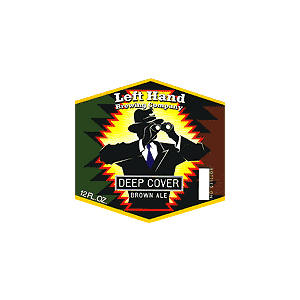
Left Hand Brewing Company Deep CoverThis is another Left Hand B.C. brew that's been in continuous pour since their opening—gotta admire the staying power (a few sips and it's obvious why this brew is still around). "Deep Cover" may just refer to the massive light tan head that conceals this deep amber colored malty brew. On the nose, expect inviting notes of caramel nuttiness with slightly roasted scents, as well as flourishes of toffee and molasses. The flavor profile is similar, adding a light spritzing of peppery hops that linger in the background, offsetting the sweet, maple-syrup like notes. A distinct, dry nuttiness also tames the sweet malty profile. Look for a mild-bitterness in the finish of this excellent medium-bodied brown ale. The caramel notes will pair nicely with steak. Also great with almond or maple-walnut cake.

Serving Temperature: 44-52° F
Int'l Bittering Units: 20.0
Alcohol by Volume: 4.4%
Suggested Glassware: Pint Glass or Mug
Malts: Premium Pale 2-Row, Crystal, Munich, Brown & Chocolate
Hops: U.S. Goldings

Sawtooth ESB

Left Hand B.C.'s flagship beer presents notes of caramel, just-baked bread and citrusy hops on the nose. As it warms, expect additional fruity notes to evolve. The flavor opens with caramel flavors and the subtlest bit of chocolate, followed by the herbal earthiness of hops. Look for a blend of slightly spicy hops and grapefruit notes. This very well-balanced beer finishes with an appropriately firm bitterness and is a great domestic interpretation of the ESB (Extra Special Bitter) style, with a distinctly American stamp (higher aromatics from the hops than most traditional UK offerings). A great brew to pair with fish and chips, mild English cheeses like Lancashire, or grilled chicken, sweetly glazed.

Serving Temperature: 42-50° F
Int'l Bittering Units: 27.0
Alcohol by Volume: 4.8%
Suggested Glassware: Pint Glass
Malts: Premium Pale 2-Row, Crystal, Munich & Left Hand Custom Malt
Hops: Magnum, U.S. Goldings, Fuggles, Cascade

Kulmbacher Brewery (Kulmbacher Brauerei)—Kulmbach, Germany (Northern Bavaria, a.k.a. Franconia)

In an area of northern Bavaria, today known as Franconia, in a town called Kulmbach, remnants of beer bread were found in a vessel dating back to 3000 BC. Other archaeological evidence has shown that brewing was a firmly established activity in Kulmbach since at least the mid-14th century. Given this ancient history, the town of Kulmbach is frequently said to be the birthplace of Germany's beer industry; a sort of fountainhead from which the Bavarian brewing heritage flowed. Expectedly, the Kulmbacher Brewery, established 1846, makes some of the finest beers in all of Germany.

Beer is a celebrated way of life in Franconia. On the last weekend of every July for at least the past 125 years, Kulmbach has held a beer festival in the town square. The region is especially well known for its more potent brewings. Originally, these higher potency malty nectars were concocted to sustain long distance travel during export throughout Europe, relying on higher ABVs as a natural preservative. But interestingly, one of the strongest beer styles indigenous to this famed area was discovered, not designed, in a sort of post-brewing mishap. As the story goes, a wooden barrel of bock bier, a strong, locally brewed malty beer in the 6.5-7.5% ABV range, was inadvertently left in the brewery yard in the middle of winter. Severe snow storms ensued and the barrel was forgotten, out of sight and covered by snowfall until the tail end of the season. When it was discovered, the contents were partially frozen, and the barrel had split open. The brewers, being a curious lot, chipped away the ice to see what became of their brew, sampling what remained in the barrel. Much to their surprise, the residual beer was richer and more concentrated than the original, with an exceptionally clean taste. So what happened? Well, because water freezes before alcohol, a portion of the beer's water content was forced out of the brew, resulting in a concentration of alcohol and sugars relative to the remaining beer volume. This accidentally-discovered "technique" was refined, and today gives us one of the beers the region is famous for: Eisbock ('eis' meaning 'ice' in German).

In addition to producing eisbock, the Kulmbacher Brewery makes a range of over 20 other beers, including a crisp, flavorful pilsner which we've selected, along with their eisbock, to showcase the diversity of beer flavors produced by this brewery.

If you'd like more information about the Kulmbacher Brewery check out http://www.kulmbacher.de.

Pilsner

Kulmbacher Brewery PilsnerSince its inception as a style of beer in 1842, Pilsner has become the single most popular style of beer the world has ever known. Golden in color, it originated in the Czech Republic town of Pilsen. Up until that time, all beer was dark and cloudy. The Czech pilsner was the first beer to be brewed clear and golden. The Germans quickly proved to be the most passionate devotees of the new style and the German contribution was to make the beer a bit lighter in body—better suited to everyday drinking—and to add an extra dose of hops for a refreshingly bitter zing.

Expect a massive, brilliant white head to top this lucent gold, well-carbonated beer. Look for a characteristic pilsner maltiness with notes of floral and spicy hops. We found it to be remarkably refreshing, easy-drinking, with a crisp, clean, dry finish and slightly bitter hop-driven aftertaste. A very food-friendly beer that will partner nicely with anything from light fish to Chicken Kiev to pizza to spicy Thai cuisine.

Serving Temperature: 48° F
Alcohol by Volume: 5.0%
Suggested Glassware: Pilsner Glass or Flute Glass

Eisbock

**Important Note: this brew may be subjected to very low temperatures while being matured, but it should be consumed at cellar temperatures so that you may experience the full range of its robust flavor profile.

Kulmbacher Eisbock is the original Bavarian Eisbock, and it's as celebrated today as it was when it first rose to popularity. How celebrated you ask? Well, there is actually an Eisbock festival in Kulmbach every March that celebrates the style. On the last Saturday of the month, at about 7 o'clock in the evening, the festivity commences with the ceremonial hacking open of an ice-encrusted wooden cask (sound familiar?). The 10% ABV beer that pours forth is deeply complex, with a dark, reddish-brown color, sweet, malty aroma and a smooth palate. The Kulmbacher Eisbock, which used to carry the subtitle "Bayrisch G'frorns" (meaning "Bavarian Frozen"—it's still on the label if you look closely), is made from five different malt varieties. For all intents and purposes, it's a bottled version of this festival brew. Expect sweet caramel malts, notes of fresh biscuits, figs, and rum-soaked apricots on the nose, and look for a creamy, oaken edge, with some distinct vanilla notes in the background. This full-bodied brew is slightly roasty, with notes of maple syrup, raisins, distinct cookie-dough like flavors, and an undercurrent of chocolate, caramel and plum. The finish presents faint notes of coffee, roastiness, and late breaking walnutty dryness. A great beer to enjoy with a book at bedtime, or with chocolate covered figs (or both!). This is a brew that'll age gracefully, so feel free to let a couple bottles age for another winter—just don't leave them out in the snow, try the cellar instead.

Serving Temperature: 52-60° F**
Alcohol by Volume: 9.2%
Suggested Glassware: Snifter

C&H Internationals Logo Since 1994
Join Our Club
Gift Memberships

Membership Renewals
Reorders
Home Page
More Information
Current Selections
Past Selections
Testimonials
Other Gourmet Clubs
Corporate Gifts
Wedding Gifts
Brewery Search
Style Guide
Beer Fun Section
Industry Resources
Festivals
Print a Gift Card
Send a Virtual Brew
Refer a Friend
Send a Hint
E-Promos
Contact Us
Link to Us

1 - 800 - 625 - 8238
(Outside US call: 949-206-1904)
P.O. Box 1627, Lake Forest, CA 92609