Past Newsletters
March 2008
Brewery |
Beers Featured |
| Pennsylvania Brewing Company | Penn Weizen |
| Lake Placid Craft Brewing Company | Ubu Ale |
| Pennsylvania Brewing Company | Penn Dark |
| Lake Placid Craft Brewing Company | India Pale Ale |
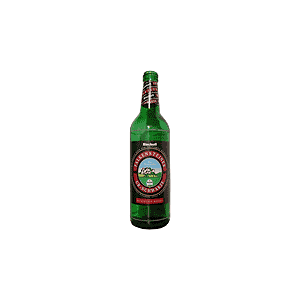
| Privatbrauerei Bischoff (Germany) | Falkensteiner Ur-Weisse |
| Privatbrauerei Bischoff (Germany) | Doppelbock |
Pennsylvania Brewing Company
Tom Pastorius, a Pittsburgh native of German descent, discovered beer while stationed in Germany, a country that considers its "bier" as much a staple as bread. Once his service days ended, Tom returned to the States. He began longing for good German beer. "Beer tastes better over there," he said. "I just missed the beer…"
Dissatisfied with commercially available beverage choices, and in need of a job, Tom decided to start his own brewery. In 1986, he purchased a nearly 150-year-old abandoned brick and stone brewery for $225,000. A three-year, labor-intensive $4 million restoration followed, and thus, the Pennsylvania Brewing Company was born. Talk about going to great lengths to get great beer! Tom's goal to brew authentic German beers quickly became a reality, and these days he is considered a pioneer in the microbrewery renaissance.
For more information about the brewery and scheduled tours, or their attached restaurant, call (412) 237-9400, or visit their website at www.pennbrew.com.
Penn Weizen
This is the brewery's most award-winning beer. It's taken home the National Grand Champion ribbon from the United States Beer Tasting Championship every year since 2002 and a Gold Medal at the 2000 GABF (plus a bunch of other accolades). The aroma is spot on for a Bavarian-style Hefe Weizen with banana being rather robust and spicy clove also present, buttressed by a yeasty bubble gum note, a touch of sliced orange and distinct wheat notes. Hops are a bit more present than expected—an American embellishment. In the flavor, the banana and clove are trimmed back quite a bit from what you'd expect off the nose, with the banana character being more like fresh-baked banana bread. Note the effervescent character imparted by the carbonation which, when paired with the lightly tart quality imparted by the wheat, leaves the palate clean and prepped for another sip.
Serving Temperature: 42-47° F
Int'l Bittering Units: 12.0
Alcohol by Volume: 5.0%
Suggested Glassware: Weizen Glass
Malts: Wheat, 2-Row Barley
Hops: Hallertau, Perle
A gold medal winner at the 1999 Great American Beer Festival and the 2000 World Beer Cup. Note the attractive off-white head which provides a nice contrast atop such a dark brew. The nose is quite a treat—roasty, with the slightest touch of coffee beans, and minor notes of smoky charred wood, almost like burnt driftwood—salty and sticky like the ocean—with hints at vanilla and a whisper of bourbon. Quite unique. Expect some husky, roasted malt character up front in the flavor. Things smooth out in the middle with a nutty, lightly caramel character, and finish rather crisp and clean. It's fairly uncommon to experience this level of crispness in a domestic lager this dark—spot on for the Münchener Dunkel style on which it is modeled. Pair this beer with smoked turkey & sharp cheddar cheese sandwiches on rye bread—dill pickle spears on the side. Even easier, but SO rewarding: lightly melt some sharp cheddar over pumpernickel—simple yet satisfying and a great pairing for this tasty dark brew. Enjoy!
Serving Temperature: 45-50° F
Int'l Bittering Units: 25.0
Alcohol by Volume: 5.0%
Suggested Glassware: Pint Glass or Mug (clear)
Malts: Munich, Roasted Dark
Hops: Hallertau
Lake Placid Craft Brewing Company
The Lake Placid Craft Brewing Company got its start in 1996 as the Lake Placid Pub & Brewery (LPP&B). Owner and Brewmaster Chris Ericson has been serving great beers and delicious food in a comfortable atmosphere since day one. Unofficially, his brewing operation began on the smallest possible scale: with a homebrewing kit. Officially, the LPP&B's brewing operation began on a somewhat larger—though still rather small—scale as a sale-on-site-only brewpub that pumped out fewer than 400 barrels each year.
Their fresh, tasty, small-batch brews quickly grew in popularity, and requests for their beers poured in from area restaurant and bar owners. Production increased dramatically to keep up with demand, and they sold every last drop of beer they brewed (much of it before it was physically brewed). In November 2001, Chris purchased the short-lived AAA Brewery in Plattsburgh, New York and dubbed it The Lake Placid Craft Brewing Company. This expansion to a 13,000 sq. ft. production facility vastly improved their storage capabilities and quadrupled their brewing capacity. Most importantly, it added the almighty "bottle" to their product lineup—no more draft-only sales—which really helped get them more exposure. In 2005 & 2007 they were awarded the "Best Brewery in New York State" by TAP New York; and in 2003, 2005 & 2007 they were recognized as the "Best Brewery in the Hudson Valley."
For more information about the brewery or scheduled tours, call 866-4-UBU-ALE, or visit their website at www.ubuale.com.
Expect a nice big malty nose with fresh grains and a flowery hop note. Look for notes of sweet caramel, brown sugar, taffy, apples, oranges, grapefruit, lemon zest & chocolate. Quite citrusy. We found it went down less sweet than expected, with bitterness coming in quickly, rounded out by a peppery hop profile making its debut late in the progression. The sweeter notes really take a back seat, with citrus rind flavors and those peppery hops grounding the whole thing. Look for a subtle touch of tobacco. This would pair nicely with a medium-bodied, mildly peppery cigar. We've got 'em. Check out www.monthlyclubs.com. But be forewarned, the pair may knock you down—watch out, the robust ABV is deceptively imperceptible.
Serving Temperature: 50-55° F
Int'l Bittering Units: 40.0
Alcohol by Volume: 7.0%
Suggested Glassware: Pint Glass or Snifter
Malts: 2-Row Pale, Crystal 45, Other ("secret") Roasted Malts, Wheat Malt
Hops: Mt. Hood, Willamette
This IPA has a powerful yet graceful hop intensity that is reminiscent of wet-hop beers (which are made using freshly picked rather than dried hops)—we were surprised to learn that they've achieved this hop character with just one varietal (Amarillo). On the nose, expect a high hops presence, but not at all bawdy; they won't punch you in the nose, but they are boldly bitter in the flavor profile. Also note an ample malty backbone that bodes of a well-balanced IPA. On the palate, you'll get lots of grapefruit, but orange and even lemon also enter the scene, with pine accents and a touch of aspirin. The malt flavor of fresh grains shines through despite being blanketed by hops. Note how the hops yield resinous piney flavors that cling to the back of the tongue and throat. Bitterness is quite high, some would say "intense", but perfectly appropriate for a traditional east coast IPA. Overall, we'd sum up the flavor as something like a honeyed, candied grapefruit that's been steeped in schnapps. Try it with spicy samosas.
Serving Temperature: 42-44° F
Int'l Bittering Units: 56.0
Alcohol by Volume: 6.8%
Suggested Glassware: Pint Glass or Seidel
Malts: 2-Row Pale, Marris Otter Pale, Munich, Crystal 45 & 85, Wheat Malt
Hops: Amarillo
Privatbrauerei Bischoff—Winnweiler, Germany (Southwestern Germany)
Most of the "oldest" U.S. craft-brewed beers in production today aren't even 40 years old yet. The vast majority of domestic craft-breweries are less than 25 years old. Contrast this with our featured international brewery, which turns 142 this year. Yeah, they've had some time to get the whole brewing thing down pat…
The Privatbrauerei Bischoff is located in a region of Germany known as Nordpfalz, part of the area commonly referred to as the Palatinate (Pfalz is German for Palatinate). The area is home to Germany's largest coherent forest—and is well-regarded for its attractive natural landscape, including the dominating Donnersberg ("Thunder Mountain") which marks the region's highest point. Privatbrauerei Bischoff resides in the town of Winnweiler. This area of the Palatinate has a significantly cooler climate than that found just north; whereas grapevines and German vintners thrive along the northerly Deutsche Weinstrasse (German Wine Route), this territory is better known for its barley farmers and traditionalist maltsters (not to mention beer!)
The region's natural resources provide crystal-clear spring water which is used in all of the brewery's beers. It is this water, along with locally-grown barley, regional hops and yeast sourced from the famed banks of Weihenstephan that have been used by five generations of Bischoff family brewers. Back on December 7, 1866, when this area was still a part of Bavaria, Christian Bischoff poured the first commercial batch of Bischoff beer. Through the generations, his establishment has been the only Nordpfalz brewery to have remained in the same family since its founding. From the time of its humble beginnings in a small converted barn-turned-brewery, Christian's descendants have repeatedly updated Privatbrauerei Bischoff's brewing equipment and expanded their lineup of beers. In 2001, his great-great-grandsons, Drs. Sven and Erik Bischoff, joined the team.
The brewery marked its 140th birthday with an impressive cache of prizes awarded by the prestigious DLG Test Center, Germany's independent drinks and food testing society: 2 Gold and 3 Silver Prizes. The DLG's 2006 competition saw 552 beer entries from no less than 158 international breweries. Unlike most formal competitions, DLG's testing & evaluation subjects entrants to stringent laboratory tests in addition to the typical sensory appraisals. Yes, they take their beer VERY seriously in Germany…
Presently, the brewery has an impressive line up of 17 beers. Unfortunately, we can't bring them all to your door, but we did pick two of our favorites for this month's international features. Prost!
For more information about the brewery (in German only), check out their website at www.bischoff-bier.de.
You may have noticed "Ur" as a prefix that shows up quite a bit in beer names, particularly those hailing from Germany and the Czech Republic. Ur is a German prefix that can mean "first," "prime," or "original," but the term is sometimes loosely applied to mean older or traditional. Clearly, Falkensteiner Ur-Weisse is not the original or first German hefeweizen, but it is brewed to emulate the traditional, older styles of hefeweizens brewed in Bavaria. In appearance, it pours a turbid honey amber with a very white, creamy head. On the nose, expect traditional hefeweizen notes: characteristic clove and mild banana esters. Look for a touch of floral, noble hops with notes of lemon zest and honey. There's also a dilute orange note and hint of grassiness. A feature that really sets this wheat beer apart from others is the extremely lush, velvety smooth feel in the mouth—it's downright creamy in texture—almost like Guinness in terms of mouthfeel, very uncommon for this style of beer. On the palate, expect the traditional banana notes to be subdued, with biscuit and bread character rising to the top of the flavor profile, rounded out by a touch of clove-like spice. Note a citrus-peel fade (think lemon without the intense sourness). Through the finish, things dry out effectively, with a light bitterness leaving you ready for another thirst-quenching sip. Overall, a very easy-drinking beer that delivers suave drinkability and an unexpectedly luscious body. Wonderfully refreshing, this is a thirst quencher from the get go.
Note: many people reflexively add a lemon wedge to their hefeweizens. Please resist the temptation, at least until you've had at least one of these without the fruit and can sample the true flavor—there's plenty of it to stand on its own. Plus, we're pretty sure that when this beer took home the 2006 DLG Tasting Center's Gold Prize, it was served sans lemon.
Serving Temperature: 45-50° F
Alcohol by Volume: 5.2%
Suggested Glassware: Weizen Glass
Recognized with a Silver Medal/Highly Recommended rating by the Beverage Tasting Institute in 2006, and a Silver Medal at the 2006 World Beer Championships, this double bock (doppelbock) has won over quite a few fans. Let's get right to it, shall we? The beer pours a rich, clear amber color with garnet highlights when held to the light. Give it a good high pour to fully bring out the lightly caramelized meringue-toned head. After a moment to let it settle down, take in the aroma. Expect honeyed, ripe red apples and a touch of grapes on the nose, with a sweet-dough note and a touch of the traditional German yeast mustiness. This beer stood out among our beer panelists because it asserts its own unique personality. Some might say it has a bit more of a schwarzbier-like nose than traditional doppelbock, but this is within the permitted profile for the style. Also on the nose, look for juicy, chewy, sweet malts and a slight hint of blonde tobacco. On the palate, the beer goes down a little edgier than many doppelbocks (which often run very sweet and smooth), with an assertive carbonation level and an overall flavor that lands a bit on the bitter side, which helps stave what might otherwise have become a cloying sweetness that some doppelbocks suffer from. Expect to also pick up some alcohol notes, which contribute a little more bite and edge. A pretty complex array of flavors develops as it warms. There's a pleasantly fruity character which provides notes of apples and grapes, as well as rum-soaked raisins, rye, and a ghost-like juniper note. Look for a late-breaking, sweet coffee-like note toward the finish (think Viennese coffee). Notice that the hops are also a bit more present in the finish than is typical for the style, but they nicely help bitter things up and contribute a slightly grassy character along with the slightest hint of lemon-peel/zest. Overall, this beer's got a nice kick to it and an assertive, somewhat rebel character. And it's not afraid to show it… Be sure to put a bottle or two aside—this will age quite nicely (try 12-18 months, kept at cellar temperatures (45-50°F)).
Serving Temperature: 47-52° F
Alcohol by Volume: 7.5%
Suggested Glassware: Flute Glass or Seidel