Past Newsletters - November 2009
DOM = Domestic Beer Club; INT = International Beer Club; VAR = Domestic International Variety Beer Club; RBC = Rare Beer Club
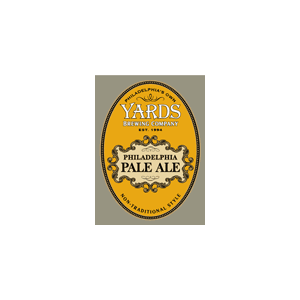
For a city like Philadelphia, whose rich brewing heritage was virtually wiped out, it’s difficult to overstate the importance of Yards Brewing Company. Before their founding in 1994, Philly had been without her own brewery since the last of the great old breweries, Schmidt’s, went under in 1987. While a seven year dry spell might not sound like much, 1987 dealt a major blow to beer lovers who were shocked to find out they were suddenly left without a hometown brewery for the first time in over 300 years! What was left? Bud. Miller. Coors… Were it not for the availability of another Pennsylvania brew, Yuengling, it’s likely riots would have ensued.
In 1988, collegiate wrestlers Tom Kehoe and Jon Bovit realized they could sustain their thirst for quality beer by brewing beer themselves. As they made their way through college they continued to experiment with homebrewing and shared with friends. Demand for their homebrew surged, leading them to take the leap into professional brewing. In 1994 they founded Yards Brewing Company, emptying their savings to get started and making beer in a small, garage-sized brewery in the Manayunk section of Philadelphia. Their beers caused quite a stir—these guys were crafting cask-conditioned ales on a tiny, homemade, three-barrel brewing system, and insisting that they be served by local pubs and taverns via traditional beer engines (hand-driven pumps that pull the beer from the keg.) Upon unveiling their Extra Special Ale at the Philadelphia Craft Beer Festival in April of 1995, beer drinkers in Philadelphia were flabbergasted—even the beers that were formerly available from Philly’s last breweries in the 60s, 70s and 80s, were nothing like this. Yards quickly became the forerunners in the regional craft-brewed beer scene.
We’ve run out of space to continue the story, so check out http://www.blip.tv/file/603458/ for a short film by Stephen Metzger about Philadelphia’s brewing history and more about the important role of Yards Brewing Company—it is a great tale, full of ups and downs and punctuated by what is quickly becoming a final round triumph.
For more information about the brewery and scheduled tours, call (215) 634-2600 or check out their web site at www.yardsbrewing.com.
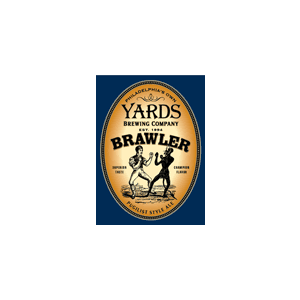
A so called “pugilist style ale” that is “great for when you want to go a few rounds,” this is clearly a session beer—one you can have a few of and keep your wits (and motor skills) about you. Pours a clear, medium brown color, capped by an ever present off white head that dissipates to a full collar hugging the edge of the glass. Look for bold grains on the nose, full of pumpernickel bread, cocoa (a la hot cocoa), orange peel, a bit of charcoal, hints of maple syrup, and some gingerbread spice. Very nicely done: a big nose and a low ABV. The flavor is mild but ample with chocolate milk and very toasty grains. Make saltines out of pumpernickel, and they’d taste like this beer. Expect faint plum-like fruitiness ahead of a toasty, grainy, bready, finish featuring mild tea-like bitterness and a minor cherry skin aftertaste. A nice English style mild that evokes notes of any number of world class brown ales. Pair with Texas hold ‘em, and another few rounds.
Serving Temperature: 45-50° F
Int'l Bittering Units: 20
Alcohol by Volume: 4.1%
Suggested Glassware: Pint Glass or Mug
Malts: Melanoidin, English 2-Row
Hops: East Kent Golding
Philadelphia’s own pale ale pours a medium straw color topped by an off white colored head that is a bit oily looking—that would be the hop oils! Expect a big hoppy aroma with a focus on non-traditional fruits—plumes of peach notes leap from the glass, along with citrus tones and hugely resinous pine sap, with wafts of baked bread as it warms. This east-coaster is giving the west coast hoppy brews a run for their money in terms of aroma; an awesome hop nose in a responsibly ABV’d brew. Look for a light, even crisp impression on the palate, with a nice, bready, almost neutral malt profile. The massive hoppy nose does not give way to the bitterness you might expect for a beer so mightily hopped in its aroma, which makes it a great example of the brewer’s craft and versatility in use of hops. We refer to this as a very hoppy beer, but it’s hoppiness is aroma-focused, with some hop flavor as well, but less hoppy in terms of bitterness. It’s got the nose of an IPA with the profile of a pale ale. The clean malt grain profile lets leafy, resinous hop notes and crystallized fruit (peach, nectarines) take center stage. As it warms, hop flavors swell in a piney, grapefruit-like, resiny crescendo. The beer finishes with rindy, citrusy, piney notes and a moderate bitterness. A great hop fix without the surge in ABV often present in massive hop bombs. Pair with spicy chipotle chicken or Jamaican jerk pork tenderloin.
Serving Temperature: 40-45° F
Int’l Bittering Units: 25
Alcohol by Volume: 4.6%
Suggested Glassware: Pint Glass
Malts: English Pale, Pilsner
Hops: Amarillo & Simcoe
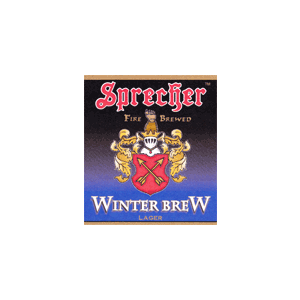
We've been fans of the Sprecher Brewing Company for some time. With over 20 beers in their cumulative brewing portfolio, we’ve enjoyed everything we’ve gotten our hands on. This month, we’ve focused on limited release beers in their collection, and they are some fine brews! The first thing you'll likely notice is that their bottle labels give the impression of being an import; notice the griffin-like emblem and Euro-style-typeface (and the name Sprecher, meaning "speaker" in German, implying a German brewery). But closer examination reveals the banner line "Established in Milwaukee – 1985"—it's almost jarring to discover this beer isn't brewed by a 200+ year old brewery from Bavaria (and that's before even tasting the stuff—you'll really question it after you try them!).
Sprecher Brewing Co. was founded in 1985 by Randal Sprecher, a former brewing supervisor at Pabst Brewing Company, in Milwaukee, Wisconsin. Within 10 years the company had outgrown their first location and in 1994 they moved to their current location in Glendale, Wisconsin. The new, larger brewery enabled the company to continue growing; today they remain proud contributors to Milwaukee's great brewing tradition—and by Milwaukee's great brewing tradition we don't mean the current macro-behemoth based there—this city was, in the late 1800s, home to more than 80 breweries—but prohibition changed all of that in 1919. Still, it can be spoken of historically as a craft brewing haven, and the Sprecher beers certainly speak to us; they tell us these guys know what's up. If you're ever in the Milwaukee area, drop in to Glendale, Winconsin for a visit and buy whatever Sprecher beers you can get home with you (helpful hint: bring an extra suitcase!).
For more information about the brewery and scheduled tours, visit their website at www.sprecherbrewery.com or call them at call (414) 964-2739.
Winter Brew is a Munich-Style Bock beer that pours a very dark chestnut brown color beneath a pale tan head that fades somewhat quickly to a collared covering. Expect first impressions on the nose to suggest that this is going to be a rich and malty brew. Look for notes of stone fruits (cherries, plums) along with a hefty caramel presence, some maple syrup notes balanced by a mild roastiness and spicy Tettnanger hops blended with that hallmark ‘German-lager mustiness.’ We found it had a fantastically full mouthfeel that nicely coats the palate with notes of biscuits & grains rolled in caramel, faint orange, some plum and additional roasty characteristics. The flavor profile fully blossoms just ahead of the finish, with the beer opening up some and letting doughy, bread-like notes emerge, with the finish ushering in some mildly bitter hoppiness, sharpened by an almost stinging, biting carbonation. Great bock beer, and not too heavy, yet showcasing all the great features of traditional German bockbier. Overall, it’s got tons of flavor yet manages to retain a lagered cleanliness. Sprecher really knows their stuff, and brews some amazing German-style beers. This winner of the 2004 Bronze and 2002 Gold Medals at the World Beer Cup will pair nicely with Carne Asada, black beans and rice.
Serving Temperature: 50° F
Int’l Bittering Units: 21
Alcohol by Volume: 5.75%
Suggested Glassware: Flute, Pilsner Glass, Mug, Stein, Pint Glass
Malts: Pale, Caramel, Black Patent, Chocolate
Hops: Cascade, Mt. Hood, Tettnanger, Chinook
What’s in a name? Dunkle means “dark” and Weizen means “wheat” in German, making this beer, literally, a dark wheat beer. Look for a deep caramel amber color with orange hues capped by a very creamy light tan head that laces masterfully along the glass. Rich caramel and dough-like notes complement aromas of clove and banana and a hint of bubble gum. As expected for a dunkelweizen, there are some bread-like notes and these work very nicely against the fruity esters that evoke scents of musty orange peel. Amidst the complex flavors rises the core of many a good German-style wheat beer: the yeast. In this beer, there are subtle spicy characteristics when cool, a damp musty quality and an herbal, almost minty, mentholated numbness on the tongue—all combinations of the yeast and spicy yet subtle hopping. As the beer warms, expect the spiciness to grow, evoking impressions of cinnamon spice. Surrounding this core are notes of past-prime oranges, caramel, Portuguese sweet bread, and an almost creamy richness. Like all good weisse beers, it finishes with what is commonly described as a “wheaty twang” which is best described as a slightly sour, mildly acidic character that helps give wheat beers (light or dark) their thirst-quenching character. The finish is rounded out by notes of caramel, gingerbread, cloves, and after-breaths of cinnamon. Appearing well beyond what we would describe as a finish or aftertaste there is a ‘residual linger’ of spicy numbness that rests on the palate—a most interesting experience. Try pairing with German smoked sausage.
Serving Temperature: 45-50° F
Int'l Bittering Units: 15
Alcohol by Volume: 4.8%
Suggested Glassware: Weizen Glass
Malts: Pale, Carapils, Wheat, Caramel, Black, Chocolate
Hops: Cascade, Mt. Hood, Tettnanger, Chinook, Hallertau
Coopers Brewery Limited—Regency Park, Australia (Southern Australia)
The Coopers Brewery was founded in 1862 just outside Adelaide, Australia, in the town of Leabrook. This respectable outfit is the last stronghold of the historic family-owned breweries on the Australian continent. Thomas Cooper, a Wesleyan preacher from Yorkshire, England, immigrated to southern Australia and founded the brewery at a time when big breweries dominated the local colonies. Unfortunately, that fact hasn’t changed much in Australia, and the Coopers Brewery had faced multiple threats of hostile takeover from the big boys.
Thomas Cooper’s brewing career was initiated much by accident when his ailing wife requested that he make a restorative ale—from an old family recipe—to be used as a tonic. Turns out the ale was well received not only by his wife, but by locals for whom he provided samples. Appreciated for its taste and perceived medicinal attributes, demand grew enough for Cooper to start his famous brewery, which today remains as the sole independent brewery in Australia to survive the entire 20th century.
Interestingly, as a Wesleyan preacher, Thomas Cooper felt that pubs were sinful places (though he wisely saw no evil in beer—after all, it was the tonic that aided his wife's health). Thus, for most of its history, the brewery owned no pubs, and today they own only one, the Earl of Aberdeen, in the old center of Adelaide. A brewery with no pubs, while commonplace in the US microbrewery revolution, is a very rare scenario for established overseas breweries. This apparent lack of an "automatic market" seems to have been critical in avoiding takeover bids during their history. And we like to believe that Thomas Cooper would have been a fan of our beer of the month clubs for this very reason—no pub necessary to enjoy these fine brews, right?
We're major fans of Coopers and their true-to-style beers, and admire them for sticking to their goal of being a family-based business. Back in 2005, a competing brewery (a conglomerate really), had launched a hostile takeover bid. Coopers, while family-run, does have shareholders, and if a majority of them approved the deal, it would have been adios to independence. Thankfully, the Coopers family (and their shareholders) were ready for the fight, rejected all bids, and have proudly maintained their independence as a family-owned and operated brewery. Join us in lifting a pint to their continued independence!
For more information about the brewery, check out their website at www.coopers.com.au
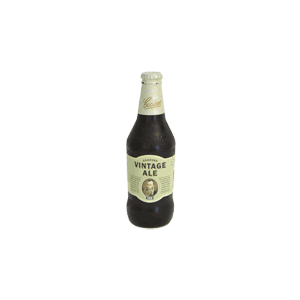
Naturally carbonated in the bottle, this beer has a fine sedimentary layer that you may or may not want to disturb when pouring. Purely a matter of preference, you can pour the beer gently and leave a bit of the beer behind in the bottle to minimize introduction of this sediment, or, swirl the bottle about halfway through the pour to kick it up and pour into your glass. Typically, if it’s a pale beer that is very “pretty” to look at, served in a glass where the sparkle and rising carbonation jets are part of the appeal, we favor leaving the sediment behind. But in a darker beer like this, and especially in stronger, limited vintage brews, we like to get every last drop. It’s your call—try it both ways to find out what you prefer (keep in mind, the decision “to rouse or not to rouse” is not entirely one driven by visual aesthetics; the yeast can have an effect on the aroma and flavor of the beer. Luckily, we send more than one bottle of each of our featured beers, so you can easily try both ways and decide for yourself). Coopers Vintage Ale is brewed just once a year and is always labeled with its year of vintage. The 2008 vintage is still a bit “young”, though already over a year in age. If you look closely at the printing on the bottle itself, instead of a “Best Before” date you’ll find a “Best After” date. Why? Because this very sturdy beer was designed to be matured; when kept at cellar temperatures (low-mid 50s) the beer will age gracefully for years to come. The oldest Coopers Vintage Ale we’ve had was 4 years old and it was still magnificent, so be sure to stash a bottle or two away for at least a year. Take detailed tasting notes this time around so you can compare how the beer has developed when you wake it from its slumber in 2010 or later. On the nose, look for notes of apple skins, peaches, apricots, clementines, honey with nutty, yeasty, caramel nuances, figs, gingerbread and floral complexities. Hops are overwhelmed by the maltiness, but they’re there if you look for them (you may pick them up as more of a tingle or spice in the nose). The flavor profile is front-loaded with caramel, under-ripened apples, red grapes, cereal grains and floral notes. But all of these sweeter notes are quickly dried up as the hops kick in with a balancing, stemmy woodiness and very earthy drying effect. As it warms, the beer develops a prominent Kentucky Straight Bourbon Whiskey-like note in the aftertaste. Quite nicely done—this is another stellar “cellar” vintage! A fine cigar beer to be paired with a rich, oily maduro cigar (speaking of cigars, check out www.cigarmonthclub.com for info on our Premium Cigar of the Month Club).
Serving Temperature: 50-55°F
Alcohol by Volume: 7.5%
Suggested Glassware: Pint Glass, Snifter or Stein
Brasserie Duyck—Jenlain, France (Northeastern France, a.k.a. French Flanders)
Think of France’s liquid exports and what’s the first thing you think of? We’re pretty sure it’s not beer… Notwithstanding this, the French have created some exceptional beers over the years, particularly in the northeast of the country where they have taken a lesson from brewing savants in the nearby Flanders region of Belgium. Truth be told, these neighboring cultures have borrowed from each other—the Flemish have incorporated wine- and champagne-like features in their beers, and the French in turn have 'borrowed back' these traditions and characteristics in theirs. Which is not to say the French lack originality in their beers. To the contrary, a unique style of beer referred to as Bière de Garde originated in northern France. Bière de Garde remains the only style of beer indigenous to the country. Thankfully there are a few breweries in northern France, in the region that is known by a few titles—French Flanders is one, Nord-Pas de Celais is another—that still produce excellent French beers.
Our second featured international brewery, Brasserie Duyck, is independently owned and specializes in France’s native beer. The brewery, founded in 1922 on a site that was once a farm, is credited with reviving the Bière de Garde style from the brink of extinction as well as encouraging numerous smaller Bière de Garde breweries in northern France.
Duyck is the surname of a family of French brewers who settled in the hamlet of Jenlain in 1922. Léon Duyck was the first member of the family to take up the trade of brewing. He handed down his passion for traditional French brewing to his son Félix, who set up his farmhouse brewery in Jenlain, near Valenciennes, where he produced his first matured beer, which would become the famous Jenlain brand. The name of the village was not adopted as the name of his famed beer until 1968, many years after it was first created. At that point, the brewery had been under the control of Félix's son Robert for eight years. Robert manned the helm of the family business for thirty years before passing it on to his son Raymond (great-grandson of the family's brewing patriarch, Léon). That's four generations of family brewing, and one mustn't underestimate the value brought to a brewery by having the same family controlling the process for over 80 years.
Brasserie Duyck remains a traditional farmhouse brewery, complete with traditional buildings and rustic atmosphere. If you ever find yourself in the northeast of France, visit Jenlain and enjoy this fantastic beer at its absolute freshest.
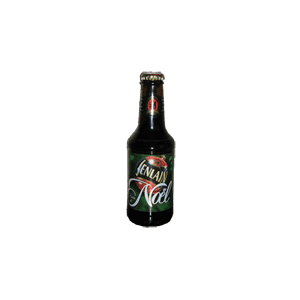
In the years following the Second World War, many northern European breweries would brew and sell a richer and stronger beer at the same price as their year-round beers. This was their annual gift to their customers. The Duyck brewing family has perpetuated this custom by creating a special beer which they sell at the price of their flagship beers. Produced with more malt than Jenlain Ambrée, their hallmark Bière de Garde, this beer has three different types of malt made from French-grown barley and three varieties of aromatic, deeply earthy hops from Alsace. Like all the Jenlain beers, Jenlain Noël is highly drinkable and presents a clean, crisp, herbal, hoppy profile. The Jenlain beers are known for their very earthy hop characteristics—and despite the additional spice notes in this beer, it remains grounded by this trademark quality. Look for notes of fruit (think black cherries), floral aromatics, hints of orange, some musty yeastiness and of course, earthy hops. The flavor profile presents oranges, cherries, a Grand Marnier-like note, an undercurrent of black tea, and a minor note of biscuity grains. The peppery, spicy, hoppy profile provides bite in the flavor and finish, freshening up the palate for another sip by adroitly drying things out. This is quite a versatile beer when it comes to the dinner table. The sweeter notes and spiciness marry well with honeyed, brown-sugar-glazed, clove-covered, holiday ham. Alternatively, you can capitalize on the earthiness from the hops by pairing with a mushroom salad.
Serving Temperature: 45-50°F
Alcohol by Volume: 6.8%
Suggested Glassware: Tulip
Mikkeller—Copenhagen, Denmark (Central Eastern Denmark)
The Scandinavian beer scene is exploding. There's been a surge in recent years in the number of microbreweries, many emulating the big, bold beers of the US microbrew revolution. This isn’t to suggest that they lack their own creativity—not at all. In fact, some of the most adventurous brews on the planet emanate from Scandinavia. One of the breweries that has led the charge in the creativity (and quality) department is Mikkeller, founded in the kingdom of Denmark by Mikkel Borg Bjergsø and Kristian Klarup Keller (the name Mikkeller is a combination of their first and last names). Barely three years old, their rise to beer geek prominence has been meteoric. In 2006, their first year in business, Mikkeller was named Danish brewery of the year, and the fifth best brewery in the world. The secret to their success? As Bjergsø, now in the business by himself (Keller left to take a job in another field) says, "We brew the beer we like, and we don't think too much what the customer wants." Not pulling any punches there... Turns out, customers like what he's doing. Mikkeller beers are highly coveted across many continents, which is why we couldn’t be more excited about bringing you one of their newest creations this month, about a month before anyone else in the country will have access. Merry Christmas, Happy Holidays, whatever… you’re welcome…
Despite the founding duo’s split, Bjergsø has not quite gone it alone. He's became a self-proclaimed “gypsy brewer,” working in a multitude of nations alongside some heavy hitters. He’s teamed up with brewing illuminati like AleSmith, Stone, De Struise, and Three Floyds, among others. Part of what's got Mikkeller noticed, besides their boundary-pushing beers, is their attitude. Bjergsø prides himself on pushing the envelope, while not taking himself too seriously. With amusing names like "Gone Cold Turkey?" "It's Alive!" "All Others Pale," "Drink Your Sorrows Away," and "Beer Geek Breakfast," he’s fully, completely and totally embraced his brand’s beer geekdom. This Danish brewer is steeped with the youthful, hip elements that have also helped make bands from Denmark some of the best break-out music-makers of the past 5+ years. There's a blatant intelligence, but not pompousness, paired with levity blended with high gravity. The fact is, Mikkeller may be just about the coolest brewery out there. There, we said it… They recently brewed "Black," which they describe as "Denmark's strongest beer and Mikkeller's 'most violent' beer to date." Hell yes!
Here are a couple examples of their "style"… http://www.youtube.com/watch?v=hXpFVPFHHJM
(take home quote: “kiss the Bratwurst”)
http://www.youtube.com/watch?v=fqrtcQk3Ziw
(take home quote: “I got the worst hair day of my life and you’re offering me beer!?”)
http://www.youtube.com/watch?v=4UBAfWyySmk
(take home quote: “you might have heard of me… but your girlfriend, your mother—they definitely know my name.”)
http://www.youtube.com/watch?v=Qem0iqkkT-4
(take home quote: “all the guys were very excited…”)
OK, OK, we know, it's a pain in the arse to try and copy URLs like these by hand from this printed newsletter to your browser. One day we’ll be super-ultra-multi-media and our tasting notes will read themselves to you via live video feed and will pilot your web-browser in total hands off fashion… Virtual beerality baby... But until that happens, here's an easier way to get to the links above: just punch this one up— www.beermonthclub.com/pastbeernews.htm and dig up this month's newsletter (it's easy, you'll find it)—where you'll be able to just click the links above, or, copy and paste them into your browser.
Mikkeller started brewing beer in their kitchen, and set out to challenge the Danes' taste buds with intense taste adventures, seeking to provoke some inventiveness in Danish beer brewing. As they put it "why not show the way?" Mission accomplished Mikkeller. Thousands of beer geeks can’t be wrong.
For more information about the brewery, check out their website at www.mikkeller.dk
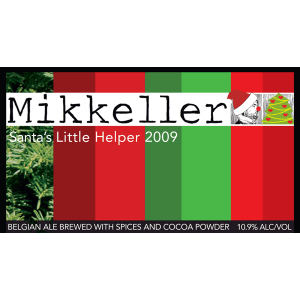
Pours a deep chocolate brown in appearance topped by a very thick, permanent hot-cocoa-like head. Not surprisingly, a complex aroma greets the nose (this is a Mikkeller beer, after all). It seems Santa’s still got a lot of presents left in the bag. Either it’s early in the trip, or, he’s loaded on this fine sauce and is only hitting every 100th house or so. So, a deep dark big ABV beer—what do we expect? Chocolate? Yup, it’s in there. Plums? Yes, them too. Raisins? Maybe… Star anise? Sure, that’s coming across as well. But what’s truly unique about this beer is that these otherwise dominant players are stashed away within a more prominent bouquet of atypical nuances. The dark Cassonade (a type of “true” brown sugar) used in the recipe lends a sweetness to the nose, and hints at a sort of concentrated, caramelized maple syrup & pralines. Somehow, the 11% alcohol content manages to rest beneath the surface, hiding frighteningly well in true leviathan style. Cinnamon barely jumps out, but the placement gives the impression that it will announce itself more on the palate—the tip of the iceberg if you will. Expect a sprucey, almost minty character, pine (dare we suggest Scandinavian pine?), and with all of this other elegant chaos going on in the nose, the aromatics are kept grounded in the realm of beer geeks’ familiar companion, the hop. These ‘kind hops’ provide a clean zing in the nostrils, lending some citrus character along with zesty sweet orange peel. Coriander notes barely register as an herbal flitter amidst faint impressions of Sambuca. On the palate, you may find yourself saying “wow, this could be the perfect blend of hops, spice and rich maltiness I’ve ever had.” That’s what we said anyway… So, sure, we’re total beer nerds over here, but our panel collectively decided that this is their all time favorite holiday beer. That’s saying A LOT. Rich layers of chocolate, treacle, gentle cinnamon spice, toasted ginger, dark chocolate, fresh mint sprig, orange juice, currants, cola, and enough alcohol to warm even Santa’s rather large belly, even after all of those damned gingerbread cookies. The interplay of complex tastes and the alcohol heat turns the booze into another major player among the portfolio of flavors. It bats the notes about, bouncing them across the palate time and again in a complex cascade. Black berry notes grow as it warms, giving a faint impression of black currant schnapps in the mildly bitter finish. At full warmth, additional notes of cracked black pepper and Sweetarts candy develop. Santa’s Little Helper ain’t so little… This is a big, powerful, bombastic-yet-graceful brew. Really a work of art in a bottle if you ask us.
Beer geeks rejoice!—You must have been very, very good this year!!
Serving Temperature: 55° F
Alcohol by Volume: 11.0%
Style: Strong Abbey-style Spiced Holiday Ale
Suggested Glassware: Snifter
Brasserie St. Germain—Aix-Noulette, France (Northern France)
Breaking from tradition can not only be difficult, it can be dangerous. Deviation from the norm often upsets the hegemonic rule tacitly adhered to when we fail to question the world around us. (No, this is not the beginning of our manifesto…) As a member of this club, you already know that most people choose not to question, especially when it comes to their beer; they imbibe what is served to them, what’s most common, what the ‘TV-looky-box’ suggests will make them more attractive to women, and, a better sports fan. But you have taken a different path. You have elected to seek out the best, not the biggest. You question the norm, and even suggest to others that they do the same as you try to steer your friends and family to the enriching experience so often found in the pursuit of better beer.
So, we know that you will appreciate the story of Hildegard of Bingen, a woman of the Rhine River Valley (now Germany) who was dedicated by her parents to the Church at birth, sent off to a Benedictine monastery, and eventually became the founder of a convent, a theologian and philosopher, a musical composer, a seer, scientist and healer, pioneer of holistic medicine, and, more or less, the forebear of the women's liberation movement—all back in the 12th Century A.D., a time when women were regarded as little more than property, hardly ever educated, and generally unable to read or write. But Hildegard gave counsel to popes and kings, and produced many important works in a range of disciplines. She is considered by many to be the first writer ever to describe the female orgasm, and was known for her positive views on sex (not typical of the Church at that time). Questioning the establishment? You betcha. And among all her other specialties, she was a major advocate of the use of hops in beer—something barely done at the time, as the herb-and-spice blends used to bitter beer (called “gruit”) were often made exclusively by the Church.
The folks behind Brasserie St. Germain likewise appreciated the story of Hildegard, naming many of their beers after her, and making reference to a treatise that legend tells she wrote, called “The Benefits of Beer.” On page 24, according to legend, she revealed a great secret, which men have fought to obtain for generations. No copies of the treatise exist in the modern world, and no one knows what the great secret was. Speculation abounds about what the secret could have been, and many historians agree that no such treatise ever existed, but the allure of this mystery has endured for generations.
For the brewers at St. Germain, they seem to think the secret is “more hops!” In this regard, they have broken with regional tradition since their inception in 2003. Their brewery, in French Flanders, is not well known for its heavy handedness when it comes to dosing beers with hops, but St. Germain has focused around the power and glory of the flower that so inspired Hildegard, and, legions of beer geeks worldwide. After only six years in the brewing game, the tiny Brasserie St. Germain has made its mark as, indisputably, the most awarded brewery in France. Try any of their beers, and you’ll discover for yourself that the reason why is no mystery at all.
Like kids at Christmas, folks in the vicinity of Brasserie St. Germain in Aix-Noulette, France, clamor for this beer every holiday season. Despite being available for a mere two months each year, Page 24 Noël accounts for 10% of the brewery’s small annual production. There’s not much to go around, meaning not everyone ends up getting what they wanted for Christmas. This makes us even more excited to announce that the bottles you now have are among the very first available in the country! Never before in the US, we’ve now got a little slice of beery Christmas heaven procured for our members. Truthfully, it’s a bit “grinchy” on our parts to take some of what would normally have gone to the locals, but hey, sometimes we need to do a little Robin Hood’ing here and there to slake our members’ insatiable thirst for rare beer. The beer, when poured into an oversized tulip glass, pours a coppery orange color with an off white head that starts about 2-3 fingers thick and fades to a clingy collar. A vibrantly aromatic bouquet greets the nose on this special holiday Bière de Garde. Expect spicy notes, with some alcohol rising forth and nipping at the nostrils with a cinnamon-like tingle, but there are softer notes of fresh red berries (raspberry?), oak, maraschino cherries, nectarines, and a cellar-like musty character that dissipates over time as the beer breathes. Goes down fruity, clean, quite refreshing and almost light, which is a bit unexpected after a fairly intense, almost aggressive nose on this nearly 7% ABV brew. Moderately sweet, but not syrupy or heavy—it’s sweet like fresh fruit—ripe, clean and juicy. Look for notes of fresh grains to maintain a presence, along with a very faintly roasty character imparted by the use of black malt (quite atypical in the style). But we found the most prominent feature to be a clean, ripe fruitiness that is somehow lighter and more ethereal than most beers in the spiced, holiday-brew genre. Finishes with some mildly phenolic, spicy notes, and an almost lemon-like acidity and ghost-like suggestion of lime flesh. The musty, cellar-like notes normally present in Bière de Garde have taken a back seat to fresher, vibrant fruity notes and citrus acidity with less aggressive hops, all cradled with finishing characteristics reminiscent of a top shelf Manhattan (the cocktail). Sweet vermouth meets bourbon whisky… We’re tempted to drop a cherry in this beer to complete the cocktail, but it’s already got all the fruit notes that it needs. Quite interesting and plentiful in the flavor department. Consider pairing with chicken Francese to bring out the lemony bitterness, or alongside a rich, sweet Madeira chicken recipe to contrast and complement the sweetness of the beer. Joyeux Noël!
Serving Temperature: 43-46° F
Alcohol by Volume: 6.9%
Style: Holiday Bière de Garde
Suggested Glassware: Tulip (or Snifter, swirled often!)