Past Newsletters - Feb 2009
DOM = Domestic Beer Club; INT = International Beer Club; VAR = Domestic International Variety Beer Club; RB = Rare Beer Club
The Atwater Block Brewery is located in the heart of Detroit's Rivertown district. Housed in a reconditioned 1916 warehouse, the 18,000-square-foot brewery features an imported state-of-the-art Kasper-Schulz German brewhouse and a 170-seat restaurant featuring a 60-foot bar with two-story glass walls that give patrons a direct view of the brewhouse.
The brewery has changed hands a few times, from the original group of investors who, founded the place in 1996, to the second set of owners, who changed the name and founded the "Stoney Creek Brewing Company." Current owners Howard Hampton and Mark Rieth took over in 2005 when Stoney Creek owners hit troubled waters. The pair restored the original name and retained the original German brewmaster, Hazen Schumacher. ABBC typically focus on German-style lagers, but they offer up some tasty and creative ales as well. Prost!
For more information about the brewery and brewpub—and scheduled tours—call (313) 877-9205 or check out their web site at www.atwaterbeer.com.
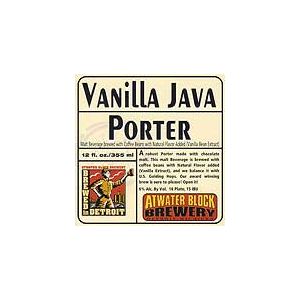
Wake up and smell the beer! This brew has vanilla and Java beans added to it, explaining the unique aroma. Expect roasted coffee beans and a bite of vanilla on the nose. Look for roasted coffee flavors, chicory, ultra-dark chocolate, and a lactic (milk-like) flavor. Overall, the flavor is smoother than the sharp nose suggests, presenting prominent vanilla and slightly woody notes, rounded out by a chocolate milk and coffee-like finish, fading with the slightest note of dark rum in the aftertaste. This beer begs to be paired with ultra-dark chocolate. And we have to pitch our Gourmet Chocolate of the Month Club here because it has perfect treats to pair with dark, chocolatey beers like this one. Chocolate and beer go particularly well together (particularly rich, roasty, dark beers)—and, even if you're not looking to get into beer and chocolate pairings, you know someone out there who would love getting gourmet chocolate treats on a monthly basis. Visit www.monthlyclubs.com for more info.
Serving Temperature: 45-50° F
Int'l Bittering Units: 14
Alcohol by Volume: 6.0%
Suggested Glassware: Pint Glass or Large Coffee Mug (best enjoyed on your day off)
The world’s most popular style of beer is Pilsner, and it is sorely underrepresented in the world of microbrewed beers. Atwater’s version gives you an idea of what ‘mainstream’ beer used to be like in the U.S. prior to prohibition: flavorful! On the nose, expect grassy, floral, herbal hops—so characteristic of the Tettnang varietal used in this beer—along with clean, fresh malt and grain notes. On the palate, look for crisp, lightly sweet malt notes, with minor hints of fruit (think green grapes), offset by grassier malt notes. Finishes clean with a firm hoppy bitterness. Overall, it hits the mark, being both well-crafted and very easy drinking with a crisp, bitter bite—what true Pilsner beer should be. Another hallmark of this beer style is its food-friendliness; this beer will work with just about anything you can throw at it, from fried chicken to filet mignon.
Serving Temperature: 40-45° F
Int'l Bittering Units: 31
Alcohol by Volume: 4.7%
Suggested Glassware: Pilsner Glass or Pint Glass
Malts: Pilsner
Hops: Tettnang
The city of Milwaukee, Wisconsin, home to beer giants Schlitz, Pabst, and Miller, is better known for its large brewers than micros. Brothers Russ and Jim Klisch have been working on changing that since opening the Lakefront Brewing Company in 1987. Though the brothers have a family heritage with roots in the brewing and beer service industry, the pair worked in very different fields: Russ Klisch was a chemical engineer and Jim a Milwaukee police officer. But in the 80s, Russ got Jim a book about beer making. As Russ says, Jim wasn’t half bad at it, which inspired a bit of sibling rivalry that got Russ bitten by the brewing bug as well. By the mid 1980s, their homebrewing efforts were becoming quite popular with friends and family, who encouraged the two to turn their hobby into a business.
Today, the Lakefront Brewery is still a small, locally-owned, family-run microbrewery. They’re credited with bottling the first US fruit beer since prohibition (in 1992), introducing the first certified organic beer to be labeled in the States (in 1996), creating one of the country’s first gluten-free beers (in 2006), permitting sufferers of Celiac’s disease to have a beer they can actually drink, and have been leaders in Wisconsin’s green business movement.
For more information about the brewery and scheduled tours, call (414) 372-8800 or check out their web site at www.lakefrontbrewery.com.
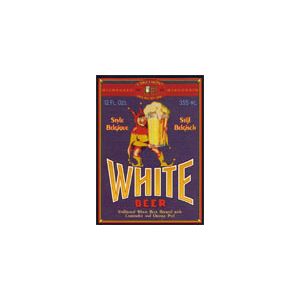
2003 was a great year for LBC: they took home no fewer than 5 medals from the World Beer Championship, including a Silver for this one. Expect yeasty aromas with style-standard cloves, coriander, and orange. Goes down with a hearty graininess and hoppy bitterness rather than the sour, tart quality often associated with this style. The tartness is there, but it plays second fiddle to the grainy astringency and hop bitterness. We liked this unique trait because it gives this wit some girth and makes it bolder than many traditional styles, making a nice “winter wit” out of a style often served in hot weather. The bitterness fades over a nice arc where all flavors converge, leaving orange peel and coriander spice to linger in the finish. The brewery recommends pairing with Belgian moules frites (steamed, buttered mussels and French fries) or charcuterie.
Serving Temperature: 45-50° F
Int'l Bittering Units: 9.5
Alcohol by Volume: 4.3%
Suggested Glassware: Pint Glass or Mug (clear)
Malts: 2-Row Pale, Pale Wheat, Wheat Flakes, Oat Flakes
Hops: Glacier, Sterling
This beer was a Silver medal winner at the 2003 World Beer Championship. Expect rich bagel dough notes with a touch of rye-like spiciness and fresh, roasted barley. Look for coffee notes throughout, blossoming as it warms, all wrapped in chocolate and faint hints of raisins. Packed with flavor, yet it has the smoothness and drinkability characteristic of this lager style. Gentle spiciness mingles with chocolate, prune, and medium-roast coffee bean notes, segueing to a creamy, rich middle, all grounded by late-breaking flourishes of lemon-peel bitterness and espresso. The finish is quite notable; bitter up front, running to slightly sweet, smooth and mellow, with the bitterness returning very prominently at the end. Dark fleshy fruits round out the fade. This is a great beer to have with spiced gravy beef tips or lamb kebobs, or paired with a medium-bodied cigar (Shameless Plug Alert! Visit www.monthlyclubs.com for information about our Premium Cigar of the Month Club.)
Serving Temperature: 48-50° FInt'l Bittering Units: 11.7
Alcohol by Volume: 5.5%
Suggested Glassware: Pilsner Glass or Mug (opaque)
Malts: 2-Row Pale, Munich, Caramunich, Chocolate, Carafa (de-husk)
Hops: Mt. Hood
Big City Brewing Company Ltd.—Kingston, Jamaica (Eastern South Coast of Jamaica)
You’ve probably heard of or even tried the Jamaican beer “Red Stripe.” This champagne-like brew is actually easy drinking and quite refreshing, with the flavor profile something you’d expect could do the trick as a Caribbean refresher. But, interestingly, many island nations, including those in the Caribbean, have a high incidence of bigger alcohol stouts in their range of available beers.
Consider the tropical climate of Jamaica and you might wonder why someone would reach for a thick, hearty, high alcohol stout to quench their thirst. How is that refreshing? Well, perhaps it’s not the best beverage to grab when trying to rehydrate after a hot day’s work under the sun, but stronger brews are not uncommon in this part of the world, where many islanders have traditionally been rum drinkers. And, as it turns out, the maltier, sweeter flavors found in these tropical stouts make them more quenching than their dry stout counterparts from Europe and the U.S. Perhaps no where else is the beer myth that “darker means stronger” less myth than fact than in the Caribbean.
It certainly holds true at The Big City Brewing Company in Kingston, Jamaica. We admire their founding principle: to produce a beer that consists only of local produce. In 1994 they set out with this goal in mind; and, by 1999, they graduated to the “big city leagues” by purchasing their full-scale brewery and equipment. Using state-of-the-art hardware from Germany, Italy and the U.S., along with a dedicated staff, they now have three successful, authentically Jamaican brands available.
While foreign breweries have had a presence on the island for over 100 years, The Big City Brewing Company currently stands proud as the only brewery in Jamaica owned and operated by Jamaicans.
For more information about the brewery, visit their website at www.bigcitybrewing.com.
As a fan of better beer, you may know the history behind the birth of India Pale Ale (IPA), a style that evolved as a more highly hopped, higher alcohol by volume (ABV) Pale Ale that would survive the long sea voyage from England to the British colonies in India. So, what do England, India, and IPAs have to do with a review of a stout from Jamaica? Well, the evolution of IPA has some similarities with this beer’s stylistic subcategory: “tropical stout.” Stout is not a single, uniform style of beer. There are multiple substyles, with most folks being familiar with the version of Guinness you find at your local pub, an Irish Dry Stout (there are multiple versions of Guinness in fact, spanning nearly all the stout substyles). In order for stout to survive the long, warm journey to various tropical and other export locales, a bigger-bodied, roastier, higher ABV version evolved. Jamaica has held on to the tradition of brewing stout in this style, known as Foreign or Export Stout, with versions made for, or in, tropical locales known as Tropical Stouts. Tropical versions can be quite sweet without much roast character or drying bitterness, while export versions tend to be moderately dry (like a scaled-up version of Irish dry stout). Big City’s Jamaica Stout is a tropical stout; expect fruity esters, with prunes, raisins, and black cherries along with some coffee-like roastiness notes on the nose. The beer goes down with much of the same flavors as those hinted at in the aroma, with plenty of chocolate and coffee, flashes of black licorice, and dark rum with a nice warming sensation from the alcohol. We suggest enjoying as an aperitif, or pairing with chocolate rum cake.
Serving Temperature: 50-55°F
Alcohol by Volume: 8.0%
Suggested Glassware: Pint Glass or Snifter
Belhaven Brewery Company Ltd.—Dunbar, Scotland (Southeastern Coast of Scotland)
The Belhaven Brewery Company Ltd. is the oldest surviving brewery in Scotland, and one of the oldest in all of the U.K. Its roots as a commercial brewery go back to 1719, but most historians accept that a brewery has existed on the site since at least the Middle Ages. The two wells and some of the cellars contained within the brewery date from at least the 15th century, and credible evidence indicates that the wells were dug by Benedictine monks in 1415.
The Benedictine, or "blessed," order was blessed indeed in the art of ale brewing, though it seems their sacred brewing gifts were earned rather than ordained. The brothers worked at the Belhaven site for several hundred years, cultivating the land, planting crops, and digging wells. So notable were their efforts, and enduring their presence, that the land on which the Belhaven Brewery now stands became known as “Monk's Croft.”
By the 16th century, brewing had been firmly established at the brewery site; records document that Belhaven ale was supplied to the Franco-Scottish army, which was bent on invading England in the 1550s and which, at that time, was garrisoned at nearby Dunbar Castle. By the early 18th century, the Brewery had come into the ownership of Mr. John Johnstone, an event commemorated by the carving of the date 1719 into a support beam still present in the brewery. A single family then owned the brewery for more than 250 years, firmly securing the styles and recipes of this famed brewers' (bel)haven.
If you'd like more information about the Belhaven Brewery Company Ltd., check out www.belhaven.co.uk.
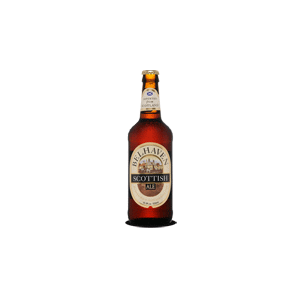
Similar to the situation described for “stout” having many substyles, “Scottish Ale” has various subcategories. Belhaven Scottish Ale is one of the benchmarks of the “80 Shilling” or “export” version. These subcategories were initially identified based on price (in shillings, represented as “/-“), which was directly correlated to gravity (% sugars) and percent alcohol. The shilling scale ran in increments of ten, starting at 60/- (light), followed by 70/- (heavy), and 80/- (export) and then from 90/- to 160/- for much heavier “Scotch Ales.” FYI: beers in the 60 to 80/- range are distinguished from “Scotch Ales” (90 to 160/- range) by the arcane term “Scottish Ales.” Confused yet? Don’t worry; it’s one of the murkier stylistic distinctions in the roughly 100 styles and substyles of beers out there. In general, traditional Scottish ales have leaned more toward sweeter, maltier flavor profiles than their dry, hoppy, British ale counterparts. The reason behind this is rooted in the fact that Scotland is home to abundant sources of barley but is quite distant from the principal European hop-growing regions. Scottish ales also tend toward darker malts than English versions. Belhaven Scottish Ale is certainly maltier than hoppy. On the nose, expect a subtle mustiness and slightly peppery hop aroma, both offsetting the honeyish, caramel malts, with an ever-so-slight note of anise. This medium-bodied beer has a smoky, gently peppery flavor that balances the firm malt backbone. Look for the caramel, honey-like sweet malts to become less bashful as the beer warms, and an exceptionally clean finish. Some pairing suggestions: lamb chops with gravy, flame-grilled chicken and veggie skewers (a little bit of char on these will really marry the smoky elements in the beer), or a well-done, pepper-seasoned London Broil.
Serving Temperature: 45-50°F
Alcohol by Volume: 5.2%
Suggested Glassware: Pint Glass
| Translation: | Schelde Brewery (The Schelde is a major river that runs through the Southern Netherlands, Belgium and Northern France) |
| County: | The Netherlands |
| City: | Hoogstraten (the beer label may state ‘sGravenpolder, they recently relocated the brewing site) |
| Regional Locale: | Southern Central Netherlands in the borderlands between Holland and Belgium, literally feet from the border. |
| Official Language: | Dutch |
| How To Say Beer There: | Bier (pronounced: BEE-yehr) |
| Continent: | Europe |
The Netherlands has an ancestral and geographical tie to Belgium, so it’s not surprising that beer culture is a normal part of life in both countries. The Belgians are better known for their culture of brewing creativity, whereas the beer most typically associated with The Netherlands is Heineken. But don’t let that negatively influence you. What if the U.S. beer scene was judged entirely by our major brands? You wouldn’t think much of what the country has to offer—and, yet, the U.S. currently has the most kinetic and vibrant brewing scene the world over. And, while Flemish style or Sour Red ales, which use wild yeast and are high in acidity, are becoming massively popular in the U.S. better beer scene, we owe this style to not only Belgium, but The Netherlands, as it is native to both. The Netherlands is also home to one of only seven abbey breweries in the world that brews the Trappist Trippel style of beer. So, a rich brewing heritage pervades this nation; and we’ve selected a hard-to-find beer from a tiny Netherlands microbrewery, De Scheldebrouwerij. A relatively young brewery, they were founded in 1994, but they are staunchly old-fashioned in their brewing methods. Still, they have a youthful wit when it comes to incorporating wordplay in naming their beers (for more on this, check out the review below), calling attention to their unique brand of beers brewed according to their own liking—and, we expect, to yours. Gezondheid!
For more information about the brewery, check out their website at www.hansjedrinker.com.
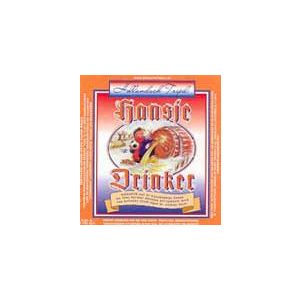
“A Taste of Dutch courage” claims the label. Drink enough of it and you may feel you can take on the world. The label depicts what the name plays on, the famous Hansje Brinker, the heroic Dutch boy who put his finger in the dike to hold back the floodwaters. Hansje Drinker, on the other hand, has his finger poorly holding back the flow from a barrel tipped on its side, and a full tulip full of beer. The beer is flowing right into the snow… (this is one instance where it would be okay to eat the yellow snow!) He’s seen, appropriately, next to his skates, a reference to the book that made this fictional character famous in 1865, The Silver Skates, by American writer Mary Mapes Dodge. In this tale, a father’s ill health is restored by the good deeds of his children. Hansje Drinker, on the other hand, appears to be a bit mischievous, sitting on thin, cracking ice, getting loaded. Ah, hell, we’ve all got a dark side… There’s a lot of yeast left in the bottles of this beer, which permits a natural carbonation in the bottle and makes this a “living beer.” While there’s nothing wrong with consuming it, for aesthetic purposes in this beer’s style, we recommend pouring gently and leaving the yeast behind in the bottle, which will allow the beer to pour a relatively clear, deep amber-straw color. The nose presents alcohol and notes of raw honey, cherries, mango chutney, and a spicy profile featuring prominent coriander, with some cardamom, allspice, and black pepper. Look for fruity notes, like apricot, kiwi, and other tropical fruits, along with blonde tobacco as it warms. Despite the alcohol on the sniff, it goes down with less alcohol taste than implied by nose. It spikes early with a bitter bite that almost instantly fades to permit a flood of sweeter elements. Not at all cloying, the beer has sweet notes found in a melange of all fruits mentioned above, with some honey-malt notes and caramel developing amidst the fruit and yeasty phenolics. Expect it to finish with a gentle sour note and caramel-and-fruit fade with a note similar to date nuts, with a final flourish of green apple skins. At full warmth, this is a fruit and spice bomb, with pepper becoming quite prominent. This style of beer is rarely recommended with chocolate, but we found that it was a true treat when paired with dark chocolate (60% cacao or greater.) We offer a Chocolate of the Month Club that features a wide range of decadent chocolate treats of all sorts. Check out www.monthlyclubs.com for more information. As a beer connoisseur (or burgeoning one), you may have heard about how wonderfully the right pairing of beer and chocolate can be. It’s true! Consider getting a dual membership to both clubs so you can enjoy this exciting partnership, or get a chocolate club membership for someone you know you loves the stuff (then invite them over to share your beer and their chocolate!)
Serving Temperature: 45-50° F
Alcohol by Volume: 8.0%
Style: Belgian-style Triple Ale
Suggested Glassware: Goblet, Chalice or Tulip
| Translation: | La Choulette Brewery (a ‘choulette’ is the wooden ball used in a European sport, Crosse, popular in the 1800s & described as a cross between golf and field hockey) |
| County: | France |
| City: | Hordain |
| Regional Locale: | Central Northern tip of France, near Lille (about 100 miles north of Paris) |
| Official Language: | French |
| How To Say Beer There: | Bière (pronounced: b’yaire) |
| Continent: | Europe |
Bière de Garde (meaning “beer for keeping”) is the indigenous beer style of France. Similar to Belgium’s Saison style, it, too, is a farmhouse ale. Developed in the northern corner of France, near the Belgian border, it was brewed in early spring and kept for drinking in the warmer summer months. Bière de Garde is most often likened to Saison, but indeed there are differences, with the former typically more malt-focused, less spicy, less tart, and often possessing more of a cellar-like mustiness than the wild “horse blanket” character often found in the latter. There are a few artisanal brewers who still brew the style, though it was in danger of complete extinction some years ago. At the dawn of the 20th century, there were nearly 250 breweries making Bière de Garde, but the crushing popularity of lager beers effectively led to an almost whole-scale demise of the farm country brewery style. One very small brewery that has survived (there are fewer than two dozen that remain today) is Brasserie La Choulette, located in Hordain, France. Their beers are critically acclaimed, but what’s a bunch of accolades these days—seriously, if Britney Spears can win a Grammy, what’s that say about awards? Fortunately, these folks actually have talent, truly deserving the high praise earned by their beers.
The brewery dates from 1885, having been in the hands of the current owners, Alain Dhaussy and his wife, Martine, since 1977. Yes, lager beer lust effectively shut it down. Though Alain had studied pharmacy, his grandfather was a brewer and his son a beer wholesaler. It seemed natural to embrace the family tradition and become a brewer himself. An amateur historian, he ultimately brought the brewery back to its roots by returning to the tradition of brewing Bière de Garde, and has since been recognized internationally as producing some of the world’s finest examples of this traditional French farmhouse style. The La Choulette beer we’ve selected for you is a Bière de Garde with a twist (check out the beer review below for more details). Enjoy!
For more information about the brewery, check out their website at www.lachoulette.com.
Framboise (pronounced: fram-bwahz) is French for raspberries and is typically associated with “lambic,” a style of beer that is traditionally made in the southwest of Brussels, Belgium, where ambient airborne yeast spontaneously ferment the beer in open, lidless vats (no yeast is added by the brewer; the beer is left in an attic space, vents to let in outside air are opened, and fans are turned on—and nature takes its course). This region of Belgium is one of very few in the world where this natural, wild yeast inoculation is possible. La Choulette Framboise is not a lambic; it’s a Bière de Garde, France’s only indigenous style of beer, with raspberries added. The result is a less tart, but still fruity, beer that delivers the spiciness and drinkability of the Bière de Garde style, with the aroma of fresh-picked fruit. This amber colored beer pours a pink hue with a white, tight-laced head of a slightly pinkish hue. Not surprisingly, it smells like fresh, unwashed berries, complete with the woody notes you get in the stems and pistil remnants (the small hairlike protrusions in the fruit) of fresh-picked raspberries. Look for a slight cranberry note, as well, with a clean malt sweetness. Alcohol is absent from the bouquet, which is surprising given that this is one-and-a-half times the strength of most commercial Belgian framboise beers. By comparison with most commercial lambic-based framboise beers, it’s far more subtle and dramatically less sweet, and has very little tart (acidity) character. Expect the berry flavors to taste ripe and very natural—no artificial extracts here! Instead of whacking you over the skull with raspberry notes and cloyingly sweet character, this beer tastes as though it’s bathed in raspberries rather than saturated with them. As it warms, a faint chocolate note is detected, giving this beer a great dessert quality. Finishes approachably dry rather than overtly tart, with a raspberry and biscuit fade and faint wood and iron notes. More an experience of “fruit in your beer” than a “fruit beer.” Rated “Exceptional” during the 2003 World Beer Championships in Chicago. Whereas more tart examples work nicely with bitter, dark chocolates, this one works quite well with milk chocolate, particularly something with raisins, blueberries, and/or cranberries. Want to elevate a “Chunky” bar to something of gourmet caliber? Pair it with this beer. Or enjoy with a sweet crepe loaded with blueberries.
Serving Temperature: 40-45°F
Alcohol by Volume: 6.0%
Style: Bière de Garde with Raspberries added
Suggested Glassware: Flute or Small Tulip