Past Newsletters - Apr 2009
DOM = Domestic Beer Club; INT = International Beer Club; VAR = Domestic International Variety Beer Club; RB = Rare Beer Club
Charlie Otto was a well-respected area homebrewer when demand for his hand-crafted beers quickly grew to the point where he began thinking about starting his own commercial enterprise. But because Wyoming did not issue licenses to homebrewers, Charlie had to challenge the law. Through an ambitious effort, he ultimately helped get a bill passed which would allow him to start selling his beer commercially. In 1988, he secured the first malt beverage manufacturer’s permit issued in the state in over 35 years. Along with his brother Ernie, the pair founded the Otto Brothers' Brewing Company, officially the first modern microbrewery in Wyoming.
So, have you ever been to a local brewery or brewpub and had a “growler” filled with beer to take home? Thank these guys for that experience. In 1989 they rediscovered a long-forgotten container, a European, lidded tin pail originally used to transport beer from the tavern at which it was purchased. The Otto Brothers' Brewing Company reintroduced it in a modern, 64-ounce glass jug version.
These trailblazers then took on the law again to bring about the legalization of brewpubs in the Cowboy State in 1992, opening Wyoming's first brewpub. It brought a surge in popularity to the Otto Brothers' beer lineup, leading the brothers Otto to build their current brewery at the base of Teton Pass in Victor, Idaho, in 1998. The move prompted renaming it the Grand Teton Brewing Company. The site was chosen for its proximity to locally-grown barleys and Northwestern hops, as well as nearby Teton Glacier water.
Given the natural beauty of the region, it makes sense that the brewery went “green” in 2005; everything from the heat that fires their brew kettles, to their hot water, to their building heat comes from use of biodiesel. They’ve kept with their vision of creating beers as majestic and beautiful as the National Parks that they celebrate. Seriously, these are magnificently crafted beers; we just love everything that this brewery does.
For more information about the brewery or scheduled tours, call 888-899-1656, or visit their website at www.GrandTetonBrewing.com.
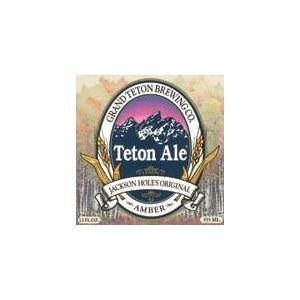
Happy birthday, Teton Ale. This year you’re 20, nearly old enough to drink! This beer was launched as Grand Teton B.C.’s original flagship brew. At the tender age of 19, this beer had already won 3 medals from the North American Association of Brewers, including a Silver in 2008. Expect big, robust aromas of candied citrus peel, grapefruit, resinous hoppy spice notes, big caramel notes, a tingling hop character in the nostrils, and notes of candied apple as the beer warms. On the palate, look for ample notes of red apple skins, toasted biscuit, and pine & grapefruit zest, with a limey, pine-like character toward the finish. This beer wraps up moderately bitter with citrus resins and apple flavors in the fade. Another true classic American ale from Grand Teton B.C. We suggest pairing with a Spicy Ethiopian dish like Doro Tibs smothered in spicy awaze sauce.
Serving Temperature: 45-50° F
Int'l Bittering Units: 24
Alcohol by Volume: 4.98%
Suggested Glassware: Pint Glass
Malts: Idaho 2-Row Pale, German Vienna, CaraAmber
Hops: UK Goldings, Willamette, Cascade
Like its namesake, this reliable brew does the trick every time. And get this: it’s actually featured at Yellowstone National Park, where it is the park’s top-selling beer. On the nose, expect sweetbread, honey, delicate citrus notes, a slight hoppy spiciness, grassiness, and malt balls (think Whoppers). Expect the flavor profile to begin tame, letting the beer go down easy, then blossoming just after the swallow into notes of sweet malt and honey, rounded out by a mild bitterness and echoes of fresh grain. You know, it’s easy to take a beer like this for granted, with its old-school microbrewed flavor and easygoing nature. But think about when you were stepping away from macro light lagers. What if the likes of this beer crossed your lips? You’d be floored. The truth is, there are still many people who have yet to experience that type of revolution in taste, and this beer is one that would work great as an “intro-to-flavor” beer, yet it holds its own with established craft-beer lovers with its complex yet easy drinking character. This is a good yardwork brew, so get out there and tend them weeds; you know it’s time!
Serving Temperature: 40-45° F
Int’l Bittering Units: 23
Alcohol by Volume: 4.94%
Suggested Glassware: Pint Glass or Mug
Malts: Idaho 2-Row Pale, German Vienna, Caramel
Hops: UK Goldings, Willamette, Cascade
The Cape Ann Brewing Company got its start quite literally as a detour. Founder Jeremy Goldberg had been working as a bond broker on Wall Street, but after witnessing the tragic events of 9/11, he began to rethink where his life was headed, concluding that life was too short. So, what to do to experience life to the fullest? Why, join his friends making a documentary about craft beer in the United States, what else? The film, American Beer, chronicles the adventures and the many beers of America experienced by the team as they “road trip” their way from New York City out across the nation, visiting 38 breweries in 40 days.*
Not surprisingly, after an adventure like that—what with interviewing American brewing entrepreneurs and experiencing some of the world’s best beers at the source—Jeremy knew that his future lay in beer. Within six months of the trip, along with his brother-in-law Michael Beaton and father Michael Goldberg, plans for the Cape Ann Brewing Company were being hatched. Founded in Gloucester, Massachusetts, home of America’s oldest seaport, their beer lineup pays homage to the town’s entrenched fishing heritage.
In May of 2004, Cape Ann Brewing Company released their flagship beer, Fisherman’s Brew, an American Amber Lager. Kudos to them for launching a craft brewery with a lager—not a traditional move, given the extra refrigeration and storage costs association with making lager beer. These days they have three year-round beers and a fresh catch of seasonal goodies, with a portion of sales donated to the Northeast Seafood Coalition, a non-profit organization dedicated to working with government regulation and environmental concerns to preserve the long-term health of the fishery resources, fishing communities and the fishing industry.
For more information about Cape Ann Brewing Company, call 866-BEER-MEN or check out their web site at www.CapeAnnBrewing.com. Or drop anchor and hang with ‘em at their brand new brewhouse located at 27 Commercial Street in Gloucester, MA.
*To check out a trailer for American Beer (definitely entertaining for beer lovers), or to order yourself a copy, visit: http://www.sixhundred.com/films/american_beer/
As any good fisherman’s tale reveals, it’s what lurks beneath the surface that you have to look out for. For an IPA, the hop aromas on this beer don’t quite explode out of the glass. Instead, they remain calm and serene, though you certainly can pick up some hop resins with citrus character dominating. As the beer warms, the current rouses notes of pine needles, brown sugar, and hints of spruce. But how quickly the tide can turn from calm to tumultuous. This beer lets you know immediately upon the swallow that there’s more going on that would be offered up by the nose. There’s a higher viscosity than expected, giving a rich, mouth-filling character. Look for notes of gingerbread, saltines, leafy, woody hops, and notes of honey-glazed biscuits, all swept away by a squall of bitterness. Sticky hop resins drop anchor in the throat and don’t let go. A complex brew, the relative calm of the aroma masks a turbulence beneath the surface—but enjoy the ride as this hoppy brew doesn’t overwhelm, lending itself to being rather sessionable for the hopheads out there. Try it with an Italian sub loaded with sweet and spicy peppers.
Int’l Bittering Units: 64
Alcohol by Volume: 6.0%
Suggested Glassware: Pint Glass
Malts: Crisp Pale, Crisp Crystal, Briess Carapils
Hops: Chinook, Sorachi Ace
Gold Medal winner at the 2007 Great International Beer Festival. There are a lot of US beers popping up with the word “Kölsch” slapped on the label. Strictly speaking, only beers brewed in Cologne, Germany can truly be called Kölsch. It’s a very specific style and a regionally protected designation. Many of the domestic interpretations of the style blend “American” characteristics like high hopping rates with a light, easy-drinking ale. Traditional Kölsch is a sort of hybrid beer blending ale- and lager-like qualities. It should have a light character, with hints of fruit (like an ale), often similar to green grapes, and an overall cleanliness in the finish (similar to a pale lager). Cape Ann’s Fisherman’s Ale fits into what we’d call “American-style Kölsch.” Look for soft malty notes, honey, and a touch of apple on the nose with some lemony hop notes. On the palate, expect a rye-like spice note with a sturdier bitterness than is typical of the style. Note a faint, German-style mustiness evocative of a Bavarian Pilsner. There’s a nice balance of malt and hops, with sweet caramel and bitter-citrus hop notes. A fine and truly refreshing session ale. Try with wedges of Manchego cheese melted over thin slices of sourdough bread.
Serving Temperature: 40-45° FInt'l Bittering Units: 24
Alcohol by Volume: 5.0%
Suggested Glassware: Stange
Malts: Crisp Pale, Durst Munich
Hops: Nugget, Czech Saaz
Cervejaria Sudbrack Ltda. (Sudbrack Brewery Ltd.)—Blumenau, Santa Catarina, Brazil (Southeastern Brazil)
Thanks to the microbrew renaissance of the 80s and 90s, Americans have literally thousands of choices for beer. For "real beer" fans, life, as they say, is good. The craft brewer spirit has spread outward from the US, too, which is not to say we created it; craft brewers have been at it in parts of Europe since at least the 11th century. But some efforts in the US have actually led to the resurrection of styles of beer that were nearly lost to history (porter is one example that comes to mind).
There's a definite contagiousness surrounding the enjoyment of microbrewed beer. In fact, it's not limited to the US; it's spreading throughout the continent. But what about our southerly neighbors? Well, truth be told, the craze has yet to really take hold. While there are some true brew craftspeople in South America, pallid pilsner beers (mainly cheap, adjunct versions) are king. Hey, let's not kid ourselves; the same is (sadly) true in the states – and worldwide, for that matter. But thanks to a handful of truly dedicated brewers, better beer is getting noticed down there. The folks at Cervejaria Sudbrack have been brewing quality ales and lagers in accordance with traditions of European masters. Their true-to-style beers so closely emulate the best British, Belgian, and German beers, that in a blind taste test, you'd be shocked to discover they came out of Brazil. But, interestingly, the region of Blumenau, in which they make their home, is no stranger to European tradition.
Beginning with the Portuguese Azors, who colonized the land many centuries ago, European traditions were brought to this region of South America. These early settlers certainly left their mark (the national language of Brazil remains Portuguese). Immigrants from the heartland of beer culture, Germany, also took up residence here in the 1800s, when they colonized the region. They, too, left their mark. Blumenau, in the province of Santa Catarina, Brazil, where the Sudbrack brewery is located, is home to the world's second largest Oktoberfest outside of Munich.
Despite the beer-loving roots firmly planted here some 200 years ago, local craft-brewed beer has been difficult to find. As Cervejaria Sudbrack cofounder Juliano Mendes puts it, “[Brazil is] twenty-five years behind where the United States is today. The US has already created a relatively large group of interested and educated consumers of craft beer. In Brazil, we are only at the beginning of the ‘craft beer revolution’ and we have a lot of work in front of us in order to create this type of ‘craft beer culture’.” To hammer home the point, consider this: today, craft brewers in Brazil hold about 0.05% of the market (the figure hovers just above 4% in the US, an 8-fold difference).
While studying in Boston, and taking inspiration from the craft brewed beers made by The Boston Beer Company (Samuel Adams), Juliano and his brother decided that they'd return to Brazil and start a brewery. In 2002, Juliano, his brother, father, and a fellow associate founded Cervejaria Sudbrack. Aided in no small part by a brewing engineer who was educated in Berlin and their brewmaster, who studied at the legendary Brauerei Weihenstephan, the brewery has developed full-bodied, world-class brews that are quickly garnering critical acclaim. We were floored by how well made their beers are, not to mention how true to style their Belgian- and German-inspired beers are.
Interestingly, the brewery has its own theme song, which you can listen to at: www.eisenbahn.com.br/mp3/01_Hino_Eisenbahn.mp3. We spent hours trying to figure out a way to get the tune to play as you opened your monthly shipment, but we couldn't get our finance department to share our enthusiasm. So, pop open one of these beers, pour into the appropriate glassware, load up that theme song and crank up those computer speakers!
For more information about the brewery, visit www.eisenbahn.com.br.
Vigorosa is brewed in the Weizenbock style, a type of dark beer brewed with wheat (aka dunkelweizen) but brewed with heftier amounts of wheat and malted barley and, therefore, landing at a higher alcoholic strength than your typical dark wheat beer. Expect it to pour the darkest possible shade of amber, blissfully murky due to suspended wheat and yeast, with a luscious, finely-bubbled, fluffy, off-white head. On the nose look for a boom of clove-like phenolic notes and some roasty edginess. Right on the money for a Bavarian-style weizenbock: sweet, yeasty, and musty. On the palate, there are some light smoky notes, with hints of roastiness that help to offset the massive sweetness. Balance is also imparted by ample hop content that mellows out the sweet notes. Cloves are the most prominent component of the flavor, but there’s also a citrusy note (orange), and overripened bananas. Look for a spicy edge, from what must have been a very active yeast strain (makes sense; vigorosa does mean vigorous in Portuguese). Once fully warmed, expect a blossoming of caramel. The beer finishes with a nice belly-warming sensation, moderate bitterness and clovey finish, with the slightest touch of champagne flavor and feel (from the high carbonation). This one’s a sipper we prefer consuming on its own.
Serving Temperature: 45-50°F
Alcohol by Volume: 8.0%
Suggested Glassware: Flute Glass, Weizen Glass
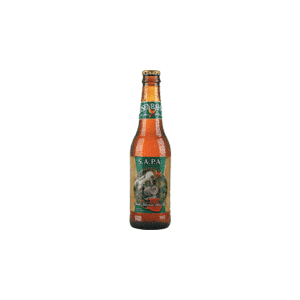
A South American beer brewed in strict accordance with the 1516 German Reinheitsgebot (an ancient beer purity law?). It would seem so, but this sucker tastes more Belgian than German. S.A.P.A. stands for South American Pale Ale, which is an interesting title considering the fact that this is actually a Belgian-style Pale Ale. The word Eisenbahn is German for railroad, and the original Brazilian labels for the Eisenbahn beers depict classic train engine cars. The new US labels embody the South American spirit, capturing an animated train car cutting through a vibrantly colored landscape of dense forest as it trail-blazes its way out of South American (en route to the US beer market no doubt).
If you’re expecting a classic Pale Ale, you’re in for a shock. We didn’t know what to expect when we popped these babies open for review. Here’s an excerpt from one of our beer panel reviewer’s notes: “Absolutely unexpected Belgian yeastiness strikes me instantly. This pale ale smells like a witbier or fruity hefeweizen with its big bubble gum notes and suggestions of candied banana bread. A major departure from the US and English Pale Ale style, and distinctly Belgian.” Expect Belgian yeast flavors (banana, cloves) as well some horse blanket notes, similar to a farmhouse ale (also known as “Saison”). The finish is a mix of sweetness, cereal graininess, smokiness and yeastiness.
Try this one with a Greek or Mediterranean salad loaded with Feta cheese and olives.
Serving Temperature: 45-50°F
Alcohol by Volume: 4.8%
Suggested Glassware: Tulip or Pint Glass
Saint Somewhere Brewing Company—Tarpon Springs, Florida, USA (Western coast of Central Florida)
And now, ladies and gentlemen, we’re proud to introduce the first US brewery to be featured in our Collector’s Beer Club: the Saint Somewhere Brewing Company of Tarpon Springs, Florida.
There are certain “good beer hot spots” in the country, where craft brewing is at the forefront of the local brewing culture and people are taking notice. Florida is not one of them. But perhaps that is changing with the likes of Saint Somewhere setting up shop and creating the insanely good beers they’ve been crafting. Their focus is traditionally brewed, small batch, handcrafted Belgian-style ales. And small they are: last year they sold about 140 barrels of beer. That’s just about 4,400 gallons of beer. To put that into perspective, many people use well over that volume in their monthly household water consumption.
Founder and owner Bob Sylvester got his brewing start in 2001 on one of those “Mr. Beer” homebrew kits that you may have seen at Bed, Bath & Beyond. Now, if you can make good beer on one of those “systems,” the good Lord may just be telling you that you’ve got talent. Spurred on by his early homebrew efforts, Bob joined a homebrewing club near his home in the Tampa Bay area and honed his skills. Entering one of his beers (a tough-to-homebrew Flemish-style Red Ale) into the Best Florida Beer Competition, he beat out over 300 Florida homebrews, by winning the category and taking home Best of Show!
A mere five years after that first Mr. Beer brew, Bob went pro, leaving behind an over twenty-year history working retail in men’s clothing, and starting the Saint Somewhere Brewing Company. He wanted the company to be very Florida-centric but to brew beers that fit into a Belgian-style sort of style spectrum. The name “Saint Somewhere” comes from a lyric in a Jimmy Buffett song called boat drinks:
“Lately, newspaper mentioned cheap fare… I gotta fly to saint somewhere…”
It’s a clever reference not only to the beach and island lifestyle that comes with Floridian life, but the “Saint” reference marries that to the famous Abbey-style ales of Belgium. In fact, the label imagery on every bottle of the Saint Somewhere beers was taken from a sort of “Florida tourism brochure” printed in the early 20th century, evoking images of tropical paradise, fairies and the land of milk and honey.
As the sole employee of the company, Bob has complete creative control and LOTS of work; the man makes his own candi sugar for goodness sake (a key ingredient used in brewing numerous Belgian ales). His brewery is a straightforward assemblage of used dairy equipment. Improvisation, baby! There is nothing electronic in his brewing apparatus; everything is done manually. This is basically a scaled-up homebrew system that uses open fermentation, where the beer is left to ferment in unclosed containers, permitting some ambient, wild yeast to take root, and letting Bob visually check the fermentation at every stage. It’s a traditional Belgian technique, as Bob is very fond of authenticity in his approach, even paying more to import only Belgian malts (the same ones used for nearly all Trappist breweries) and European whole leaf hops. And he even adds Brettanomyces (basically “wild yeast”) while bottling his beers, giving a slight funky character that nicely dries out the beers, and naturally conditions (carbonates and matures) the beer while it sits in the bottle waiting for the lucky sipper to embark on their own journey to St. Somewhere.
Their website is under construction (www.SaintSomewhereBrewing.com), but they do have a presence on Myspace that they update regularly, so go make friends with them there: www.myspace.com/saintsomewherebrewing. And if you’re in their area, near Tampa Bay, you may be asked (via Myspace) to help Bob bottle any of his current lineup of three beers—he often is in need of volunteers, and will give you free beer for your trouble!
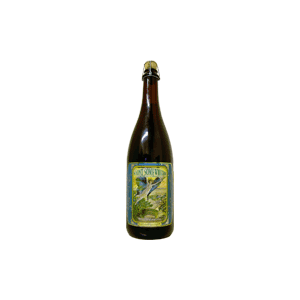
Lectio Divina translates to “Divine Reading,” and you can read the back bottle label for more on what’s meant by the name. This particular tome offers up an eloquent, everlasting beige head sitting atop a cloudy, caramel-amber. The nose is heavenly—and it’s just insane that this beer was made domestically as it’s got such a characteristically Belgian-nose. Look for lambic-like tart fruit notes, with an almost vinous acidity apparent in the scent. Expect notes of dark cherries, tangerines, bubble gum, caramel, and suggestions of cantaloupe amidst flutters of yeast and hops spiciness. There is a gentle funkiness (think horse blanket) on the nose that comes from open fermentation and the use of Brettanomyces during bottle conditioning. Probably the closest-to-traditional-lambic nose we’ve ever encountered on a non-Belgian brew. The sheer complexity on the nose foreshadows that there will be unexpected twists as the story unfolds. As it warms, deep currents of caramel emerge, and a bit of heat from the alcohol can be detected. The beer goes down with a rich, almost creamy caramel backbone, but oh how the plot thickens. There are notes of fermented raisins, SweetTarts candy, ripened-to-the-point-of-bruised red apples, nectarines, red grapes, strawberries, Belgian yeastiness, traditional Gueuze sourness, alcohol, and pear skins—so many parallel narratives it’s just plain engrossing. Finishes with a dry spiciness and more reflections of caramel amidst a mildly tart retreat. We have read the word, and it is glorious and divine indeed. There’s so much going on in this beer, we just could not put it down. Our view is that it’s best enjoyed on its own, or with a “Good book.”
Serving Temperature: 50-55° F
Alcohol by Volume: 8.0%
Style: “Dark Saison” meets Bière de Garde meets Gueuze meets Abbey Ale
Suggested Glassware: Wide-Mouthed Stemmed Goblet or Oversized Wine Glass
Brouwerij De Graal (The Grail Brewery)—Brakel, Belgium (The Flemish Ardennes, in Central Western Belgium)
“Purity and Innocence of Spirit Shall Reveal the Glory of the Grail.”
Or, you could just drink any of the beers brewed by our second featured Collectors Beer brewery and get a feel for that glory. Brouwerij De Graal, or “The Grail Brewery” in Dutch, has, like our first featured brewery, obvious religious symbolism behind the name. This is not uncommon for Belgian beers, among whose ranks live many a monastically-brewed Abbey beer. Let’s face it, monks can brew some damned fine beer—and many strive to deliver beer of like quality.
Brouwerij De Graal is a small artisanal brewery located in the Flemish Ardennes (the informal name given to the hilly region in the south of the province of East Flanders). Brewer and owner Wim Saeyens was a homebrewer for years before opening the brewery in 2002. Wim holds a Ph.D. in chemistry and attended the brewing school at the University of Ghent. All credentials aside, the man can brew with the best of them.
A curious peculiarity is that De Graal produces a 40% alcohol beverage, a sort of beer-schnapps, called Bierbrand that is made by the distillation of De Graal beers. The aromatic liquor is distilled twice in order to retain only the alcohol and hop aromas from the original beers, and is then matured in oak Bourbon barrels. Now this is taking beer to its furthest extremes!
And since their opening in 2002, one of De Graal’s specialties has been the production of beers on premises, an arrangement that permits customers to brew their own beer on site, according to their own wishes. This is a great way for customers to create a personalized beer, and is a great outlet for pubs and restaurants that want to sell their own beer but don’t want to bear the capital expense of setting up their own brewery. Another common use is for birthday, anniversary, or wedding celebrations, yielding individualistic beers that make these events truly memorable. Having tasted a handful of the commercial De Graal beers, we’re jealous that people can just waltz on into the place and brew a beer on their system, with the guidance of their masterbrewer. Ah, Belgian beer culture . . . there’s nothing quite like it on Earth. (Though there are a handful of similar “brew on premises” outfits operating in the USA. Check your local listings; you might just have one in your area. In the meantime, we’ll keep sending you some of the world’s best brews.)
For more information about the brewery, check out their website at www.degraal.be.
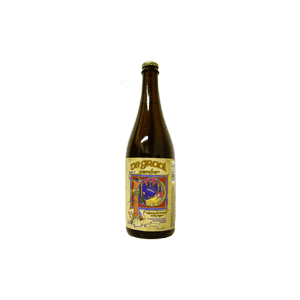
Gember (Dutch for “ginger”) was among brewer/owner Wim Saeyens’ first commercially brewed beers—a bold move to kick off his brewery’s offerings as this is an uncommon style of beer (which is part of why we lined it up for you to check out this month). De Graal Gember is a blond beer spiced with ginger. This spicy root has long been used in beers as a spicing agent and, in some cases, can entirely supplant the use of hops. Its application is not that bold in this beer. Instead, it gives the beer some notes of gentle spice and supplies a drying character in the finish. On the nose, look for notes of chamomile-like tea, lemon, ginger, vanilla, orange-blossom honey, leafy, herbal noble hops, coriander, some clovey-spiciness and a waft of floral elements. On the palate, expect notes of honey, pepper, lime, earthy, minerally hop notes and, of course, ginger. A minor note of lavender peeks through here and there, but ginger spice takes center stage, and helps balance the big malt sweetness. Pair with ginger-spiced chicken thighs served with green and red peppers, pineapple chunks and picante sauce.
Serving Temperature: 45-50° F
Alcohol by Volume: 8.0%
Style: Strong Pale Belgian Ale Spiced with Ginger
Suggested Glassware: Tulip or Snifter