The Microbrewed Beer of the Month Club

Past Newsletters - May 2009

Brewery
Beers Featured
DOM
VAR
INT
RB
Santa Fe Brewing Company State Pen Porter
Check
Check
Penn Brewing Company Penn Kaiser Pilsner
Check
Check
Santa Fe Brewing Company Santa Fe Pale Ale
Check
Lion Brewery (PA) Stegmaier Brewhouse Bock
Check
The Lion Brewery Ceylon (Sri Lanka) Lion Stout
Check
Check
The Lion Brewery Ceylon (Sri Lanka) Lion Imperial Lager
Check
Check
Klein Duimpje Huisbrouwerij (Tom Thumb Home Brewery) (The Netherlands) Erik De Noorman
Check
Microbrasserie Les Trois Mousquetaires (The Three Musketeers Microbrewery) (Canada) Doppelbock
Check

DOM = Domestic Beer Club; INT = International Beer Club; VAR = Domestic International Variety Beer Club; RB = Rare Beer Club

I'm ready toPlace My Order Button

Santa Fe Brewing Company

The history of the Santa Fe Brewing Company dates back to at least 1892, when a brewery was first incorporated under that name. In those days, rapid, reliable transportation of perishable products like beer left a lot to be desired, which meant there were more local breweries (about 4,000 in the U.S. alone) that catered to their own turf. Santa Fe, New Mexico, was no exception. In those days, the variety of beers brewed was tremendous—something similar to the range being produced by today’s microbreweries. Shamefully, Prohibition resulted in the vast majority of American breweries being shut down, laying the groundwork for "the dark ages of beer" that followed when Prohibition was repealed in 1933 (despite that dark ages reference, this was the rise of fizzy, pale-yellow, tasteless beer—and consider this: that figure of 4,000+ American breweries fell to a paltry 80 by 1983!)

In 1988 the modern Santa Fe Brewing Company was established. All of their beers are made from hops shipped directly from the grower in Washington state and specialty malts imported from the U.K., without addition of preservatives (other than hops and alcohol, that is—natural preservatives). And they’re environmentally-focused as well; their delivery trucks run off of vegetable oil, they collect the carbon-dioxide they produce during fermentation to grow algae for bio-fuel, and use 100% recycled material in all of their packaging. As New Mexico's oldest microbrewery, they've had over 20 years to hone their craft-brewed beers. They offer a truly solid lineup of beers and since 2005 have served up tasty grub at the Pub & Grill located next door to the brewery.

For more information about the brewery and their Pub & Grill, check out their web site at www.santafebrewing.com or give them a ring at (505)-424-3333.

State Pen Porter

State Pen PorterIf they served this stuff at the New Mexico State Penitentiary, we’d have more people trying to get locked up. Thankfully, you can get it without first needing a record. The nose presents a porter lover’s dream: richly roasty, raisiny, pruny, with coffee-like notes capped by citrus and apple notes, and a faint whisper of chalk dust. That chalky character is perfectly appropriate in the wide range of possible flavors in porter, and serves to make this an extremely dry beer. Expect roasted malts and coffee on the palate. Definitely running on the drier side, the fruity notes present on the nose are mere suggestions in the flavor profile. As it warms, look for a sizable coffee presence to develop in the finish, and notes of alcohol to peak through in the linger—these would evoke a coffee liquor flavor were it not for the intensely dry character of this porter. Overall this is a fairly complex porter with a lot going on. Temperature plays a big role in the flavor profile of this beer—so experiment with it at different levels of coolness to find your favorite. Pair with barbecued beef brisket. 

Serving Temperature: 45-55° F
Int’l Bittering Units: 35
Alcohol by Volume: 6.4%
Suggested Glassware: Pint Glass
Malts: Chocolate, Carastan, Rahr 2-Row
Hops: Cluster, Cascade, Hallertau

Santa Fe Pale Ale

Santa Fe Pale Ale LabelSanta Fe Pale Ale pours brassy in color with a sedimentary haze provided by a small amount of yeast left in the bottle to naturally condition the beer. It will be capped by a big cappuccino-like frothy head when poured with vigor. On the nose, look for notes of honey and floral qualities, with some citrus notes, leaning toward tropical fruits (think mango), and a fair amount of spicy hop character. Expect a rather nectary flavor, with floral, honeyed notes and a mild-to-moderate bitterness balancing caramel malt flavors. Finishes spicy with a candy orange flavor in the linger, with the faintest suggestion of butterscotch. Overall, very easy to drink and leaning toward a more floral, perfumy hop profile rather than pine-and-citrus-heavy offerings. The hop spiciness will cut nicely through fattier meat dishes such as braised breast of duck—give it a try.

Serving Temperature: 40-45° F
Int'l Bittering Units: 38
Alcohol by Volume: 5.4%
Suggested Glassware: Pint Glass 
Malts: Carastan, Rahr 2-Row, Crystal
Hops: Cluster, Cascade, Willamette, Crystal

Pennsylvania Brewing Company

Tom Pastorius, a Pittsburgh native of German descent, discovered real beer while stationed in Germany, a country that considers its "bier" as much a staple as bread. Once his service days ended, Tom returned to the States. He began longing for good German beer. "Beer tastes better over there," he said. "I just missed the beer…" Interestingly, Tom’s great-great-great-great-great-great-great grandfather, Franz Daniel Pastorius, a friend of William Penn, led the first group of German settlers to America in 1683 and founded Germantown, Pennsylvania. The two dined frequently together, partaking in Penn’s brewery offerings from Pensbury Manor. Ten generations later, the Pastorius family still enjoys fine Pennsylvania-brewed beer.  

Dissatisfied with commercially available beverage choices, and in need of a job, Tom decided to start his own brewery. In 1986, he purchased a nearly 150-year-old abandoned brick and stone brewery for $225,000. A three-year, labor-intensive $4 million restoration followed, and thus, the Pennsylvania Brewing Company was born. Talk about going to great lengths to get great beer! Tom's goal to brew authentic German beers quickly became a reality, and these days he is considered a pioneer in the microbrewery renaissance.

For more information about the brewery and scheduled tours, or their attached restaurant, call (412) 237-9400, or visit their website at www.pennbrew.com.

Penn Kaiser Pilsner

Now, this just in: out of 472 breweries who entered 2,052 brews in 75 beer style categories, Kaiser Pils bested 43 others to win the German-Style Pilsener category at the ’08 Great American Beer Festival. Expect the classic spicy, noble hoppiness and crisp grain notes that one expects from a German-style pilsner. Bready malts, with a hint of toastiness, wash over the palate with notes of grassy hops and a sprightly mouthfeel. Finishes with an earthy, spicy hop fade and faint impressions of citrus. One of the most versatile, food-friendly beer styles available, we threw this at a rich and creamy freshly-prepared clam chowder—the bitterness and spice really cut through this creamy soup (and will do the same for similar soups & sauces).

Serving Temperature: 40-45° F
Int'l Bittering Units: 45
Alcohol by Volume: 4.5%
Suggested Glassware: Pilsner Glass
Malts: 2-Row Pale, Pilsen, Dextrin
Hops: Various Hallertau Varietals, Perle

The Lion Brewery (Wilkes-Barre, PA)

Stegmaier Brewhouse Bock

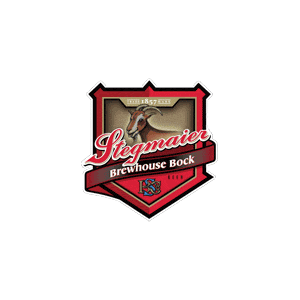
Stegmaier Brewhouse Bock LabelA traditional style bock beer, the Stegmaier Brewhouse Bock pours an attractive crystal clear dark reddish copper color. Carbonation is low to moderate, so we recommend an aggressive pour to build a sufficient head and unlock the traditional bock aromas. Look for an inviting toasty maltiness on the nose with bready, biscuit-like notes and only a hint of hops. Flavor-wise, this beer is all about the malt, which is just what we expect from a well-made bock.  The hops present themselves just enough to balance the malty sweetness, particularly towards the finish, but are restrained in both bitterness and aroma, allowing the toasty malt character to take center stage. Look for caramel and toffee notes on the palate, with a delightful mild finish. We found this medium-bodied bock to be ultra smooth, no doubt owing to the extended lagering time Stegmaier offers it, and it’s super easy to finish one bottle and find yourself picking up yet another one. The malty sweetness makes a good foil for spicy fare like Thai food, or more traditionally, a nice spicy bockwurst.

Serving Temperature: 45-50° F
Alcohol by Volume: 6.2%
Suggested Glassware: Mug, Stein, or Pilsner Glass
Malts: 2-Row Pale, Munich

The Lion Brewery Ceylon (Sri Lanka)

The island nation of Sri Lanka is the home of both of this month’s international beer features. Good beer made its way to this part of the world back when Sri Lanka was known as Ceylon and was colonized by Portuguese, Dutch and British citizens (among others). The British had a particular interest in the local hill country, as it provided an ideal climate in which to plant that most nationally demanded of plants—tea. The Scottish were quite experienced with tea cultivation, and in the 1800s there was no shortage of them living and working in the region. One particular Scotsman, Sir Samuel Backer, lived in the veritable Garden of Eden up in the hill town of Nuara Eliya. In 1849, recognizing the unquenched thirst of his fellow European patriots for their other favorite beverage (ale), he established Sri Lanka's first brewery, the Ceylon Brewery, at the foot of one of Nuwara Eliya's most beautiful waterfalls, known as ‘the Lover's Leap.’

Sir Backer set up the brewery in an effort to bring beer to the local colony dwellers and natives alike, but likely did not envision the tremendous success of the brewery, nor the fact that nearly 100 years after it was founded, his beer would start to find its way back to his homeland, the U.K., as a Sri Lankan export. As the brewery garnered attention from eager investors, financial contributions greatly enhanced and expanded the original brewery enterprise.
After being taken over by Murree Brewery of India in 1884, the present company was founded by Mr. G. W. Lindsay White in 1911. Under his stewardship, the brewery flourished even further, a trend that continues to this day. In order to meet expanding demand, a second brewery, The Lion Brewery Ceylon, was established in Biyagama. A spring flowing from the hills above the brewery supplies their clear, chemical-free water, and malts are obtained from the reputable maltsters in the Czech Republic, Britain and Denmark. Hops are sourced from Slovenia, and they have been using the same high quality British yeast for fermentation for more than 30 years.

If you'd like more information about The Lion Brewery Ceylon, visit www.lionbeer.com.

Lion Stout

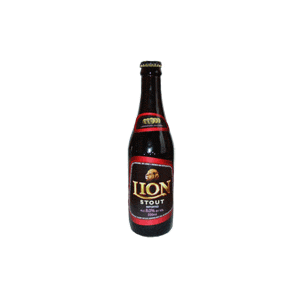
Lion Stout BottleSri Lanka just might be the only country in which every brewery makes a stout. Granted there are only about three brewing companies, but this is still an impressive commentary on the sophistication of regional palates. While Lion Stout is technically designated as a tropical stout, it is a hearty, traditional stout presenting the typically aromatic, chocolaty, coffee- and toffee-accented notes of a bold European or American strong stout. Note the pruny, mocha aromas, with fudge and chocolate cake prominent on the nose, along with toasted marshmallows, figs, chocolate milk, cocoa nibs, molasses and dark wheat bread. Sit with this one for a while. There is so much to take in from the aroma—very complex, with alcohol creeping into the nostrils as it warms, providing a Kahlua-like note. Expect a high viscosity brew with rich, luscious chocolate notes. The beer is extraordinarily rich and chocolaty, finishing only mildly bitter, permitting malty sweetness to dominate. Look for notes of chocolate pudding to develop alongside mocha, raisins, and figs. This is a truly world class beer—a superior example of a tropical stout.

We recommend pairing this beer with anything accented with coconut, such as spicy Thai coconut beef, Sri Lankan curries or creamy coconut desserts accompanied by dark chocolate candy. Don't have any chocolates to accompany your Lion Stout? Well we do—and as a member of our Gourmet Chocolate of the Month Club, you could too. Visit www.monthlyclubs.com for more details about the remarkable boutique chocolates we feature each month, or give us a ring at 800-625-8238 to inquire about membership details—we'd love to hear from you!

Serving Temperature: 45-50°F
Alcohol by Volume: 8.0%
Suggested Glassware: Snifter, Oversized Wine Glass or Pint Glass

Lion Imperial Lager

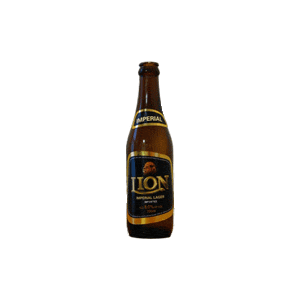
Lion Imperial Lager BottleThis Imperial Lager pours a light-to-medium straw color with a healthy mane of a head that’s rather plentiful for a lager of this ABV (higher alcohol content can kill head retention, especially in lagers). You can expect to take in notes of fresh cut grass, apples and caramel malt sweetness on the nose, with faint impressions of Scotch whisky. This lion’s alcohol content remains docile, but be warned, it will prey on you as it lurks—so be alert! Flavorwise, we have here an amped-up lager that brings full-bodied flavors. Alcohol really doesn’t roar the way you’d think it would at nearly 9%—it’s more of a gentle purr motoring in the background and its sharpness actually serves as a counterbalance to the sweeter notes from the heavy malt character. There are some over-ripened orange, citrus notes, and cereal huskiness in the middle, along with honey, sugar, and an oily slickness in the mouthfeel. Look for it to finish with a gentle hoppy spiciness and a lick of alcohol, presenting a mead-like fade (mead, for those unfamiliar, it a beverage made from fermented honey). Malt liquor is sort of a dirty phrase to us, but it has, nonetheless, evolved into a distinct “style” (with the name forced on us by bureaucratic alcohol enforcement entities to distinguish it from other beers due to higher alcohol content… Because of this, many of the craft-brewed beers you enjoy today are “technically” classified, in the US, as malt liquor, but despite the overreaching technical definition that can be applied to a huge number of beers of various styles, there’s a range of beers that truly fit into what beer aficionados consider to be the stylistic parameters of malt liquor). Lion Imperial Lager is a very nice example—a sexy, refined malt liquor, with more elegant, noble hop notes than your standard US or “European macro” strong lagers. The King of the jungle, if you will, of malt liquors, “Imperial Lager” is a fitting reference.

Serving Temperature: 40-45°F
Alcohol by Volume: 8.5%
Suggested Glassware: Pint Glass, Flute Glass or whatever 40-oz. capacity vessel you can find (yes, it will take a few bottles to fill, and no, we don’t seriously recommend this route).

Klein Duimpje Huisbrouwerij (Tom Thumb Homebrewery)—Hillegom, Netherlands (Northwestern Netherlands)

Klein Duimpje Huisbrouwerij translates to the Tom Thumb Homebrewery. Tom Thumb, for those unfamiliar with the story, was a character said to have been born to a couple in the times of King Arthur. The pair longed for a son, even one no larger than the size of a thumb. Being a sort of genie-in-the-bottle-style trickster, Merlin granted them their wish, casting a spell that would give them their tiny son, Tom.

Clearly, the brewer is making a statement that this is one tiny brewing outfit. That brewer is Erik Bouman, who started his fermentation foray as an amateur winemaker around 1990. Not too long into his amateur winemaking career, he traded grapes for grains, becoming a beer homebrewer in 1994. In early 1997, with just a few years of homebrewing under his belt, he entered a beer to be judged in the “winter beer” style of the 1st Dutch Championship for Amateur Beer Brewers, and won with an early rendition of his homebrewed barleywine, “Erik De Noorman” (the current version of which we’re featuring this month). Shortly after that, he submitted his Porter to be judged at the General Dutch Championship, where beers of all styles compete for best in show. His porter beat out more than 400 other beers to be selected as the Best Beer of the competition. ’97 was a good year for Erik, and no doubt played a big part in his drive to make beer brewing his living.

These days, Erik is selling his homebrewed beer on a larger scale, but that ‘larger scale’ is relative to brewing five gallons at a time in his kitchen. He still brews a lower volume of beer than what probably goes down your drain in a couple months of washing up for work. His beers are truly a handcrafted product—the way all beers used to be made. We’re looking forward to trying more of his beers one of these days—there just wasn’t enough to go around for us to get most of his offerings to our beer panel for review. We did, however, appreciate the samples of Barleywine that we received. We found it a flavorful and individualistic beer, selecting it as our first featured Collector’s Beer Club brew this month.

Check out www.kleinduimpje.nl for more information (at the time we visited, it was in Dutch only, and was pretty light on info… Apparently, when you’re the only person brewing your beer and you’re trying to keep up with demand, there’s not much time for website maintenance. Hey, we’ll take beer over bandwidth any day).

Erik De Noorman

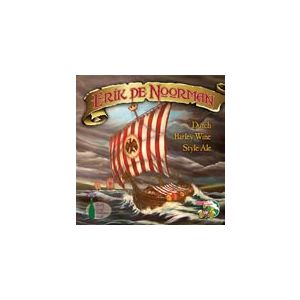
Erik De Noorman LabelIs it just us or do Dutch brewers have a need to be clever in their beer names? Beer after beer that we try from The Netherlands (and other northern European countries) has had some intellectually wise-ass name. Eric De Noorman is the name of a fictional comic strip character authored by Hans Georg Kresse from 1946-1964. The stories chronicle the various escapades of the eponymous Viking king. Dutch Brewer Erik Bouman seems to have written himself into the story by working his name into the name of this beer. So is Erik claiming to be a Viking? A sort of marauding beer maverick on a quest to colonize the surrounding regions with his legacy of better beer? Is he equating his homebrewing prowess to the naval superiority of the Vikings? He did not return our calls requesting an interview, so we can’t say. Let’s let the beer do the talking, shall we? Look for a fruity, floral, quite rose-like nose, with a sharp edge of hops and wafts of rum-soaked raisins and apricots. On the palate, the beer’s alcohol content makes its presence known—which is perfectly appropriate for a barleywine. Expect some dark berry skin notes and a distinctly Chardonnay-like flavor and feel with white grape skins and some tannin-like bite and edge. The beer finishes with earthy, floral hoppy bitterness and quite a bit of berry-like tartness. This sipper is great on its own, but feel free to serve up an earthy, blue-veined cheese alongside it.

Serving Temperature: 50-55° F
Alcohol by Volume: 9.0%
Style: Barleywine
Suggested Glassware: Snifter

Microbrasserie Les Trois Mousquetaires (The Three Musketeers Microbrewery)—Brossard, Canada (Québec) (Southeastern Canada)

Microbrasserie Les Trois Mousquetaires (The Three Musketeers Microbrewery) was founded just less than five years ago, and while they focus on creating traditional German-style beers, they definitely have applied their own North American treatment. As you'll find in the Doppelbock we've sent you, they're not afraid to mix tradition with creative interpretation. Part of their flexibility in this regard lies in their approach to brewing; as head brewer Jonathan Lafortune states himself, "I don't come from the microbiology branch of brewing, I'm more like a chef in a kitchen. The recipes come from my senses, my heart and my passions. I'm an Epicurean."

It’s been Jonathan's good senses that have helped him develop some first-rate beers. We featured a pair of their beers in our International Beer of the Month Club a couple years ago, as part of their first foray into the U.S. market. The beer we’ve selected for you in the Collectors Beer Club is also a beer never before available outside of Canada.

So, who are the three musketeers? Actually, that's a bit complicated. Like the heroes of Alexandre Dumas, there are four of them. Jonathan we've already mentioned, though he wasn't actually onboard at the start—he joined the brewery about seven months after it was founded. While not technically one of the founding musketeers, his coming on board so early permitted him to develop all the beer recipes they currently brew. In addition to Jonathan, there's Sylvain Plourde and Daniel Pion who were part of the original three "musketeers" who founded the brewery in June of 2004 (the third musketeer, their original brewer and the fellow who introduced Jonathan into the mix, ended up leaving the company). The original three were coworkers at the famous Imperial Tobacco Montreal. However, when the company closed its Montreal branch in June of 2003, the three were out of work. Right around the same time, they got word of a brewery for sale and decided to take the plunge into the brewing industry. These days, Sylvain handles the accounting and Daniel helps with the production and brewing process. From what Jonathan tells us, these two also appear to be mechanical geniuses—they built their own bottling line!?! Anyone who's in the brewing field or has seen these complex machine-beasts in action will realize what a feat of technical mastery this is. The fourth musketeer is a fellow named Patrice (we didn't get a last name), who is actually the brewery's first "employee," serving in the sales capacity along with Jonathan and Daniel.

Like many brewers, Jonathan Lafortune got his start in brewing as a beer connoisseur. He wanted to improve his skills in tasting the nuances of beer, so he took to homebrewing to expand his knowledge of ingredients and flavors. His entry into professional brewing happened when his friend, one of the "original" three musketeers who bought the brewery (the original brewer), asked him if he wanted to brew professionally—he said yes, and got in on the gig. And we have to say, having gone from homebrewer to professional brewer in such a short span of time, this guy's got a real gift for his new trade. In the past two years, he's created more than two dozen beers, from a weizenbock, a Sticke ("secret") Alt, and a smoked Scotch ale. Most have been made available only on draft at area bars, but all have met with high demand. We're pleased to have the opportunity to feature beers by this up-and-coming Canadian microbrewery.

If you'd like more information about Les Trois Mousquetaires Microbrasserie, check out their website (currently under construction and in French only last time it was up): www.lestroismousquetaires.ca.

Doppelbock

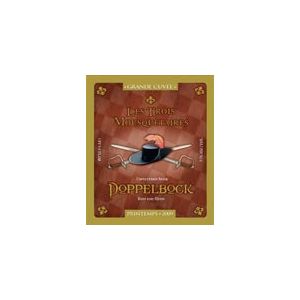
Microbrasserie Doppelbock LabelSo here’s some straight talk: we’re not quite sure what this beer will taste like when you get it. Why? Because it was still maturing when we lined it up. We were sent an early sample of the beer, still immature, but we loved it. We felt it could only become better by the time it reaches your door. We also tasted a slightly different version of this doppelbock while visiting Canada in 2008 and based on that, knew we couldn’t miss with this one. Our tasting notes here are based on the early, immature samples we reviewed, so don’t be surprised if you find your own distinct notes as you partake. We encountered layered aromatics, with notes of chocolate, caramel, nougat, raisins, pumpernickel, vanilla pods, and wisps of oaky alcohol. Flavors ran the gamut, with cocoa, caramel, roasted malt, raisins, and a pleasantly warming alcohol all encountered. We found that our samples finished with a molasses and coffee-like fade, with hops never rising to the forefront, but executing a balancing effect quite nicely. The sweetness and ‘size’ of this beer makes it an excellent night cap beer; however, pairing with boldly flavored foods like Mexican Carne Asada is an option worth trying.

Serving Temperature: 45-50° F
Alcohol by Volume: approx. 8.0% (final ABV not available at time of printing)
Style: Doppelbock
Suggested Glassware: Mug, Pilsner Glass or Goblet

I'm ready toPlace My Order Button

C&H Internationals Logo Since 1994
Join Our Club
Gift Memberships

Membership Renewals
Reorders
Home Page
More Information
Current Selections
Past Selections
Testimonials
Other Gourmet Clubs
Corporate Gifts
Wedding Gifts
Brewery Search
Style Guide
Beer Fun Section
Industry Resources
Festivals
Print a Gift Card
Send a Virtual Brew
Refer a Friend
Send a Hint
E-Promos
Contact Us
Link to Us

1 - 800 - 625 - 8238
(Outside US call: 949-206-1904)
P.O. Box 1627, Lake Forest, CA 92609