Past Newsletters - July 2009
DOM = Domestic Beer Club; INT = International Beer Club; VAR = Domestic International Variety Beer Club; RB = Rare Beer Club
We’ve been fans of the Boulder Beer Company for years now. Colorado’s first microbrewery celebrates a major milestone this year: their 30th anniversary! This puts them in an elite club made up of only a handful of breweries in the nation. These days, the big CO is known for a number of award-winning micros—just about all of whom owe some of their success to the Boulder Beer Company. Founded by two college professors, their primary goal was to produce beers in the traditional style of the robust European ales. The original brewery site was a small farm northeast of Boulder, and the brewhouse did in fact share space with a few goats. Five years later, they moved their one-barrel brewing system to their current facility in Boulder. Each year, they pay homage to their roots by hosting a big ol’ beer party called the Goat Shed Revival. This year’s is sure to be their biggest and baddest to date. Happy Birthday guys!
For more information about the brewery and scheduled tours or this year’s Goat Shed Revival, call (303) 444-8448 or check out their web site at www.boulderbeer.com.
Bring on the birthday brew! On the nose, expect big biscuity and toasty notes amidst citrusy cascade hop aromas and seeds (think wild bird feed). Look for fruity notes to emerge as it warms, with a roasty, nutty profile and hints of milk chocolate and caramel. This beer is on the bigger side—a so-called “India brown ale”—yet it maintains balance amidst its complexities and girth. Notes of caramel, roastiness, toffee, grapefruit zest, crackers and sweet bread dough are all balanced by a moderate bitterness and citrusy fade. Overall, quite interesting in that the sweeter elements and more bitter elements run a constant balancing act with one another rather than just a sweet start ended by a bitter finish. A nicely crafted brew fitting for commemorating the brewery’s 30th anniversary, and a definite throwback to the pioneer brews. Pair with something smoky like smoked beef brisket.
Serving Temperature: 45-52° F
Int'l Bittering Units: 60
Alcohol by Volume: 6.8%
Suggested Glassware: Pint Glass, Mug or Stein
Malts: Belgian Biscuit, Chocolate, Pale, Gambrinus Honey
Hops: Cascade
‘The Mojo’ brings it with an explosion of citrusy, piney hop aromatics and big time fruit notes. Oh sweet & hoppy goodness! The pine character is huge; sappy and resinous, with grapefruit flesh and rind also prominent on the nose. Flavor begins big & citrusy, almost juicy, with grapefruit and tangerine flavors. These are washed to the background by a sticking bitterness that develops, grows, and hangs on and on. A lightly sweet malt backbone does its best to keep the hops in check, but hops are at the helm here as waves of hop flavors and bitterness dominate. Note breaths of pine sap, evergreens, and alcohol coming through the nose when breathing out. Overall, a big, beautiful IPA that’s interesting but manages to maintain drinkability. A great session beer for the hop fanatics out there that will work very well with a variety of Indian curry dishes.
Serving Temperature: 43-50° F
Int’l Bittering Units: 70
Alcohol by Volume: 7.2%
Suggested Glassware: Pint Glass
Malts: Pale, Wheat, Caramel
Hops: Amarillo, Centennial
Flying Dog has gained nationwide success since the brand was founded in 1990. By combining bold, uncompromising craft beers with branding that captures the irreverent spirit of today's beer drinker, they've created quite a few canine-inspired "characters" in the beer world. Not surprising, considering what an interesting character founder George Stranahan is. The heir to a multi-million-dollar fortune from the Champion Spark Plug company, he was never content to simply live the trust-fund life. Early on he rejected authority and the stuffy, elitist attitude often found among the wealthy, opting to pursue a PhD in Physics. In 1959 he proposed what has become the Aspen Center for Physics. Since then, he's been a cattle rancher, pal of Hunter S. Thompson, whiskey distiller, barkeep & cook, trusted publican, brewery owner and investor.
Clearly, a can-do spirit like his has much to do with the success of Flying Dog, including their recent expansion east, where they purchased the Wild Goose Brewery in Frederick, Maryland to serve as an east coast brewing center for their growing brand. Yes, this dog truly is flying, all the way to Europe! Flying Dog's beers are now available in select locations in Sweden, Finland, Denmark, Austria, Italy, UK and Holland. As they say, in their forever-irreverent style, "we are taking this bitch international!"
For more information about the brewery and scheduled tours, call (303)-292-5027 or check out their web site at www.flyingdogales.com.
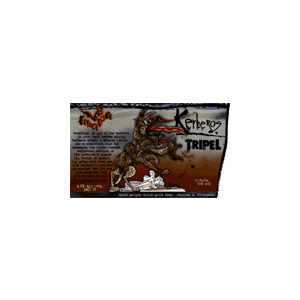
Kerberos, the multi-headed guard dog of Hades prevents those who have crossed the River Styx from leaving. Unlike the typical concept of a guard dog who keeps people out, Kerberos seeks to keep folks in one place. You too may find yourself unable to break away from the bottle as Kerberos confines you to your barstool. Look for notes of custard and butterscotch on the nose. There are some semi-sharp European hop aromas, but mainly sweeter notes dominate. Now we know we don’t have a refined canine sense of smell, but even sticking our snouts deep into this beer, we struggle to pull out any notes of alcohol—they’re better hidden than that bone you buried in your backyard. Notes of tapioca emerge as it warms along with mild spiciness. Kerberos’s three-headed bark is more aggressive than its bite, flavor-wise. The beer goes down rich, full-bodied, and viscous, but smooth, warming and pleasant. Expect subdued notes of overripened peach, butterscotch, and a faint nip of anise. Notice the faint clove character and a vanilla-meets-oak-note. Toward the finish, look for musty herbal notes evoking the likes of rosemary and thyme, and a latent white pepper spiciness in the finish with a slightly grassy hop fade. Overall a very complex beer with a somewhat nontraditional flavor profile for the style. Flying dog has put their own stamp on the Tripel style with Kerberos. And if we had three heads, we’d make sure there was a goblet of this beer for each of them. Pair with oven roasted potatoes with butter, garlic and rosemary.
Int’l Bittering Units: 27
Alcohol by Volume: 8.6%
Suggested Glassware: Goblet or Snifter
Malts: Weyerman Pils, Briess Aromatic
Hops: German Perle, Strisserspalt, Saaz
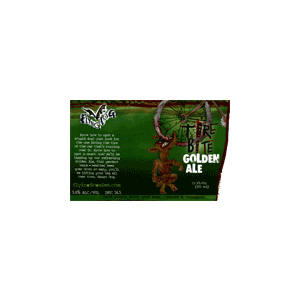
Tire Bite is brewed in the Kölsch style, a unique style of beer found only in Cologne, Germany (outside of which it’s not legal to call it Kölsch). It’s a light-bodied style that has the clean and crisp nature of a lager, with some of the fruitier notes found in an ale. It is a unique style of beer that leaves no room for error in the brewing process, as even small flaws in flavor will announce themselves like your neighbors’ yappy dog. Pours a crystal clear golden copper hue, with a just off-white colored, tiny-bubbled head. On the nose, expect a very nicely balanced bouquet, with floral aromatics, caramel malts, hints of straw and lemons. Look for clean grains on the palate, with a well-rounded bitterness that works well against the mild caramel sweetness provided by a tasty malt bill. Note a faint whisper of crisp, ripe apples toward the finish, with floral hop flavors and lemony hop notes in the finish. Overall, light, crisp and refreshing, delivering great flavor for an easy-drinking beer. Pairs well with anything off the grill, and hot weather in general.
Int'l Bittering Units: 20
Alcohol by Volume: 4.7%
Suggested Glassware: Stange or Pint Glass
Malts: 2-Row, White Wheat, Munich
Hops: German Perle, Hallertau
Herold Brewery (Pivovar Herold)-Březnice, Czech Republic (South Central Czech Republic)
The history of beer brewing in the Czech Republic is much older than the country's current borders. Chronicled evidence reveals that hops from the region were exported as far back as 903 A.D., and that hop growing regions had been established as early as 859 A.D. Bohemian hops were so prized that at one point, the penalty for cutting and exporting the hops for cultivation elsewhere was punishable by death. The first Czech brewery was built in 1118, in bold disobedience of an order by the Bishop of Prague banning brewing (the violation of which carried excommunicative consequences). The order was annulled by Pope Innocent IV when King Wenceslas negotiated the repeal on behalf of his people. Bringing beer to the people! Certainly, he earned his title "Good King Wenceslas." How ironic that he was slain by his drunken brother.
Until the 16th century, brewing was not practiced in large breweries, but rather in the kitchens and pantries of town houses. Ultimately, the noble classes began to run various sorts of business at their estates, and this shifted brewing out of local homes and into palaces and castles, which typically possessed their own on-site breweries. The beer brewed in these breweries was sold in local public houses for the serfs to enjoy – and enjoy they did; brewing became huge business, adding to the fortunes of noble families through the centuries.
One of these once regal brewing facilities is located in a castle in the town of Březnice, located about 40 miles due south of the Czech capital, Prague. The ancient tradition of brewing in this town goes back to at least the 15th century and is chronicled in a 1454 document that names Mikes Vanek, a maltster (one who produces malted barley and/or wheat), as the Březnice village mayor. The castle at Březnice dates back to at least 1415 and the first documented reference to a brewery traces to the year 1506 (hence the date on the Herold beer labels). That makes this year their 503rd anniversary, which is an astonishing milestone if you think about it! They are one of the oldest functioning breweries in the Czech Republic.
The small brewery of the castle, now called Pivovar Herold, lies in what was originally a Gothic structure that was ultimately expanded and redesigned in renaissance and baroque styles. The estate has been owned by numerous noble families, and under them, the brewery was in nearly constant use and revitalization, even with its tumultuous turnovers. Despite the various takeovers and chain of owners, beer brewing remained a critical tradition (even when taken over by a devout Catholic who added to the castle a new chapel and had a Jesuit seminary constructed nearby).
Sadly, subsequent political climates negatively affected the brewing industry. Under Communist rule, the brewery was seized yet again—taken over by the state, with very little capital invested into it or any of the nation's breweries during the period. As with so many other trades, the communist regime simply produced the product and squeezed as much money as possible out of the industry by minimizing self-investment. However on the upside, beer was very cheap—and legal. This helped establish beer drinking as perhaps the single most popular hobby among Czech men. One of the Czech Republic's most famous beer drinkers, the protagonist of Jaroslav Hasek's novel "The Good Soldier Svejk" proclaimed that the government that raises the price of beer is destined to fall within one year. In 1984 the Communists almost doubled the price of beer, and though off by four years, his prognostication was fulfilled. Any politicians reading this who are among those currently considering the wave of recently proposed hefty increases in beer taxation, take note.
Interestingly, there was a paradoxically positive consequence of Communist ownership: the lack of investment in the facility. Without major modernization over the years, the Herold Brewery still makes beer the old-fashioned way, using only traditional methods, equipment and ingredients. While subsequent owners have modernized certain components of the brewery, Pivovar Herold still makes most of its own malt, in the Pilsner style, from local barley; highly uncommon for most commercial breweries operating today.
When Communism collapsed, the state's properties were slowly permitted to return to private ownership, and the Herold Brewery again became a privately held entity. In 2004, the brewery's management was taken over by a new director, David Porteous, who set a new direction for Herold's development, driven by a desire to distance their business practices from those of the globalized market and return to the craft-brewing tradition of Březnice 's roots. As he states, "to be sure, the rationale behind the activities of the small breweries is to retain true love for their work." We'll raise a pint to that!
So where does the name Herold come from? It was selected from the symbol of the herald, or spokesman of the king, seen on the coat of arms present at the brewery at the Březnice castle. It's appropriate because the brewery has historically been an integral part of the castle, and it's clever since the name has virtually the same meaning in most northern European languages. Given the royal heritage of the brewery, and the caliber of their beers, we agree that the name suitably represents its noble past!
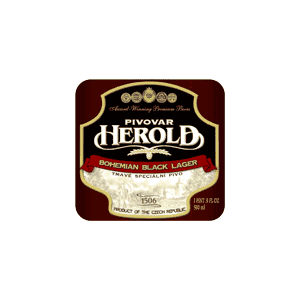
Herold Brewery's Bohemian Granát Lager debuted in the 19th century, but was discontinued in favor of other, lighter beers. Expect a deep garnet color topped by a creamy tan head. Swirling the beer in the glass rouses malty, chocolate-laden notes that are offset by the spry aromatics of a traditionally hoppy, almost grassy, Czech Saaz hop character and notes of Red Delicious apples rolled in caramel. The flavor is rich and robust, with caramel, toffee, hints of plum, and an undercurrent of leafy hops. It begins rich and malty, immediately sweet, but this is almost instantly balanced by rich roasty notes and a very lengthy bitterness. Look for notes of coffee-infused molasses, and prominent notes of caramelized sugar and toasted bread as well as almonds and pralines. Finishes with an exceptionally long bitter fade. Once it warms, swirling brings out notes of oranges and almonds. Enjoy alongside steak served with caramelized onions.
Serving Temperature: 42-48°F
Alcohol by Volume: 5.8%
Suggested Glassware: Pint Glass, Pilsner Glass, Mug (clear) or Stein
Our second featured international beer is an example of a Black Lager. German varieties of this style are often referred to as Schwarzbier (Schwarze means black in German). However, the brewers have intentionally distinguished the brew from German examples by including the term 'Bohemian' in the title. Expect a deep, nearly black color adorned with a wonderfully creamy, chocolaty-brown head. The aroma is particularly pleasant on the nose, full of sweet malts, black currants, roasted chocolate and coffee scents, with a vinous (wine-like) character in the background mingling with aged maduro tobacco notes. Look for notes of singed molasses, dark chocolate, black currants, prunes, and minor lactic notes. Sweeter notes are replaced by black coffee notes toward the finish, with a faint acidity and a final charcoal character emerging and drying things out. Overall, a rich, full-flavored beer that packs the flavor but never beats up your palate. Grab a well-aged deep dark and oily maduro cigar for a truly rewarding pairing.
Serving Temperature: 45-50°F
Alcohol by Volume: 5.2%
Suggested Glassware: Pint Glass, Pilsner Glass, Mug or Stein
De Proef Brouwerij (The Professor Brewery)—Lochristi, Belgium (Northern Central Belgium) in Collaboration With Bell’s Brewery, Kalamazoo, Michigan, USA (Midwestern United States)
Part of what we love about being in the beer business is being able to debut boutique brews to our members. This month, we again lined up a beer not before found in the country. As a member of the club, you’re among the first in the nation to taste the long-awaited collaboration beer brewed in Belgium by a Belgian Brewmaster with the help of a classic, innovative US microbrewery. Dirk Naudts, brewer extraordinaire and well-regarded brewing innovator is the proprietor of De Proef Brouwerij in the brewing haven of Western Flanders, Belgium. His nickname, “the prof” (as in professor), is well-deserved and worn as a badge of honor, serving as the moniker for his highly respected, ultra-scientific brewery. The international craft brewing culture is rather unique in that there are so many brewers vying for a very small piece of the overall pie. Consider that in the US alone, there are more than 1,400 craft breweries slicing up only about 5% of the total beer market. With so many people trying to get their very narrow slice of the beer business out there, you’d think competition would be fierce, and collaboration uncommon. But remarkably, it’s just the opposite. Craft brewers participate in a unique spirit of cooperation domestically, but that brewing olive branch extends internationally as well. During the past three years, De Proef has played host to a series of US guest brewers from internationally renowned microbreweries—folks like Tomme Arthur of Port Brewing and Lost Abbey in Southern California, representing the west coast of the US, and Jason Perkins from Allagash Brewing Company in Maine, bringing an east coast vibe to Belgium. It was logical that the next US guest brewer be from the emerging “third coast,” the Midwest. Enter John Mallett from Bell’s Brewery in Michigan. This time around, the collaboration focused on use of ingredients from the US and Belgium, with juice from Michigan’s famed dark cherries becoming a featured ingredient, along with dark Belgian candi sugar. For bottle conditioning (the process where yeast are left in the bottle to feed on sugars in the beer to naturally produce carbonation and some alcohol), sugar from native Michigan sugar beets was added. The result is an extraordinary beer called Van Twee, meaning “from two,” that could only have come from the careful collaboration of these two innovative brewing forces. Enjoy the fruits of their international labor; this unique one-off brew will never be produced again, and you’re the first in the nation to sample it. Indeed it is true that membership does have its privileges!
Check out www.bellsbeer.com for more information about Bell’s Brewery, which has been creating insanely good beers since 1983. Little information is offered at De Proef’s website, but perhaps that will change one of these days—to see if that’s happened, check out www.proefbrouwerij.com.
This unique collaboration beer pours a very deep, hazy, burgundy brown color and is topped by a massive, intensely sticky, tan colored head that laces nicely and remains indefinitely. Smells of spicy Belgian yeast greet the nose, falling in line with expectations for a Belgian strong dark ale. But then it takes on a unique twist, with prominent notes of chocolate and some coffee, fudge, and a ‘stemmy’ woodiness. When swirled, look for faint impressions of cherry juice to arise, and note how the cherry notes play second fiddle to the chocolate notes that are quite prominent. Expect notes of dark bread, bubblegum and spicy, herbal notes as it warms, reminiscent of beers brewed in the Belgian Dubbel style. On the palate, notes of cherries hit upfront and are quickly blended with ample notes of chocolate, lightly roasted malts, and under ripened nectarines, giving a tart character that is also blended with some very sweet plum-like fruit notes. We found the finish very complex, evoking a variety of flavors found in a multitude of familiar styles; look for a unique interplay of fruity sweetness meets porter-like dryness meets sour/tart fruit & funky Brettanomyces (wild yeast often used in Lambic styles). While a vinous character is detected, it is nearly erased by the un-wine-like rush of chocolate. Overall, this is a very interesting beer with an unusual but delightful flavor profile. The chocolate aromas and flavors are particularly noteworthy, as is the sour, funky fruit character. But interestingly, these very strong flavor elements are blended in such harmonious fashion that they balance one another. The sharp, sour, tart cherry notes are kept from inducing a puckering of the mouth by the rich, roasty, creamy chocolate notes. Stylistically, it’s a hard beer to place, but oftentimes, styles are the first casualty of brewing innovation. It seems to be a combination of wood-aged Belgian strong dark ale, porter, and dubbel. Very unusual and very exciting to the palate, this beer is a bold experiment that delivers a robust novelty that only collaboration can bring. We suggest pairing with Belgian truffles, with moderate to high cocoa levels (medium-to-dark chocolate). Cellaring (storage at cellar temperatures) is recommended as this beer will continue to develop and mature in the bottle. If you can muster the willpower, set a bottle aside and check in on it at least six months down the road.
Serving Temperature: 50-60° F
Alcohol by Volume: 7.5%
Style: Belgian Strong Dark Ale brewed with Michigan Dark Cherry Juice
Suggested Glassware: Tulip or Snifter
Cerveceria Artesanal BarbaRoja (Red Beard Artisanal Brewery)—Escobar, Buenos Aires, Argentina (Northeastern Argentina)
South America is a land of great natural resources. Can beer be considered a natural resource? Well, we see no reason why it can’t, so add that to the list because there’s a burgeoning craft brewing movement afoot there. Notably, Brazil and Argentina have been making huge strides in bringing better beer to what has been a beery landscape starkly at contrast with the physical terrain of the region. Bland, lifeless, one-dimensional lagers have long been the only option in a region full of astonishing mountain peaks and lush deep valleys. Patagonia, in fact, in southernmost South America, is home to one of the richest sources of biodiversity in the world. Such breathtaking scenery may have been part of the underlying reason why Ferdinand Magellan decided to stop there during his 1520 circumnavigation of the world. Imagine his surprise when he encountered native “giants”—people reportedly 12 to 15 feet in height. Where this fanciful account came from we can only imagine; it might have been that these natives, being an average of six feet in height, seemed frighteningly and abnormally tall given the Spaniards’ average height of 5’1”. A 20% height difference might have been enough to set the stage for this over-appraisal of stature, or perhaps it was a means of crafting a legend to justify financing for would-be future explorations. In any case, this land of the giants remained an enduring legend in the minds of Europeans, even explorers that encountered Patagonian natives on separate voyages, for the next 250 years. It was the chronicles of Magellan’s voyage that gave the region its name—the etymology remains suspect, but it seems to be derived from the word ‘pata,’ meaning foot, with Patagonia translating roughly as “land of the big feet” to describe these people who were supposed to be twice the normal human height.
So with the local craft brewing revolution afoot, will Patagonia become home to the new giants of South America’s microbrewing revolution? Time will tell, but the legend is beginning with the likes of brewing outfits owned by Antonio and Vivian Mastroianni. Cerveceria Artesanal BarbaRoja (the Red Beard Artisanal Brewery), located just outside of Buenos Aires, has been brewing up authentically Argentine beers since 1998. Located in the town of Escobar, Argentina’s flower capital, the landscape begs to be consumed alongside their brews. And you can quite literally do just that if you pay BarbaRoja a visit. Patagonian hops and malts are used in their beers, and the brewery is a veritable paradise with roughly five acres of grounds to explore. Visitors frequently take up temporary residence here in the various cabanas available for lodging during summer months, partaking in delicious local cuisine served up in the Mastroiannis’ on-site restaurant. A family-owned, resort-style, microbrewing paradise? Magellan is not alone in recognizing there’s a legend being borne of this land.
If you’d like more information about the brewery, visit their website (in Spanish only at this time) at http://www.barbaroja.com.ar.
This big red ale pours a deep amber color with ruby highlights when held to the light, with a big beige head fading to a solid covering and collar. On the nose, expect deep rich caramel notes, blanketed by an aromatic tingle from the hops. Look for notes of pears, over ripened apples, and the faintest possible impression of peat. Sweet molasses, maple syrup and floral notes mingle with wafts of alcohol and dark-skinned fruit, with minor notes of oak and a ghost-like note of vanilla. There is a hefty amount of sweetness implied by the nose, but remarkably, the flavor profile only dabbles in it. Look for notes of fresh grains, and fairly prominent notes of barrel-aged, single malt scotch with scents of orange and notes of candied orange peel comingling in the mix. Interestingly, some notes of Añejo tequila also come through after the beer has had a few moments to warm and breathe, similar to the flavors you might find in an old-world Scottish Wee Heavy ale, but with a heftier hop profile providing a leafy hop character. Expect this beer to finish a bit boozy in the mouth, and warm in the belly. Overall, this is a powerful, complex sipping beer, and another great example of what seems to be a distinctly Argentinean approach to bigger beers; they seem to possess a sort of crossover effect where the flavors begin to approximate flavors of other alcoholic libations, like wine, and in the case of this beer, liquors like scotch and fine tequila, no doubt as a result of being aged for two months in wood barrels. You could pair this with smoky lamb or goat in the Argentine tradition, from the asado (grill), served with Chimichurri (a sauce of herbs, garlic and vinegar, or even schnitzel-steak), but really, this beer is sturdy enough to be enjoyed as a digestif to sip at the end of any meal, or as a nightcap to be enjoyed in the winter months (go ahead and age a bottle at 50-55° F) until winter rolls around. While not bottle-conditioned (where some yeast is left in the bottle to permit maturation in the bottle) this beer will hold up just fine for 6-12 months.
Serving Temperature: 50-55° F
Alcohol by Volume: 9.0%
Style: Barrel-Aged Imperial Red Ale
Suggested Glassware: Snifter