The Microbrewed Beer of the Month Club

Past Newsletters - January 2010

Brewery
Beers Featured
DOM
VAR
INT
RBC
Choc Beer Company Basement Batch
Check
Check
The Matt Brewing Company Saranac India Pale Ale
Check
Check
Choc Beer Company Miner Mishap
Check
The Matt Brewing Company Saranac Black & Tan
Check
Kulmbacher Brauerei (Germany) Pilsner
Check
Check
Kulmbacher Brauerei (Germany) Eisbock
Check
Check
Flying Dog Brewing Company (USA) Raging Bitch Belgian-Style India Pale Ale
Check
Brasserie des Légendes (Legends Brewery) (Belgium) Géants Goliath Tripel
Check

DOM = Domestic Beer Club; INT = International Beer Club; VAR = Domestic International Variety Beer Club; RBC = Rare Beer Club

I'm ready toPlace My Order Button

Choc Beer Company

Coal mining, Native Americans, craft-brewing, meatballs and prison all come together in the storied past of the man responsible for creating the beers of the Choc Beer Company. Young Pietro Piegari arrived in America from Italy in 1903, settling with his family in the coal-mining town of Krebs, Oklahoma. At just 11 years old, he signed on to work in the mines and changed his name to Pete Prichard, but before his 22nd birthday, a mining accident crushed one of his legs, permanently preventing his return to the coal mines.

In order to find work and pass the time, Pete took odd jobs and took up an interest in brewing beer. In 1919 he came across a recipe brewed by the local Native American tribe, the Choctaw, and worked on perfecting his own interpretation, which he named Choc Beer. Naturally, when other miners were on meal breaks, they headed up to Pete's place to grab a beer. It only seemed natural to Pete to begin serving them lunch to go with their beers. In 1925, he formalized this ritual by opening a restaurant in his home which served literally home-style, authentic Italian food. And since everyone was already calling it "Pete's place," it became permanently known by the same name. Prohibition ended up sending Pete undercover to make his beers, brewing batches discreetly in his basement and continuing to sell it to customers. But ultimately, the law caught up to him and he served two federal terms in prison for violating prohibition laws. Joe Prichard, Pete’s Grandson, took over Pete's Place in 1984 from his father, Bill, who took over from his father (Pete) in 1964. They were actually brewing and selling Choc beer until 1980, when a visit from the authorities finally led to the taps being shut off because brewpubs were illegal in Oklahoma at the time (remarkably, homebrewing remains illegal in the state). So, after a second dry spell (this time for 15 years and remarkably, post-prohibition), brewpubs became legal in Oklahoma in 1995 and Pete's grandson, Joe Prichard, reintroduced his family's Choc Beer recipe to the public at the family restaurant, which remains in operation to this day.

Today, with brewmaster Michael Lalli, Pete's Place, brewing as “The Choc Beer Company,” has at least four specialty beers and six year-round beers: Waving Wheat, Miner Mishap, Basement Batch, 1919, Pietro Piegari and Last Laugh. These six beers represent the six major chapters of the life of Pete Prichard—whose story is elaborated on at the Choc Beer Company's website and illustrated on each beer’s label. We encourage you to check out the full story online at their website, and seek out their finely crafted, family-brewed beers wherever you can!

For more information about Pete's Place or the Choc Beer Company, call (918) 423-2042 or check out their web sites at www.petes.org and www.chocbeer.com.

Basement Batch

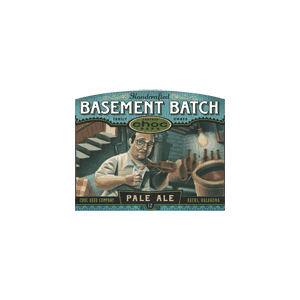
Choc Beer Basement Batch LabelThis pale ale pours a light amber color, capped by a sticky, solid off white head. Expect clean citrus and pine aromas with slight undercurrents of malts (mainly biscuit-like), faint nuttiness, with a bit of peppery spice and a back note of fruit punch. It fills the mouth with a swarm of earthy hop notes, but faint caramel undertones sweeten and weight the hops, but they maintain their loftiness above all other notes. Look for suggestions of grapefruit on the palate, earthen, ashy notes and faint impressions of cannabis. The beer finishes extremely dry, moderately bitter, with a grassy hop profile in the fade. We suggest pairing with Cambodian Lemongrass Curry over the meat of your choice.

Serving Temperature: 40-45° F
Int'l Bittering Units: 35
Alcohol by Volume: 6.4%
Suggested Glassware: Pint Glass
Malts: Munich, Caramel
Hops: Cascade, Centennial

Miner Mishap

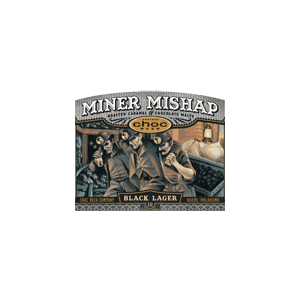
Choc Beer Miner Mishap LabelMiner Mishap is brewed to emulate a German "Schwarzbier" (translation: “black beer”) and, like the original Choc beer, it's a home-brewed recipe. This one was created by a good friend of the Pete's Place family (William Scott). Pours a deep brown cola-like color with a tan head. On the nose, expect big, roasty notes to emerge along with chocolate and plum. Nutty notes come out as well, draped in some citrus and fruit notes (almost lime-and-currant like). Expect CHOColate and coffee notes to hit the palate first, developing into notes of dark bready bitterness and a drib of black licorice & mint. The bitterness is moderate and enhanced by the carbonation, giving it a gentle bite that works nicely with the malty, roasted, nutty notes and gives this dark brew a fairly crisp, true-to-style finish. The finish lingers indefinitely with a lightly smoky character that flirts with notes of cocoa. Full-flavored and refreshing, this beer will hold up well against a char-grilled flank steak or a slice of chocolate cake served with raspberries.

Serving Temperature: 45-50° F
Int’l Bittering Units: 28
Alcohol by Volume: 5.3%
Suggested Glassware: Pilsner Glass, Flute or Pint Glass
Malts: Weyermann Pils, Munich, Carafa
Hops: German Perle

The Matt Brewing Company

The Matt Brewing Company is not only a brewery, it’s an institution. This is one of the most industry-respected, accomplished, award-winning breweries in the country, with a heritage dating back to the 19th century—exceedingly rare in the world of U.S. craft-brewed beer. Francis Xavier Matt arrived in the states in 1878 (only 13 years after the end of the American Civil War, and just shortly after the nation's 100th birthday). The man put in several years of work gaining brewing experience at the already established Bierbaur Brewery. Originally from the Black Forest region of Germany, "F.X.," as he liked to be called, settled in the sparsely populated Adirondacks of New York, where in 1888 he founded what is today one of the oldest breweries in the United States (and the oldest in New York state).

Today, the name of this family-based brewing operation honors their continued commitment to tradition and pride. The Matt Brewing Company has survived numerous world-altering events, including two World Wars and Prohibition. After the days of Prohibition had passed, F.X., then 74, was joined by his sons Walter and Frank, and a tradition of family brewing ensued. Under the leadership of the third and fourth generations of the Matt Family (Nick and Fred, respectively), the Brewery has earned a reputation as one of the most respected specialty brewers in the country, producing a wide range of distinctive, flavorful beers. It's been more than one hundred and twenty years since F.X. created the first of his brewery's malty treasures and established the legacy that is the Matt brewing tradition. As their label states, they're technically now in their "3rd century of brewing." Today, each of their brews is a flavorful testament to time-tested recipes and literally generations of experience.

For more information about the brewery and scheduled tours, give them a call at 800-765-6288 or check out their web site at www.saranac.com.

Saranac India Pale Ale

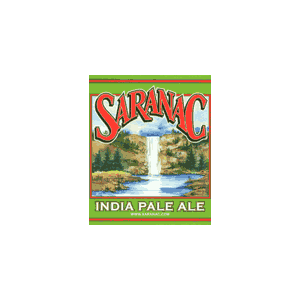
Saranac India Pale Ale LabelTo the Iroquois, native people of the Adirondacks, the word Saranac means "Cluster of Stars." Some rightfully consider the varied selection of Saranac beers themselves to be a cluster of “stars” in the microbrew world. Saranac IPA pours an appealing dark straw to pale amber color, topped with a huge meringue-like froth. Big hops! Sharp, pungent hop aromatics leap from the glass leaving a spicy, grapefruit rind tingle in the nostrils—quite like sniffing a fresh mint sprig. Look for some floral, perfumey notes as well (also from the hops). Some sweet malt notes manage to rise up through the hops indicating this beer is going to be balanced, but definitely hops-forward. On the swallow, some clean grain notes come out, but again, floral fresh hop notes command the scene, dropping very bitter, rindy notes on the palate that linger long into the finish. As it warms, there is an unexpected, subtle champagne-like note that develops, nicely placed in the overall flavor profile. The alcohol is coaxed out a bit by the hoppy elements, enhancing the sensation of alcohol heat in this nearly 6% ABV brew and contributing to the overall dryness. The brewery recommends pairing this beer with seafood, pizza or Mexican food.

Serving Temperature: 45-50°F
Int’l Bittering Units: 53.4
Alcohol by Volume: 5.91%
Suggested Glassware: Pint Glass, Mug or Stein
Malts: North American 2-Row Pale
Hops: Cascade

Saranac Black & Tan

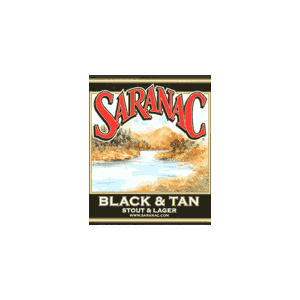
& Tan LabelLike any good B&T, the distinct flavors from both components—in this case Saranac Irish stout (Black) and amber lager (Tan) substituted for the traditional English “pale” ale that often serves as the tan in the black & tan—hold their own while also complementing one another quite well. This blended beer pours the deepest possible amber with garnet hues and is capped by a colossal toasted marshmallow head. Expect rich malty fruitiness on the nose with notes of sweetbread dough, toffee, wafts of citrusy hops here and there, but generally malt-focused. Sweet milk chocolate and mild roasted coffee notes emerge as it warms, along with apple skins. The beer goes down with quite a nice dose of bitter stout flavors, but softened by the hoppy amber lager its blended with; a very pleasant experience in contrasting flavors. Some British-style diacetyl notes emerge as it warms, buttering up the stout just a bit (think butterscotch). The beer fades with some gently warming notes of alcohol, citrusy hop bitterness, and long lasting coffee & butterscotch notes in the aftertaste. Partners well with steaks, hearty stews, soups or clams/oysters.

Serving Temperature: 50-55° F
Int'l Bittering Units: 34
Alcohol by Volume: 4.9%
Suggested Glassware: Pint Glass
Malts: Chocolate, Caramel, Roasted Barley
Hops: Willamette

Kulmbacher Brewery (Kulmbacher Brauerei)—Kulmbach, Germany (Northern Bavaria, a.k.a. Franconia)

In an area of northern Bavaria, today known as Franconia, in a town called Kulmbach, archaeological evidence shows that brewing has deep roots. Remnants of beer bread were found in a vessel dating back to 3000 B.C., and other evidence has shown that brewing was a firmly established activity in Kulmbach since at least the mid-14th century. Given this ancient history, the town of Kulmbach is frequently said to be the birthplace of Germany's beer industry, a sort of fountainhead from which the Bavarian brewing heritage flowed. Not surprisingly, the Kulmbacher Brewery, established 1846, makes some of the finest beers in all of Germany.

Beer is a celebrated way of life in Franconia. On the last weekend of every July for at least the past 125 years, Kulmbach has held a beer festival in the town square. The region is especially well known for its more potent brewings. Originally, these higher potency malty nectars were concocted to sustain long distance travel during export throughout Europe, relying on higher alcohol by volume as a natural preservative. But interestingly, one of the strongest beer styles indigenous to this famed area was ‘discovered,’ not designed, in a sort of post-brewing mishap. As the story goes, a wooden barrel of bock bier, a strong, locally brewed malty beer in the 6.5-7.5% ABV range, was inadvertently left in the brewery yard in the middle of winter. Severe snow storms that winter covered the barrel and it was left forgotten, out of sight, covered by snowfall until the tail end of the season. When it was discovered, the contents were partially frozen, and the barrel had split open. The brewers, being a curious lot, chipped away the ice to see what became of their brew, sampling what remained in the barrel (the result of a dare, we think). Much to their surprise, the residual beer was richer and more concentrated than the original, with an exceptionally clean taste despite the increased alcohol content. So what happened? Well, because water freezes before alcohol, a portion of the beer's water content was forced out of the cracked barrel, resulting in a concentration of alcohol and sugars relative to the remaining beer volume. This accidentally-discovered "technique" was refined, and today gives us one of the beers the region is famous for: Eisbock ('eis' meaning 'ice' in German).

In addition to producing eisbock, the Kulmbacher Brewery makes a range of over 20 other beers, including a crisp, flavorful pilsner which we've selected, along with their eisbock, to showcase the extremely wide diversity of beer flavors produced by this brewery—the two beers couldn’t be more different, yet interestingly, they are both lagers (not ales). Beer is indeed a remarkable beverage with an astounding spectrum of aromas and flavors. Enjoy the study in contrast that this month’s lineup provides.

If you'd like more information about the Kulmbacher Brewery check out http://www.kulmbacher.de.

Pilsner

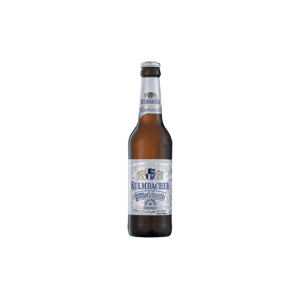
Kulmbacher Pilsner BottleSince its inception as a style of beer in 1842, Pilsner has become the single most popular style of beer the world has ever known. Golden in color, it originated in the town of Pilsen, in modern day Czech Republic. Up until that time, nearly all beer was dark and cloudy. The Czech pilsner was the first beer to be brewed a dazzling, clear golden color. The Germans quickly proved to be the most passionate devotees of the new style and the German contribution was to make the beer a bit lighter in body—better suited to everyday drinking—and to add an extra dose of hops for a refreshingly bitter zing.

Expect a massive, brilliant white head to top this lucent gold, well-carbonated beer. Look for a characteristic pilsner maltiness with notes of floral and spicy hops. We found it to be remarkably refreshing, easy-drinking, with a crisp, clean, dry finish and slightly bitter hop-driven aftertaste. A very food-friendly beer that will partner nicely with anything from light fish to Chicken Kiev to pizza to spicy Thai cuisine.

Serving Temperature: 48°F
Alcohol by Volume: 5.0%
Suggested Glassware: Pilsener Glass, Flute, or Stein

Eisbock

Kulmbacher Eisbock BottleImportant Note: this brew may be subjected to very low temperatures while being matured, but it should be consumed at cellar temperatures so that you may experience the full range of its robust flavor profile.

Kulmbacher Eisbock is the original Bavarian Eisbock, and it's as celebrated today as it was when it first rose to popularity. How celebrated you ask? Well, there is actually an Eisbock festival in Kulmbach every March that celebrates the style. On the last Saturday of the month, at about 7 o'clock in the evening, the festivity commences with the ceremonial hacking open of an ice-encrusted wooden cask (sound familiar?). The 10% ABV beer that pours forth is deeply complex, with a dark, reddish-brown color, sweet, malty aroma and a smooth palate. The Kulmbacher Eisbock, which used to carry the subtitle "Bayrisch G'frorns" (meaning "Bavarian Frozen"—it's still on the label if you look closely), is made from five different malt varieties. For all intents and purposes, it's a bottled version of this festival brew. Expect sweet caramel malts, notes of fresh biscuits, figs, and rum-soaked apricots on the nose, and look for a creamy, oaken edge, with some distinct vanilla notes in the background. This full-bodied brew is slightly roasty, with notes of maple syrup, raisins, distinct cookie-dough like flavors, and an undercurrent of chocolate, caramel and plum. The finish presents faint notes of coffee, roastiness, and late breaking walnut-like dryness. A great beer to enjoy with a book at bedtime, or with chocolate covered figs (or both!). This is a brew that'll age gracefully, so feel free to let a couple bottles age for another winter—just don't leave them out in the snow; try the cellar instead.

Serving Temperature: 52-60°F
Alcohol by Volume: 9.2%
Suggested Glassware: Snifter

Flying Dog Brewing Company—Frederick, Maryland, USA (Northeastern/Mid-Atlantic USA)

Flying Dog has gained nationwide success since its founding twenty years ago in 1990. By combining bold, uncompromising craft beers with branding that captures the irreverent spirit of today's better beer drinker, they've created quite a few canine-inspired "characters" in the beer world. Not surprising, considering what an interesting character founder George Stranahan is. The heir to a multi-million-dollar fortune from the Champion Spark Plug company, he was never content to simply live the trust-fund life. Early on he rejected authority and the stuffy, elitist attitude often found among the wealthy, opting to pursue a PhD in Physics. In 1959 he proposed what has become the Aspen Center for Physics. Since then, he's been a cattle rancher, pal of Hunter S. Thompson, whiskey distiller, barkeep & cook, trusted publican, brewery owner and investor. When he opened the Flying Dog Brewpub in Aspen, Colorado, it was the first brewing business to open there in over 100 years.

Clearly, a can-do spirit like his has much to do with the success of Flying Dog. In 2006, Flying Dog purchased the Wild Goose Brewery in Frederick, Maryland to serve as an east coast brewing center for their growing brand. Ultimately, they moved all brewing operations to this site, closing their original Colorado brewery. Yes, this dog truly is flying, all the way to Europe! Flying Dog's beers are now available in select locations in Sweden, Finland, Denmark, Austria, Italy, UK and Holland, representin’ the US with their tasty beers. As they say, in their forever-irreverent style, "we are taking this bitch international!"

Every dog has its day, but on September 26th, 2009 at The Great American Beer Festival, Flying Dog had its best day. With 3,308 beers entered by 495 breweries, Flying Dog took home gold medals for their Dogtoberfest Marzen, Gonzo Imperial Porter, 2007 Vintage Horn Dog Barley Wine and a silver medal for whiskey-barrel-aged Gonzo Imperial Porter. To top it all off, they also won "Mid-Size Brewery of the Year!" Very impressive.

Now, most of Flying Dog’s beers aren’t exactly rare—they have pretty good distribution in the US. However, their newest beer, just brewed and yet to be sold in bottles (save for the bottles we procured and the few available only at the brewery), is coming to you before just about anyone else in the world can get it. And damn is it a good beer—it ought to be, it was brewed specifically to celebrate Flying Dog’s 20th Anniversary in 2010. Enjoy being among the first in the world to celebrate this monumental occasion for one of the great US microbreweries with a suitably monumental brew, named irreverently, as always: Raging Bitch Belgian-Style India Pale Ale.

For more information about the brewery and scheduled tours, call (301) 694-7899 or check out their web site at www.flyingdogales.com.

Note: As you may have noticed, one of last month’s features, from the US as well, was also a 20 year anniversary commemorative brew, and also had the word “Bitch” in the title. Two Bitches in a row? Are we trying to be vulgar? Nah, but hell, after all, last year was a bitch of a year, let’s be frank. But you have to be able to take it all with some levity, and we hope that membership in the Rare Beer Club gives everyone a chance to kick back & relax, and that the beers we select help pull you through some of the “bitchier” moments in life, donning a smile, if possible, while drinking the good stuff!

Here’s to 2010 and plenty of great beer (we’ve got some killer stuff in the works). Cheers!

Raging Bitch Belgian-Style India Pale Ale

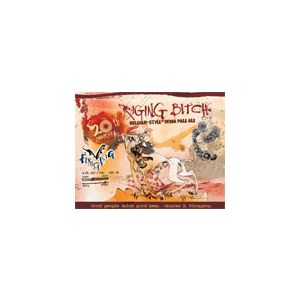
Raging Bitch LabelThis beer is available to Rare Beer Club members before general release—but keep this in mind: the beer label is going to be prohibited in something like 13+ states (take a close look and you’ll figure out why. Hint: it’s not just the name). More importantly, it’s been put into special, very limited edition 750mL bottles just for us and a handful of European distributors. The only other place you can get these coveted ¾ liter bottles is to pay a visit to the brewery in Maryland, but word is, they’re quickly running out of their own supply (yeah, we cleaned ‘em out pretty good. Feel guilty? Don’t. You deserve it). This beer is brewed as a double IPA, fermented with Belgian yeast, to give a uniquely US-meets-Belgium profile that we feel could just become the benchmark for this new “style” of beer known as Belgian IPA (well, a Belgian-Style IPA you’d have to call it, being made stateside). It pours a golden color with brassy highlights and is capped by a two-fingers-thick head that decays to a thick collar, dropping plenty of lace on the glass as the beer is consumed. Look closely under good light and you’ll see the diffraction caused by the hop oils, creating the tiny rainbows you expect to see in a slick of oil on water—an instant giveaway that this beer is well hopped. Of course, one sniff would tell you the same. Expect an alluring bouquet. A raging bitch? Not so sure; this beer smells elegant, refined, and kind. Look for inviting notes of herbal, spicy hops to leap from the glass, offering seductive notes of lavender, mandarin oranges, hints of peppery spice and melons. Yes, this bitch has some sweet melons. Of course, bigly aromatic U.S. hop notes are in there as well, giving off leafy, evergreen characteristics and general citrus rind qualities. Belgian-style spicy phenolics are present in abundant supply due to the use of the Belgian yeast strain. Flutters of warm alcohol catch the nostrils a bit here and there, but between the spicy, hoppy, phenolic qualities, these are deeply blended in the overall aroma profile. Raging Bitch is expectedly spicy on the palate as well, in part due to the Belgian yeast byproducts, in part the hefty dose of hops. Expect a sensation of tingling in the mouth, almost like the effect of inhaled menthol, or the burn of cinnamon (but no cinnamon flavors). Some alcohol warmth kicks in, especially as it warms, but like the aroma, it’s blended beautifully and supports the other flavors, which include grapefruit peel, coriander-like spice, white pepper, blonde tobacco, woody spiciness, pine sap, and some faint, crackery malt notes like those found in most traditional Belgian Pale Ales. The beer finishes very dry, with lingering reedy spice notes and a gentle tartness like immature peaches or apricots. You can tame this bitch with some spicy food, or a very sharp cheddar melted over a buffalo burger.

Raging? Well, it’s definitely got some kick. You can feel this beer the whole way down. It won’t let you off the hook easy. It won’t be forgotten. Perhaps the raging bitch part is the way that this beer sort of blows up at you just when you think all is calm and quiet. Or maybe it’s the way the beer isn’t afraid to let you know exactly who she is and that she don’t give no damn what your ass thinks about it, yet still manages to keep you coming back for more. A delicious, intriguing, sexy beast of a beer befitting Flying Dog’s 20th Birthday. Rage on baby. Rage on.

Serving Temperature: 40-45° F
Alcohol by Volume: 8.3%
Style: Belgian IPA (or if you prefer: Imperial IPA meets Belgian Pale Ale)
Suggested Glassware: Tulip, Oversized Wine Glass or Snifter

Brasserie des Légendes (Legends Brewery)—Irchonwelz (Ath), Belgium (Southwestern Belgium)

The area of Ath, in Wallonia, is home to more than just great beer; this is the land of the Giants. Since the middle ages, Ath has been known for its annual Parade of Giants in which Goliath, locally known as "Gouyasse," leads brass bands and fellow colossal-sized kinsmen through the streets, towering above carnival floats and groups of more ordinary-sized citizens in customary costumes. No surprise then that the local brewery (in the otherwise tiny town of Irchonwelz) is named Brasserie des Géants (a.k.a. the Giants' Brewery).

Not only do they craft big beers that live up to their name, their homestead is rather sizable as well. Incorporated into the remarkably well-preserved remains of the thirteenth century Castle d'Irchonwelz, the site somehow manages to unite quaint charm and indomitable fortitude. And, as they're quick to point out on brewery tours (yes, they are open for tours—a must if you are ever in the area), their entry gate was intentionally hung high enough to permit the occasional giants who may wish to stop in for a quick pint—make that keg—of beer.

Interestingly, there's a sort of paradox at play here. The name Irchonwelz comes from the word for hedgehog (urchon), a rather small creature, and the local inhabitants are affectionately referred to as "urchons." From the perspective of a hedgehog, any visitor could be considered a giant, no? Could this be where the ‘giants’ of local lore come from? No idea really, but it's a fun notion to consider. If anyone has ever been there, or plans a trip, please ask this question and get back to us! OK, we've spun enough of our own mythology here; back to the brewery…

Founded in 2000 by a couple of young urchons, Pierre Delcoigne and Vinciane Wergifosse, The Giants' Brewery was built and is run by the pair. Pierre, a graduate of the famed Brewing Engineering program of the Louvain School of Brewing, has been brewing strong for years now. In 1997, he and Vinciane acquired the Castle d'Irchonwelz in order to develop their ambitions of creating the Giants' Brewery. After two full years of construction and set up, the brewery opened. Their first brew, known as "Gouyasse" (Goliath in the local dialect), went on sale in August 2000 (perfect timing, as the annual festival of Giants is held during the fourth weekend of August). Recently, they combined their giants theme with some witch tales when they purchased the Brasserie d’Ellezelloise, in nearby Ellezelle, Belgium, a brewery that also used local lore in the marketing of its beers. In their case, it was the witch Quintine, who is said to have been the protector of the local hills in this rolling countryside region. Together, these two breweries are known by the name of Brasserie des Légendes (for obvious reasons).

All their brews are fit for giant thirsts—and Giants—alike. But don't let the name fool you; despite Géants’ Herculean title, these folks produce small batches of beer (including the batch we’ve sent you this month). Their brews are never short on flavor, and some are definitely considered "big beers," but all are created in low-volume batches and released in limited quantities. In fact, in the world of European brewing conglomerates, these folks are far more akin to David than Goliath. We wonder how they feel about the little man taking down a giant, given their appreciation of Giants and all… But we're sure they feel connected to both characters in that story—the little guy in the big world of brewing giants, and a colossus of the brewer’s art. Like the brewery itself and these dichotomous elements, their beers have complexity that's worth mulling over—so no more digressions from us Lilliputians—get to it!

For more information about the brewery, check out their web site: http://www.brasseriedeslegendes.com.

Géants Goliath Tripel

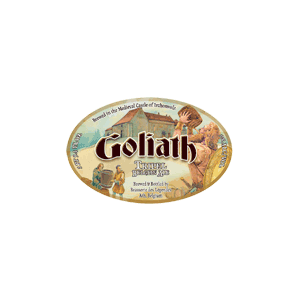
Géants Goliath Tripel LabelInterestingly, this bulky brew started as a much smaller statured creation. Goliath, pronounced “Gouyasse” in the local dialect, was brewed at a respectable 6% ABV. However, the US distributors felt that a 6% beer carrying the name Goliath was a bit oxymoronic, especially with the surge of big-bodied, bold-flavored beers that have surged in popularity. So they suggested that brewmaster Pierre Delcoigne come up with a stronger, more intimidating beer better suited to carry the name of the mythical giant. The result was the beer you now have before you, and it's become quite a hit among Ath locals since its reformulation, so much so that the brewery managed to release less than 300 cases in the US in all of 2009 (greedy locals!!). They still make the original Gouyasse, but Géants Goliath Tripel has become their most popular beer. Made without the addition of sugar, this is the only Tripel in Belgium that is made using only malt as a sugar source for our yeasty friends (unlike other brewers who rely on sugar additions to beef up the alcohol content and thin out the body). This means the beer will start out a bit sweeter when young, a result of the residual sugars from the hefty grain bill, but over time in the bottle, the flavors become increasingly dry. We've been told that six-to-twelve months in the bottle appears to be where this beer really shines; but of course, this is one of those beers that’ll be good for two to three years of aging if kept at cellar temperatures. We encourage you to set aside a bottle or two and check in on this sleeping Gulliver about once every six-to-eight months. Let’s take a moment to admire the attractive packaging, which is brand new for this beer. Formerly available only in 330ml bottles, the beautiful, foil-rimmed, traditional bulged champagne bottle it’s now bottled in will give it somewhat more champagne-like conditioning than you would have found in the old bottles. Some dispute the claim that bottle size and shape matter, but we beg to differ—we’ve tried both the previous bottling and the new, and find the new packaging not only looks impressive, it has a positive impact on the bottle-conditioning and maturation. Now let’s drink it! Wait, wait, we have to look at it in the glass—it’s a gorgeous beer, pouring a sunny butterscotch color capped by a gargantuan white froth. Ok, now let’s drink it! No, no, wait, we have to sniff it first… Look for notes of pear, oranges, rum, rosewater and pepper on the nose, supplemented by hints of vanilla and some grainy notes reminiscent of pilsner malt. Expect an abundance of very zesty hops which contribute notes of wildflowers (akin to lavender), as well as that characteristic Belgian yeastiness, and a subtle tartness. The flavor presents much of the above notes, but with more spice and pepper qualities and a rather pronounced hoppy bitterness and vanilla-like edge that manages to win out in the balancing act against the sweet malts. This is a very hoppy Tripel! Expect a dry finish with orange peel and Saaz hop bitterness rounding out peppery hop notes. A big, gentle-giant of a beer worthy of the Brobdingnagian name it carries. Pair with a sharp blue cheese starter followed by Peruvian-style Pollo Saltado served with rice, yucca fries and fried plantains.

Serving Temperature: 48-55° F
Alcohol by Volume: 9.0%
Style: Tripel
Suggested Glassware: Snifter or Goblet

I'm ready toPlace My Order Button

C&H Internationals Logo Since 1994
Join Our Club
Gift Memberships

Membership Renewals
Reorders
Home Page
More Information
Current Selections
Past Selections
Testimonials
Other Gourmet Clubs
Corporate Gifts
Wedding Gifts
Brewery Search
Style Guide
Beer Fun Section
Industry Resources
Festivals
Print a Gift Card
Send a Virtual Brew
Refer a Friend
Send a Hint
E-Promos
Contact Us
Link to Us

1 - 800 - 625 - 8238
(Outside US call: 949-206-1904)
P.O. Box 1627, Lake Forest, CA 92609