Past Newsletters - June 2010
DOM = Domestic Beer Club; INT = International Beer Club; VAR = Domestic International Variety Beer Club; RBC = Rare Beer Club
The Atlanta Brewing Company (ABC) is the oldest operational craft brewery in the state of Georgia. Like numerous areas of the south, restrictive prohibition-era "hangover" laws have meant slow momentum for the craft beer scene. The fact that this is the oldest of the state's craft breweries, and was founded in 1993, kind of gives you an idea of not only what type of pace the beer scene has been developing at, but, really, how far ahead of the curve ABC was when they decided to set up shop. In late 2005, new ownership and management joined longtime ABC Brewmaster Dave McClure. Robert Budd, President, and Dave Weil, Director of Operations, have been hard at work with Brewmaster Dave in building their brands and getting more people turned on to good beer than you can shake a Georgia peach at (yes, we do reserve the right to create our own ridiculous expressions over here in the newsletter department.)
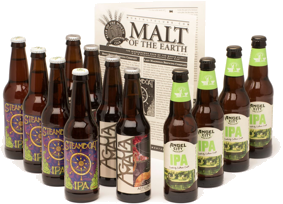
Their Red Brick Ale was the first beer they brewed and it remains their flagship brand, but this month we're featuring their Red Brick Blonde Ale and the back-from-the-dead Laughing Skull. The brewery also serves up a traditional, German-style Hefeweizen in the summertime, a hearty double-chocolate Oatmeal Porter in the winter, and an American-style Pale Ale all year round. Then there are their limited release beers like their Red Brick Barrel Select, a beer that took home Gold from the World Beer Cup in the Wood and Barrel Aged Beer category. This is their Red Brick Ale aged in Jim Beam Bourbon barrels for 10 months. Now that's some southern comfort!
In 2006, the Atlanta Brewing Company was named one of "10 great places to see what's brewing in beer" by USA Today. We agree—especially amidst the awakening of craft-brewed beer's collective consciousness that's currently happening in the South. Turns out ABC also has a great guided tour and beer tasting every Wednesday and Friday from 6 to 8 p.m. Four to six beers are offered on tap, and a tasting room with all the creature comforts one needs for such an affair is currently in the works. Pay 'em a visit and say "Hi" for us.
For more information about the brewery and scheduled tours, call (404) 355-5558.
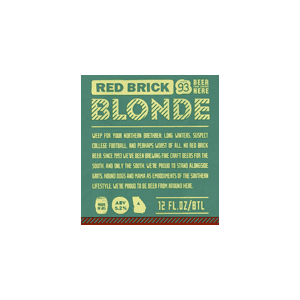
Red Brick Blonde was a Gold Medal winner at the 2007 Great American Beer Festival in the Golden or Blonde Ale category. We love a quality, craft-brewed blonde ale—this is a style that is easy to drink, but full of flavor. Expect clean, light grains on the nose, with hints of toasted crackers, and faintly floral flourishes (say that three times fast!). Lightly lemony hops are detectible, blending with the clean barley notes. The beer has just a bit more oomph in the flavor department, with all of the elements described in the bouquet landing somewhere on the palate, but punched up a bit by a subtle pepperiness from the hops and heaps of tasty toastiness. In the early years of our club, in the mid-to-late 90s, we’d have called this “hoppy”, but in the wake of today’s super-hopped double-IPAs, applying that term here would get us some scoffs. But really, for an easy-drinking golden ale, this is quite nicely hopped. And this is no dumb blonde; it’s smart, well built, and very tasty. Simple, tasty beer is difficult to make. The world needs more microbrewed beers like this, for if there were more of this stuff, there’d be less Bud/Miller/Coors and more people acquainted with simple, GOOD beer. Flavorful enough to keep the connoisseurs happy, but easy enough to drink to make it sessionable, this is a great beer for warm weather, and for warming your friends up to drinking better beer. Should come as no surprise that this beer from Hotlanta is refreshing in the sun. Share it with some cheddar and onion-capped Angus burgers from the grill.
Serving Temperature: 38-43° F
Int'l Bittering Units: 22
Alcohol by Volume: 4.9%
Suggested Glassware: Pint Glass
Malts: 2-Row Pale, Wheat
Hops: Bravo, Cascade
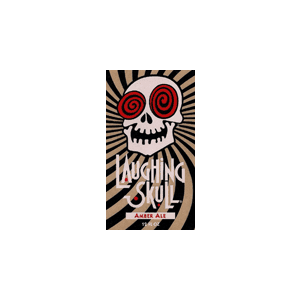
The Skull is back! Originally contract-brewed by the Atlanta B.C. for a local restaurant, Laughing Skull was a local favorite in town that disappeared in 2005. But now the skull has the last laugh, returning, albeit in modified form. Instead of a Bohemian pilsner, the beer is now an amber ale. Expect a great balance of spicy, peppery hops and floral aromatics. Citrus, spice and grains are prominent—this reminds us of the old school, high quality microbrew that led the craft-brewing charge of the 90s. Look for some crackery notes, much like toasted saltines. These also come through in the flavor profile, especially the saltines—with deeply toasted malts (not roasted, but toasted… very different things). Complex maltiness comes from the use of 11 different malts, complemented by plentiful citrus and pleasingly spicy, peppery nips from the hops. It finishes only mildly bitter with a long lasting fade of grassy hops and toasted caramel malts. Overall, this is nicely hopped, expertly balanced, just plain good beer. Great with medium cheddar cheese, it’s even better with some mesquite smoked grilled chicken.
Serving Temperature: 42-50° F
Int’l Bittering Units: 25
Alcohol by Volume: 5.5%
Suggested Glassware: Pilsner Glass
Malts: 2-Row Pale, Munich, Caramel 40, Caramel 60, Caramel 120, Victory, Bonlander, Chocolate, & others
Hops: Bravo, Cascade, Spalt
In 1666 an early "Yankee" named Nicholas Cottrell, together with a group of other settlers, purchased land from the native Narragansett Indians which would eventually become known as the town of Westerly, Rhode Island. Long after the establishment of the town, in 1855, a descendent of Nicholas named Calvert B. Cottrell formed a manufacturing company in Pawcatuck, Connecticut, on the other side of the small river across from Westerly. C.B. Cottrell & Sons, Inc. gained a worldwide reputation as manufacturers of printing presses. With over 100 patents, the Cottrell Company revolutionized printing so much that there was scarcely a magazine or periodical of any standing issued in the United States that was not printed on a Cottrell press in the late 19th and early 20th century.
The Cottrell Brewing Company was founded by Charles Cottrell Buffum, Jr. and his wife Ann in 1996. Charles, a native of Westerly, is the great, great grandson of C.B. Cottrell, and has set up shop within the old factory walls where the Cottrells made their presses for over 100 years. Occupying 9000 square feet of the former 350,000 square foot factory, the brewery's present annual production capacity is about 2000 barrels, and distribution is very limited, with the Cottrell beers available only in Connecticut, Rhode Island and Massachusetts.
The company provides only products that are fresh, full of character, and at the top of their class. The first “shipment” of Old Yankee was on February 28th, 1997, when the first keg was rolled a few hundred yards down the street to the local watering hole and tapped to the cheers of an enthusiastic local crowd. The brewery makes only two beers, both of which we’ve picked up for you this month, and keeps them local to ensure freshness. This is how beer was made and distributed back in the days of C.B. Cottrell—locally produced, and locally consumed. Glad to see this brewery keeping it old school (and just as glad that they shared some of their brews with us for our members!).
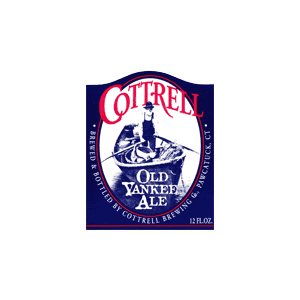
Old Yankee Ale pours a burnished copper color, capped by a faintly beige head. The head has some nice stick to it, resulting in a good lace factor (patterns of froth left along the glass as you empty it. You have poured it into a glass haven’t you? If not, fix that!). Look for notes of orchard fruit (apples, oranges), as well as some caramel and plenty of citrusy, slightly resinous hops. On the palate, the Old Yankee drops notes of sweetbread and gingerbread, caramel and citrus, and in the finish, it ends squarely on the bitter side of things, clinging to the back of the throat in a wonderfully sticky clinginess as grains and malty sweetness fade gently against the bitterness. That bitterness grows with temperature—and we like this one on the warmer side, around 55°F, where it speaks with greatest authority. Proper New England goodness. Pair with dark rooms, conspirators, and plenty to go around.
Serving Temperature: 45-55°F
Int’l Bittering Units: 26
Alcohol by Volume: 5.0%
Suggested Glassware: Pint Glass or Mug
Malts: Pale Ale, Crystal, Wheat
Hops: Summit, Cascade
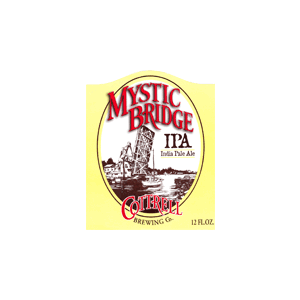
Clear vibrant copper color capped by a nice off white head that laces nicely. On the nose there are big notes of citrus, think oranges and grapefruit, with a hint of pine sap. Slight sharpness results from the union of high alpha acid hops and alcohol, making the alcohol jump out a bit more than its true strength would have you expect. Full of rich caramel and over ripened red apple flavors, some floral aromatics and sharp, bitter, citrusy notes as the hops flex their full muscle. The bitterness is very firm, but not overbearing for the style. Closes out with an earthy, woody finish. A solid example of the style with a New Englanders’ twist. Pairs excellently with spicy Mongolian BBQ.
Serving Temperature: 40-45° F
Int'l Bittering Units: 53
Alcohol by Volume: 6.0%
Suggested Glassware: Pint Glass
Malts: Pale Ale, Caramalt, Crystal
Hops: Centennial, Cascade
Carlow Brewing Company—Bagenalstown, County Carlow, Ireland (Eastern Central Ireland)
So what do you think of when you hear the words “Irish beer?” St. Patty’s Day, and inevitably, Guinness come to mind. Maybe Harp Lager too. Not exactly beers of the craft brewing movement, being owned by massive conglomerates based outside of Ireland. We’re not knocking the beers—Guinness defines what Dry Irish Stout is. For many of us, it was the first good beer we’d ever tried, informing us that there are options other than bland fizzy lager. And Harp ain’t a bad brew either. But these are the big boys of the country. Lucky for the citizenry of Ireland, the Irish mega breweries pump out much better beers than the big boys that we have domestically.
But what’s the craft brewed beer scene like in Ireland? Relatively young; some would say just getting started as it claws its way out from the shadows of the ubiquitous megabrands. At the forefront of Ireland’s craft brewing movement is the Carlow Brewing Company. Independent and family owned, it was founded by the O’Hara family in 1996, building on a keen interest in the craft of brewing and a desire to revive a tradition once common in every town and village in Ireland, but lost since the end of the 1800s.
The brewery is housed in 'The Goods Store', an old stone building which once served as the local provisions sale point for the town’s traders. Beautifully restored and converted, the visitors’ bar is a great place to have a beer after taking a tour of the brewery.
Carlow B.C. is situated in the historical hop and malt growing region of Ireland, the “Barrow Valley” region, evident by the many malt houses dotted throughout the county landscape. Brewery founder, Seamus O’Hara, aimed to revive not only the small brewery culture but also the qualities found in Irish beers from that era and beyond. As Seamus puts it “at Carlow Brewing Company we have gone back to basics and brew our beers as they used to be brewed—with natural ingredients and no artificial additives. We believe this leads to a superior quality product, with robust body, taste, flavor and aroma. Compare these characteristics with any of the mainstream brands and you will taste the difference.” Going up against the big boys, their O’Hara’s Stout was named “world’s number one stout,” by a panel of 33 international judges at the Brewing Industry International Awards, in 2000. Ah, the luck of the Irish.
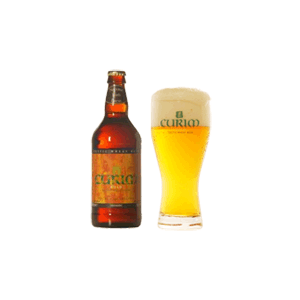
According to old Irish writings, Curim (or coirm) was a form of malt liquor originally brewed by the early Celtic inhabitants of the Barrow Valley in southeast Ireland. Bright and sparkling gold in color, Curim Gold Celtic Wheat Beer is brewed using a blend of pale malt, torrefied wheat and caramalt. On the nose, look for scents of lemon peel, butterscotch, toffee, pepper, and a subtle suggestion of Tequila. It is a very yeasty aroma, with some mustiness and honeyed sweetness, lending a uniquely Irish character to this largely filtered wheat beer. Lightly hopped using Challenger, Mount Hood and Cascade varieties, the result is a refreshing, light citrus aroma. On the palate, expect some notes of butterscotch, toffee, hints of banana and lemony hops with minor bitterness left behind on the palate along with some characteristically tart wheatiness. Very refreshing, this is a great session beer that makes for a nice complement to mild-to-moderately spicy foods.
Serving Temperature: 40-45°F
Alcohol by Volume: 4.3%
Suggested Glassware: Pint Glass, Mug (clear) or Weizen Glass
Oxfordshire Ales—Bicester, Oxfordshire, England (Central South England)
We often think of Britain as a stronghold of highly esteemed pub drinking culture, especially in contrast to our own beer drinking customs, particularly the “culture” associated with the 95% of the US market who are not regularly reaching for good beer but instead opt for pointless ghost-pilsners (you know who we’re talking about). Instead of the ubiquitous pilsner, the world’s most popular style by a long shot, the Brits managed to opt out of the trend toward ever paler lagers that began in the mid-to-late 1800s, instead making Ale their brew of choice. But the popularity and commonplaceness of lager, aided in no small part by the rampant consolidation of breweries throughout Europe into a few mega-corporations, did bring threat to hundreds of years of British drinking tradition. Even though ale remained the primary pub beer, not only was lager always breathing down its neck, the packaging and serving methods associated with mass-produced lager beer began to cast a shadow on ale’s traditions.
You’ve heard about it—the British drinking their beer “warm” and “flat.” Is it true? Not quite. By comparison to kegged, artificially force-carbonated fizzy beer that is typically dispensed in US bars as close to freezing as possible, and often, in an ice-cold glass, then yes, England’s properly served pub ales will seem warm and flat to you. Of course, the only reason that mega-brand beers have to be served so cold is that temperature actually suppresses your ability to taste the beer by dulling your sense of taste. Truth is, a well made beer should taste just fine, and oftentimes better at 45-55°F+, where the palate is awake and aroma compounds are buzzing around instead of sitting catatonic in an icy tomb.
So you can imagine if the norm was to enjoy a naturally carbonated beer in the pub, drawn from a wooden cask kept in a cellar beneath the bar (where it would be in the neighborhood of 50-60°F or so), that cold, artificially-fizzed beer would not be well-liked. That’s exactly what happened in the UK in the 2nd half of the 20th century—people realized that their traditions and their beers were under threat, since by the early 1970s, most beer in Britain was keg beer, filtered (which removes most of the live yeast), pasteurized (which kills the yeast), and artificially carbonated by the injection of carbon dioxide gas instead of letting the yeast do that job in the bottle or other serving vessel. In response to this disturbing development, a grassroots movement, called the Campaign for Real Ale (CAMRA) rose up to protest and reclaim traditional ale and pub culture. They made their terms known, for starters, by defining real ale as “beer brewed from traditional ingredients, matured by secondary fermentation in the container from which it is dispensed, and served without the use of extraneous carbon dioxide.” Today, real ale remains under threat all over the world, but those who produce it, especially those based in the UK, announce with pride their status as “real ale” brewers.
One such proud producer is Oxfordshire Ales, found on the outskirts of the village of Marsh Gibbon on the Oxfordshire and Buckinghamshire borders. The village has long been known for its beer making, with records of brewing activity tracing back as far as 1850. This brewing legacy provides a perfect backdrop for the traditional brews of Oxfordshire Ales.
Sourcing superior ingredients for their beers not only means that Oxfordshire Ales produces a consistent quality ale brew after brew, it also offers them complete control to create something entirely British. They use traditional Warminster Floor Malt, from Warminster Maltings, Britain’s oldest working floor maltings. Warminster uses British barley grown on the Hampshire chalk lands specifically for their use. To bestow just the right hint of bitterness and bring out its characteristic aroma, the brewers add a balanced amount of Styrian and English Golding hops. Live yeast are left in every bottle to permit natural carbonation through secondary fermentation, proudly qualifying as traditional, pub-appropriate real ale. Hoist a “warm” pint of the stuff and enjoy!
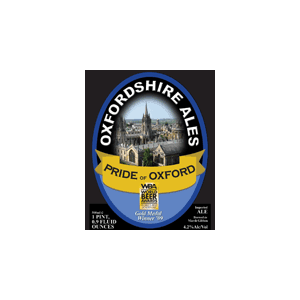
The Pride of Oxford earned the distinction of being the “World’s Best Golden Ale” at the 2009 World Beer Awards. It pours a beautiful pale amber color; a very inviting, good looking pub ale with minimal head that has only a collar after a few minutes—perfectly appropriate for the style, since this is going to be only lightly carbonated. On the nose, it smells fresh, and spot on for traditional English real ale. Look for a truly inviting nose of English hops, faint tart fruitiness, subtle apricot notes, minerals, straw and earth. Like a proper pub ale, things only get better as it warms, and really, you should be enjoying this at 50-55°F despite what your American beer-drinking training (indoctrination?) may have thus far told you. On the palate, this real ale goes down very clean and quite toasty, with a lovely, proper pub ale feel in the mouth. Toasty grains are prominent, and the modest carbonation level mimics cask ale drawn from the cellar. Expect notes of citrus, peach, caramel and cellar-like mustiness. Toward the finish, a very present hoppy dryness kicks in, really cleansing the palate, leaving a tea-like note and very earthy hops as the finish fades out. The Pride of Oxford possesses the same alcohol content as a Bud Light, but good heavens it is so much more flavorful. This is Britain’s everyday beer (or at least, it used to be—as one of the only countries to have held strongly to ale as its primary beer instead of lager, this adherence has come under threat since at least the 1970s). Pair with a ploughman’s lunch.
Serving Temperature: 50-55°F
Alcohol by Volume: 4.2%
Suggested Glassware: English Pint Glass
De Proef Brouwerij (The Professor Brewery)—Lochristi, Belgium (Northern Central Belgium) in Collaboration with Terrapin Beer Company, Athens, Georgia, USA (Southeastern United States)
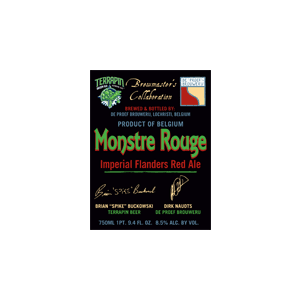
Membership has its privileges… As a Rare Beer Club member, you’ll be the first in the nation to taste the fourth installment of collaboration beers brewed by Dirk Naudts of De Proef Brouwerij and a US craft-brewer collaborator. This year’s beer, like previous offerings, was brewed in Western Flanders, Belgium, at De Proef. And in this corner, representing the US for round four is Brian “Spike” Buckowski, founder of the Terrapin Beer Company in Athens, Georgia. Their creation, called Monstre Rouge, could be described as an Imperial Flanders Red Ale, and it doesn’t hit US store shelves until August—giving you at least a month to gloat and torment your fellow beer geeks (or, share with them… what ever works for you).
De Proef owner and brewing innovator Dirk Naudts is nicknamed “the prof” (as in professor), a sobriquet that he wears with pride. The word hints at learning and teaching, so it’s a logical step to embrace that educational element through the spirit of collaboration. The international craft brewing culture is rather unique in that there are so many brewers vying for a very small piece of the overall pie. In the US alone, there are more than 1,400 craft breweries all splitting their share from about 5% of the total beer market. With so many breweries vying for their very narrow slice of the beer business, you’d think competition would be fierce, and collaboration uncommon. But remarkably, it’s just the opposite. Craft brewers participate in a unique spirit of cooperation domestically, and it turns out the brewing olive branch extends internationally as well. During the past four years, De Proef has played host to a series of US guest brewers from internationally renowned microbreweries—folks like Tomme Arthur of Port Brewing and Lost Abbey in Southern California, Jason Perkins from Allagash Brewing Company in Maine, and John Mallett of Bell’s Brewery in Michigan. Naudts was among the first international brewers to engage in this type of transatlantic team up, and the maneuver has caught on—international collaboration beers are today far more prevalent than they were about five years ago when he came up with his own Belgian-American collaboration concept.
Brian Buckowski of the Terrapin Beer Company also proudly proclaims a nickname on his business card and beer labels: “Spike.” We’re not sure where the spike comes from, but being familiar with Terrapin’s beers, we often think it refers to a heavy-handed spiking of his beers with hops—since the Terrapin beers can carry quite the alpha-acid punch. Among the Atlantic states especially, the American South is experiencing a craft-brewing surge, with some very exciting beers being dreamt up (and served up) down there. Buckowski has played a large part in that uptick in quality beer from the South, having realized early on that he wanted to apply his homebrewing skills professionally to create new beers not formerly available in Georgia, or in much of the South for that matter. Along with co-founder and fellow homebrewer John Cochran, Buckowski introduced their first beer in 2002, and took the unusual step of kicking things off with a spicy, aggressively-hopped Rye Pale Ale. A bold move for a new brewery, but smart; six months after the first pints were drawn at local watering holes in Athens, GA, it won the Gold Medal at the 2002 Great American Beer Festival in the Pale Ale category. In the years since, they’ve rolled out the barrels, oak-aging many of their beers, dosing some with honey, cocoa, and whatever else suits their fancy. They’ve made some pretty big, monster-sized beers, including one called “Big Hoppy Monster,” upon which the De Proef collaboration brew is loosely based (with some of that southern rye thrown in for good measure, of course!).
They brewed only about 110 barrels of Monstre Rouge. Trust us when we tell you, this beer will sell out at the retail level—so you may want to think about upping the number of bottles that you pick up, because not only is this a unique, very tasty brew, it’s going to age wonderfully, so stock up now so you can stash away a few monsters in the closet!
Murky brownish amber with faint hints of crimson and burgundy in the light, this beer pours with a voluminous head that sticks aggressively to the glass. A thin rainbow-colored layer can be seen atop the larger bubbles in the head as the high concentration of hop oils diffracts the light. On the nose, look for a complex layering of oranges, passion fruit, “produce aisle,” grape juice, tartness, powdered aspirin, hints of mint sprig and a fairly prominent undercurrent of barn funk and cellar mustiness. The interplay of the fruits and aromatic hops works wonders against the funkiness, livening things up and begging you to take that first sip. But, let it breathe and warm for a few moments before you do, then sniff again and notice the rock-candy like sweetness that emerges, along with resinous pine sap, candied apple and gentle nips of rye spice. Check back on the aroma, as it will continue to blossom, but for now, let’s get to sipping on this stuff! The first sip yields a burst of produce-like funk as the Brett has clearly worked its magic on the stuff, with a rush of sweet, sticky, grapefruit hoppiness and malts. This funky sweetness is quickly countered by a lengthy arc of very earthy, nearly chalky, hoppy bitterness that coats the palate in more sultry, sappy, resinous hop bitterness. Aroma check: the alcohol has landed… with a little warmth in it the alcohol notes emerge in a most lovely fashion, gracefully sharpening the hops and taming the funk, which itself has increased with temperature. And the alcohol grows a bit on the palate as well, effecting a similar result. It’s a beautiful, funky booziness that somehow manages to cloud and clean the palate at the same time. At full warmth, a bit of caramel has made its way to the party, and very subtle notes of vanilla and barreled woodiness begin to penetrate the palate. Expect a sticky, rather bitter fade that goes on for minutes, not seconds, in the extremely lengthy finish, as after breaths of funk manage to percolate through the heavy blanket of glorious alpha acids.
We guarantee that you have never had a Flanders Red like this, nor an Imperialized Red Ale quite like it—but the best of both worlds have come together taking the tart funkiness of the former and enveloping it with the hoppy aromatics and robust bitterness of the latter. Monstered up with those wild beasts, Brettanomyces, tart and bitter can be disastrous together. Throw in an indulgent level of hops aromatizing things with pine and mint and grapefruit and you’re just asking for the type of chaos that Dr. Frankenstein unleashed. Yet, somehow, The Prof and the Spike have managed to create a truly beautiful beast of a beer here. A food pairing suggestion is a bit of a challenge on this one, as we like it purely straight up as an after dinner sipper, however, it will hold up to Thai or Indian dishes that have been heavily spiced with peppers, and preferably, ginger, as that rooty spiciness will both complement and contrast the flavors of this beer.
Serving Temperature: 45-50° F
Alcohol by Volume: 8.5%
Style: Imperial Flanders Red Ale
Suggested Glassware: Snifter, Tulip or Flute Glass
Brouwerij Roman—Oudenaarde, Belgium (East Flanders) (Northwestern Central Belgium)
Let’s discuss for a few moments the explosion of Belgian beers in the USA. Whether it was your first Hoegaarden, perhaps a Saison Dupont, or that first magic sip of Duvel, chances are your first taste of Belgian beer left a profound impact on you, and maybe even expanded your own working definition of what beer “is.” Maybe it was the shock that a pale Belgian ale could taste so interesting, be so palatable, and carry an 8%+ ABV without any indication of its strength catching your interest in the flavor profile. Or perhaps it was your reaction to the spicy phenolics inherent to so many Belgian yeast strains. Or possibly you tried your first Trappist Tripel and it tasted like nothing you’d ever sampled before. The fact is, Belgian beers are so different than mainstream US macrolagers, which serve as the benchmark for many who think that Bud, Miller and Coors are the only “real” beers and everything else is “weird beer.” And it is that very difference that has helped make them so popular in the US. Big, interesting, flavorful and complex brews that are elegant, refined, often bottled in fancy champagne-style bottles complete with a cork and capped by a wire cage & cap. “This is beer?” “Beer can be fancy?” Obviously, yes.
The Belgians have been happy to send us their beer too—it’s good for their business, and, we’re glad to have them, as for many people, these beers are the very gateways to better beer drinking that heighten people’s interest in exploring other “weird beers” (let’s call them craft beers now that we’ve made our point). US craft-brewers, and even macrobrewers (Blue Moon, a Belgian-inspired witbier, is made by Molson-Coors) have capitalized on the Belgian beer popularity, creating their own “Belgian-style” beers. Therein lies the problem. Now with so many Belgian-themed beers out there, what happens to the family brewers of Belgium who really lay claim to being traditional Belgian brewers? While they remain unique and limited, the consumer can understandably be confused by the virtually ubiquitous use of the word “Belgian” on beers found at their favorite beer bar or retail store.
So what’s a brewery like Brouwerij Roman, brewing since at least 1545, making it one of the oldest family breweries of Belgium, to do to distinguish itself from other Belgian-labeled beers? Join a sort of guild of Belgian family brewers, of course. Belgian Family Brewers is a non-profit association whose members have been brewing in Belgium for at least 50 years, non-stop. Together they represent just 15% of the Belgian brewers, with a total of more than 1,500 years of experience in traditional beer brewing. The label denoting this status can be found on each bottle of beer brewed by Brouwerij Roman and other members. Seeing the BFB logo lets the consumer know that the beer is a genuine Belgian beer brewed in Belgium, comes from an independent family brewery that has been making beer for at least 50 years and is thus a traditional brewery, and that it is an original beer, meaning no copies of the recipe are sold under any other name or label. It’s a mark of authentication, and distinction; fitting for a brewery that has had at least 12 generations of family members at the helm. Think about that for a minute—this family has been making beer at their brewery since a couple decades after Cortés met Montezuma in the Aztec empire. In fact, the first commercial brewers of the family were contemporaries of Cortés—meaning they could have served him a beer (but didn’t… he was in Spain when the brewery was founded…). A historical span that wide-reaching is truly impressive. This is the best of what traditional Belgian brewing has to offer—enjoy!
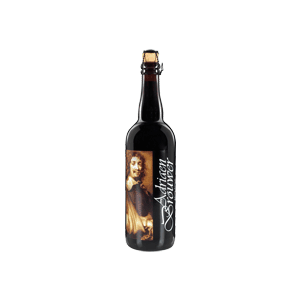
According to some, the namesake of this beer was not only an accomplished artist, but spent every dime he made as soon as he made it and died from an overdose of drink and reckless abandon. A profoundly talented genre painter, at 21 he was declared a master, often making scenes of drunken degeneracy seem delicate. Sadly at 32 (maybe 33) he was dead. While the idea that he drank himself to death might seem to fit accounts of his life and propensities, it is quite likely that it was an outbreak of plague that did him in. But accounts do make it clear: the man did love his drink—and in the brewery rich region of Flanders from which he hailed, naming a beer after him couldn’t be more appropriate. Adriaen Brouwer pours a dark brown reddish color, far clearer than the beers that would have been found in the taverns of Master Brouwer’s day. The beer is topped by a healthy off-white head that fades to a respectable covering and thick collar of foam. It greets the nose with soft, lovely floral aromas of lilac, roses and breakfast tea, lingering atop a bed of citrus fruit. Expect quite a refined aroma on this one. Restrained hop character sits well behaved in the back, playing nicely off of apple and caramel notes. The flavor offers up quite a lot of apple, and a bit of spice, notes of fresh biscuits, and a hint of white grapes (think white wine, possibly champagne). Definitely a malt-centered beer, with expertly balanced sweetness that never becomes cloying; this is a masterful creation. Finishes with lingering floral notes and very pleasant hints of apple pie. Certainly a great beer on its own, we did quite enjoy it with some caraway-flavored Havarti cheese melted over sourdough bread.
While this beer will hold up if you decide to cellar it, we feel that it’s really quite nice right now, fresh and spry and just what the brewer intended. And really, by all accounts, the real Adriaen Brouwer wouldn’t dare have let the stuff sit idle for too long. Why should you?
Serving Temperature: 45-50° F
Alcohol by Volume: 8.5%
Style: Belgian Double Brown Ale
Suggested Glassware: Tulip