Past Newsletters - January 2011
DOM = Domestic Beer Club; INT = International Beer Club; VAR = Domestic International Variety Beer Club; RBC = Rare Beer Club
RJ Rockers Brewing Company (Spartanburg, SC)
RJ Rockers’ slogan is “Handcrafted. Every beer. Every drop. Every time.” And it’s not just a nice sentiment; it’s an honest reflection of the passion that founder and owner Mark Johnsen has for the product he produces. As head brewer, Mark still makes every batch with his own hands.
After serving in the Gulf War in 1991, Mark was stationed in Germany, which ranks towards the top of our list of most amazing places to live if you’re a lover of good beer. What’s more, if you have an interest in actually learning the science and art of brewing, there is no better place to be, and Mark took full advantage of his opportune location to learn as much as he could about the brewing process.
Upon returning to the U.S. after an honorable discharge, Mark was ready to get into the brewing business for himself. The New Jersey native settled in South Carolina, and opened RJ Rockers in 1997 as a brewpub in the historic Morgan Square area of downtown Spartanburg. The brewpub developed a strong and devoted following over the next several years and became a well-known meeting place and watering hole, complete with live bands and trivia games hosted by Mark himself.
After five years of nurturing the brewpub and establishing a reputation for exceptional microbrewed beer, RJ Rockers took the leap from brewpub to full-bore brewery to provide kegged and bottled beer to restaurants, pubs, and stores across the Southeast. A building was acquired to serve as the brewhouse and a 30 barrel brewing system was installed, giving RJ Rockers an annual production capacity of 25,000 barrels – a big step up from their original brewpub system! Environmental responsibility and sustainability have been integral to the brewery’s construction. Solar panels are used to generate much of their energy needs, a steam capture system dramatically reduces water consumption, and the brewhouse’s giant bay windows ensure no electric lighting is needed during the daytime. Even RJ Rockers’ spent grain finds a home with local farmers as cattle feed.
To learn more about RJ Rockers Brewing Company or scheduled brewery tours, visit www.rjrockers.com or call (864) 585-BEER.
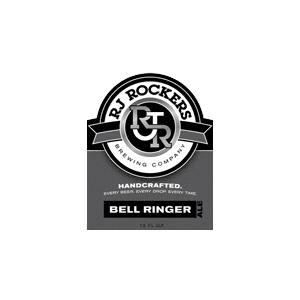
Will RJ Rockers ring your bell with this big, bad, 8.5% brew? Well, that depends on how fast you drink it and how many you have. But, in our experience… well let’s just say our beer panel was quite the lively event the night we sampled this one. On the pour, Bell Ringer offers a delicious-looking hazy amber color with an off-white head with decent retention for the high ABV. On the nose, look for a floral and lightly grassy hop profile with subtle undercurrents of pineapple and grapefruit. Beneath the hop aromas is a rich and somewhat bready malt center with a touch of earthy yeast and a light impression of straw or hay. As you take a sip, the core of sweet, biscuity malt comes to the fore accompanied by hints of brown sugar. Hanging on the malt backbone is a hop profile with enough bitterness to provide plenty of checks and balances, while offering a delicious flavor profile that’s at once subtly spicy, grassy, floral, and citric. The mouthfeel, which is soft, round, and quite full, makes Bell Ringer a pleasure to drink, and the spicy hop bitterness that lingers in the fade kept beckoning us to take another sip. No wonder it rang our bell!
Serving Temperature: 48-55°F
Alcohol by Volume: 8.5%
Int’l Bittering Units (IBUs): 53
Suggested Glassware: Pint Glass, Tulip, or Snifter
Malts: 2-Row Pale, Bonlander, 60L Caramel
Hops: Tradition, Cascade
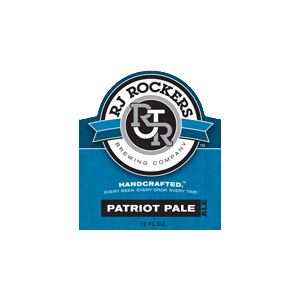
Look for a hazy, golden, light coppery color on this brew, with an ample off-white head that leaves some lacing as it recedes. We found the aroma quite interesting with a grassy, floral, and somewhat spicy hop profile accompanied by a bit of a citric zing. But, almost as prominent is a fairly robust malt profile offering a pronounced sweet toastiness and considerable caramel. These aromas come through on the palate as well, as it opens moderately sweet and stays that way with a strong center of toasty, earthy, grainy malts offering a pleasant caramel malt flavor that builds into the finish, while the hops offer a firmly bitter counterpunch. At the proper serving temperature, all the flavors are equally bold, and combined with a robust body that’s on the full side of medium, the end result is a pretty impressive, satisfying brew.
Serving Temperature: 43-48°F
Alcohol by Volume: 6.0%
Int’l Bittering Units (IBUs): 37
Suggested Glassware: Pint Glass or Mug
Malts: 2-Row Pale, Bonlander, 40L Caramel
Hops: Challenger, Cascade
Lakefront Brewery (Milwaukee, WI)
As home to mammoth beer companies Miller, Pabst, and Schlitz, Milwaukee, Wisconsin has been known more for its big “macro” breweries than for microbrewed craft beer. But, since founding Lakefront Brewing Company in 1987, brothers Russ and Jim Klisch have been dedicated to changing that perception. While there was a family heritage with roots in the brewing and beer service industry, the Klisch brothers ended up in very different careers: Jim was a Milwaukee police officer, and Russ worked in the field of chemical engineering. But then sometime in the early 1980s, Jim developed an interest in brewing and Russ gave him a book on brewing for his birthday. Russ admits that Jim wasn’t too bad at it, and that inspired a measure of sibling rivalry that got Russ bitten by the brewing bug, too. By the mid-80s, the brothers had become quite adept at brewing, and their homebrew was increasingly popular among both family and friends who encouraged Russ and Jim to expand their hobby into a full-fledged business.
Lakefront Brewery remains a locally-owned, small, family-run microbrewery, that has a knack for innovation. In 1992 they bottled the first fruit beer in the U.S. since Prohibition, and in 1996 they created the first certified organic beer in the country. They also introduced “New Grist,” one of the nation’s first gluten-free beers in 2006 (brewed with sorghum and rice in place of barley) so that those with Celiac’s disease could have access to a beer that they could safely drink. Additionally, Lakefront has been a leader in the green business movement in Wisconsin, being awarded the Travel Green Wisconsin certification in 2007.
For more info on the brewery or brewery tours (in which they give you a beer at the start of the tour instead of the end!), call (414) 372-8800 or visit them at www.lakefrontbrewery.com.
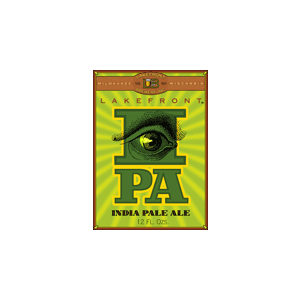
Look for a hazy, orange-amber on the pour, with a big, fluffy head that retains well before dropping to a persistent collar. The aromas are big – it cries IPA as soon as you pop it open, in fact – with prominent piney, herbal hops offering a somewhat minty cannabinoid character, with a touch of citrus rind. Take a sip and the hops hit upfront with that same bold herbal quality, with hints of grapefruit zest and pine. The malts try to get your attention with a crackery, lightly toasty flavor offering some residual sweetness with a hint of fruity esters thrown in, but ultimately the hops declare their supremacy in this brew as the big hop flavors carry into the finish and linger with a firm but not overpowering bitterness. In fact, that’s one of the things our panel really enjoyed about this brew – it’s not super bitter, but it is super flavorful. The smooth and creamy body makes it very easy to drink, and we found it made a great thirst-quenching accompaniment to some super hot Thai pork stir fry with basil and chilies.
Serving Temperature: 45-50°F
Alcohol by Volume: 6.4%
Int’l Bittering Units (IBUs): 38 (an “honest” number per the brewer; 55 using a different calculation)
Suggested Glassware: Pint Glass or Mug
Malts: Cargill 2-Row Pale, Dingemans Cara 20, Dingemans Cara 45
Hops: Columbus, Cascade, Chinook, Simcoe
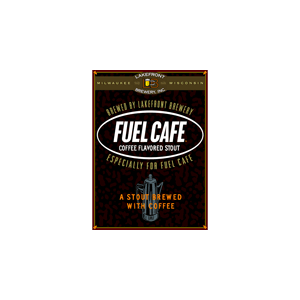
This coffee stout pours, not surprisingly, a very dark, opaque, brownish-black, with a head that retains fairly well and leaves some lacing as you drink down the glass. On the nose there are certainly strong notes of coffee, along with a robust, earthy, roasted malt character. Hops are definitely in the back seat here, as we would expect for the style. The aroma notes come forth on the palate, and there’s a distinct smoky character dancing with the light residual sweetness, and an impression of licorice that builds somewhat with warmth. This smooth, light-to-medium-bodied brew finishes with notes of coffee grounds and chocolate, with a hint of smoke and a bitter touch in the fade.
Serving Temperature: 50-55°F
Alcohol by Volume: 6.1%
Int’l Bittering Units (IBUs): 18
Suggested Glassware: Pint Glass or Mug
Malts: Cargill 2-Row Pale, Cara 45, Dingemans Special B, Crisp Roasted Barley, Crisp Chocolate, Weyermann Cara
Hops: Organic Perle
EKU Brauerei—Kulmbach, Germany (Northern Bavaria, aka Franconia)
OK students, beer class is in session, please take your seats. Find a nice snifter or tulip glass, or some other similar vessel, and commence pouring your first international beer selection. We shall now begin with a short overview of the superb German beers you’ve received this month.
A number of different styles of beer hail from the town of Kulmbach in Northern Bavaria, but most significant and notable among them is the unique style that was invented there known as “eisbock.” Eisbock is a variant of the traditional and famous “bock” beer popularized by the brewers of Einbeck, Germany, about 175 miles to the northwest of Kulmbach. Originally, bock was not known as bock; instead, the term developed as a colloquialism as “Einbeck Bier” was corrupted into “Ein Bock Bier” (which translates as “one bock beer”), and eventually it simply became “Bock Bier.”
Many years after the bock style established itself in Bavaria, a variant known as “doppelbock” (double bock) was crafted, and this new style also grew in popularity. The Paulaner monks in Munich who invented this style named their beer Salvator (“savior”—and you can actually still buy Salvator and a number of other Paulaner beers at many good specialty beer stores and better beer establishments). Sometime after this, yet another variant of the bock theme was “accidentally” invented. According to local legend, a lone barrel of doppelbock was mistakenly left outside in the yard of a brewery in Kulmbach in the middle of winter’s icy grip. Snow piled up and hid the barrel from sight, and there it lay, forgotten, until spring. When the brewery staff discovered it, they found the barrel had split open a bit, releasing some of the contents, and what remained was partially frozen. After chipping off all the ice in and around the barrel, the enterprising brewers decided to sample the residual beer—after all, you can’t let good beer go to waste! Upon tasting the beer, they realized that it had become concentrated and was far richer than normal, with a significantly higher alcohol content (normal doppelbock is about 6.5-7.5% ABV). This serendipitous discovery was the result of the simple fact that water freezes before alcohol, and in the extreme cold of winter some of the water was forced out of the beer and froze, leaving a thicker brew behind. Essentially, the beer experienced an increase in the proportion of alcohol to volume, inspiring the brewers to set about duplicating, refining, and perfecting the “technique.” The result is one of the beers Franconia is most famous for, “eisbock” (ice bock).
Kulmbacher Eisbock, the originator of the style, is produced by Kulmbacher Brauerei, while a similar brew known as EKU 28 is made by their long time adversary in the same town, the EKU Brauerei. EKU is short for Erste Kulmbacher Union, so their name translates as “First United Kulmbacher Brewery” (we’ll cover what the “28” refers to in the review below). Begun in 1872, EKU was a fierce competitor of Kulmbacher Brauerei, as well as the other breweries located in the town, such as Sandlerbrau, Mönchshof, and Reichelbrau.
Kulmbacher Brauerei, as well as the other breweries located in the town, such as Sandlerbrau, Mönchshof, and Reichelbrau.
However, through corporate expansion, mergers and takeovers these breweries have been able to set aside their differences, and in 1996, all of them became unified within the same company, known by the simplest title among them: the Kulmbacher Brauerei AG (Kulmbacher Brewery Ltd.). Though united under the same organization and name, each brewery still operates independently, with the old Kulmbacher Brauerei producing their well-regarded beers, and EKU continuing to make the EKU 28 and EKU Pils that they’ve produced for a combined 170+ years! We’re happy to see the merger didn’t cast any of these excellent beers into the dustbin of history. This month, we bring you both of EKU’s impressive and historic beers for you to savor. Prost!!
For more information (in German) about EKU and Kulmbacher, check out their web site at www.kulmbacher.de.
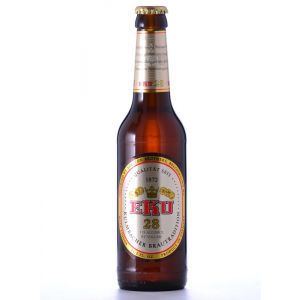
EKU 28 walks a bit of a tightrope act between a standard eisbock and an amped-up, fortified doppelbock. While their recipe has never been released to the public, we do know that it spends an astonishing nine months lagering, during which time the temperature is lowered until the beer starts to freeze. EKU claims, however, that the amount of ice removed from the beer is not really a major factor in its potent level of alcohol or its concentrated flavor. One bit of info that they do acknowledge is the “28” in its name refers to the beer’s “degrees Plato,” which is the German method of calculating a beer’s “original gravity” (a measure of the density of fermentable sugars within the malt/water mixture that begins every batch of beer). To obtain the high ABV, a very large amount of malt must be used to infuse the this mixture (known as wort—pronounced “wert”) with the sugary fuel that the yeast will convert into alcohol. An average beer typically has an original gravity of around 8-10 degrees Plato, so EKU 28 is loaded up with around three times the level of fermentable sugars as a “typical” beer.
On the nose, look for a big, caramel-heavy aroma. The impressive flavor offers up notes of thick caramel and freshly-baked bread, with light fruity hints, and not surprisingly, some notes of alcohol (producing a pleasant belly-warming effect that is quite satisfying around this time of the year). The healthy does of hops creates a very well-crafted finish which balances EKU 28’s sweet overall flavor. You could say that this is a beer for special occasions, but honestly, as soon as you open one you’ve created a special occasion! We actually don’t recommend it with food; we think it’s much nicer as a digestif after a meal, like a port wine or cognac. A full-bodied cigar might work too, if you’re so inclined.
Serving Temperature: 55°F
Alcohol by Volume: 11.0%
Suggested Glassware: Snifter
As you might suspect from the name, EKU Pils is a pilsner, a style that has loosely become the most popular style of beer in the world since its invention in 1842. This style originated in the town of Pilsen in the Czech Republic, and it was the first beer to be brewed clear and golden in color (up until that time, beer was dark and rather murky). Though it’s always remained popular in the Czech Republic, the Germans ultimately became the most devoted fans of the style. They added their own twist, too, brewing it somewhat lighter in body and adding an extra bit of hops to give a refreshing, bitter zing. EKU Pils is a well-carbonated brew, with a big, fluffy, bright white head atop the golden body. Look for notes of spicy and floral hops with a traditional pilsner maltiness. We enjoyed this easy-drinking brew, with its crisp, clean, and dry finish, and lightly lingering bitter hop-forward aftertaste. This beer is great with food, and would be a great accompaniment for anything from pizza, to whitefish, to Chicken Kiev, to spicy Thai or Indian fare. Prost!
Serving Temperature: 48°F
Alcohol by Volume: 5.0%
Suggested Glassware: Pint Glass, Pokal or Mug (clear)
Grand Teton Brewing Company—Victor, Idaho, USA (North Midwestern USA)
Happy New Year! Another year gone. But it’s not gone, really, it’s been “invested” in a bunch of beers that we and our brewing buddies are aging for you. So don’t be down about getting another year older—age gracefully along with our carefully selected series of rare beers featured in the club. This month, we’ve got another beer that has been aging for over a year, and there’s always a little extra dollop of pride when we can pull these types of beers from the US. Beer and hometown pride; in some areas, that might be a dangerous thing, so, use your patriotism responsibly.
Located in the small town of Victor, Idaho, is the Grand Teton Brewing Company. We have a lot to thank these guys for, beyond just the beer being featured this month. They are innovators and trail blazers. Pour yourself a beer and let us tell you more about them.
Picture it: Wyoming, the mid-80s; images of rolling waves of wheat along the Great Plains, wild animal preserves, Yellowstone National Park, grand mountainous terrain, world class skiing. Absolutely gorgeous country and boundless resources, standing in stark contrast to an almost total lack of good beer. Necessity is the mother of invention, and this was a period of time where a few pioneering brewers decided enough was enough—it was time to get full-flavored, freshly-brewed, locally-produced beers back into the fold. Thankfully, two brothers from Wyoming stepped forth to brew and sell beer in ways not seen in that state since Prohibition. Charlie and Ernie Otto, brothers of German-Austrian descent, had long been familiar with great beers. Charlie had become a well-respected area homebrewer, with friends and family constantly asking him to brew more beer (perhaps some of you homebrewers out there know the feeling?). Of course, the pleas for his brew soon spread beyond familial lines as locals caught wind of his fine handcrafted ales. This interest in better, pre-Prohibition style beer got the brothers thinking about starting their own commercial enterprise. But because Wyoming did not issue licenses to homebrewers, Charlie had to muscle up and take on the law. Through an ambitious effort, he eventually helped get a bill passed which would allow him to start selling his beer commercially. In 1988, he was awarded Wyoming brewery license “no. 1”.
That license came just in time—the brothers had already built a small brewhouse in Wilson, Wyoming (just outside Jackson Hole)—so securing the first malt beverage manufacturers’ permit issued in the state in over 35 years made it possible for them to start selling their delicious brew (which is sort of crucial to a business model that calls for the selling of beer). In 1988, the Otto Brothers’ Brewing Company, officially the first modern microbrewery in the state of Wyoming, opened for business.
They soon began presenting their original amber “Teton Ale” to local draught establishments and for the next two years their beers were only available on tap. Seeking a wider distribution through bottling, the brothers decided to get creative. In 1989 they rediscovered a long forgotten container: a European, lidded tin-pail known as a “growler”. The term “growler” was originally used for the tin buckets used to transport beer from the tavern at which it was purchased to the home or local eatery. The Otto Brothers’ Brewing Company reintroduced it in a modern, 64-ounce glass jug version. No doubt you’re familiar with growlers as they have since become commonplace at brewpubs throughout the nation, and the brothers Otto enjoy the credit for having resurrected and recreated this novel (and environmentally-friendly**) idea.
Thus far we’ve told you how the Otto brothers contributed to the good of the nation by setting the stage for a new generation of Wyoming brewers to spring up, and by bringing back the growler. You might think these accomplishments would be enough for these guys to be contented, but they had big plans in the works still! The brothers wanted to bring Wyoming its first brewpub, but again, state law prohibited breweries to act as retailers. Not surprisingly, Charlie was undeterred; with victories in previous legal efforts already under his belt, he began three years of letter writing, phone calling and grass roots organizing to bring about the legalization of brewpubs in the Cowboy state. And wouldn’t you know it, the guy came through for his fellow citizens; in 1992, Otto Brother’s Brewing Company opened Wyoming’s first brewpub. We’ll just say it, this guy is a hero of ours—a true beer champion.
The brewpub brought a surge in popularity to the Otto Brothers’ beer line up (at that point numbering about three ales) and in 1992 they acquired a 22-ounce bottle production line. This meant higher portability and deliverability of their brews, prompting an even greater demand for their microbrews and leading the brothers to break ground for a new, high-capacity brewery at the base of the Teton Pass in Victor, Idaho in 1998. The site was chosen for its proximity to locally-grown barleys and Northwestern hops, as well as nearby Teton Glacier water.
In the Fall of 2000 the Otto Brothers’ Brewing Company was officially renamed the Grand Teton Brewing Company in order to portray a more regional and recognizable marketing approach, while still retaining their proud history and tradition of beer-brewing in the area. While they have moved to Idaho, they left Wyoming, and the region, a better place for beer and brewers. Raise a glass in toast to GTBC and their 22 years of making a difference in the world of better beer.
For more information about the brewery, brewpub or scheduled tours, call (888) 899-1656, or visit their website at www.grandtetonbrewing.com.
2009 Cellar Reserve Sheep Eater Scotch Ale
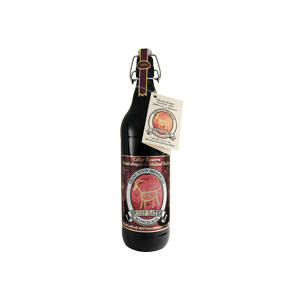
Sheep Eater Scotch Ale was one of four Cellar Reserve beers released in 2009. That year, the brewery decided to focus on each of the four beer ingredients permitted by the Reinheitsgebot [the Bavarian beer purity law of 1516 which states that beer may only be made with malted barley, hops and water (later amended to also include yeast)]. Obviously, this beer showcases the malted barley. Pours a very dark brown with ruby & garnet highlights revealed against bright light. This is one of those beers where you can tell from its behavior during the pour that it’s got a heavy viscosity to it. The head is quite slow to form, but will froth up quite a bit to create a thick, creamy, faintly tan colored head. This fades in time but leaves a lovely collar which laces nicely along the glass. Expect big barley sweetness to hit the nose first—with a tantalizing aroma of freshly brewed beer (pretty impressive given the fact that this beer is over a year old!). Look for notes of dark bread—rather yeasty in nature—and some syrup, but mainly a blast of caramel. There is a peat quality from the use of peat-smoked malt, but it’s restrained, marrying well with the alcohol scents. We also picked up notes of figs, apples and just a hint of coffee. On the palate, the beer is impressively dry for its apparent sweetness—which is one of the key hallmarks of the Strong Scotch Ale (or Wee Heavy) style. It’s all delivered in a full-bodied mouthfeel, which runs just shy of being chewy. There’s more roasted, lightly smoky malt landing on the palate than the nose suggests, and it hits the mark just right. The sweetness evokes fresh fruit, mainly raisins and plums, and there’s also a pretty prominent nuttiness. As it warms, expect alcohol and roastiness to offer a light singeing sensation, giving a spiciness that also helps balance the sweetness provided by the huge malt bill. With added warmth, look also for notes of aged leather. Things definitely dry out in the end through a gentle astringency from the roasted barley, and hops bitter things up just right as the beer remains full and round but semi-dry in the finish. Overall, this is a well balanced beer absolutely loaded with clean yet intense maltiness. Stylistically, they completely nailed it—this is a big, hefty beer that remains clean, easy to drink, and even refreshing. Kudos to this Idaho brewery for creating a beer you’d swear was straight out of Scotland.
Serving Temperature: 45-55° F
Alcohol by Volume: 7.5%
Style: Scotch Ale / Wee Heavy
Suggested Glassware: Tulip, Snifter or Pint Glass
Brouwerij Kerkom (Kerkom Brewery)—Sint-Truiden, East Flanders, Belgium (Northeastern Belgium)
In the countryside of East Flanders, Belgium, on a small family farm amidst Belgium’s best pear and cherry orchards, stirs the unrest of a man who has committed himself to a brave and noble mission to enact change in his country. Perturbed by the decreasing interest in traditional, hoppy Belgium beers, Marc Limet decided to take action and do something about it. Like a number of other small farmhouse brewers in Belgium, Marc felt compelled to move from amateur brewing to a more commercial operation to counter the disturbing trend of dumbing down in Belgian brewing. Unlike larger Belgian breweries, Marc can commit the time required to create true-brew works of art without the use of corn sugar, artificial fruit flavors, or other cheap ingredients. In so doing, he keeps alive the great brewing spirit and traditions of this beer-loving nation.
Marc Limet’s brewery, known as Brouwerij Kerkom, is essentially an extension of the home he has made with his wife Marina. Their on-site pub feels like a welcoming nook of their house; a place where folks from all over the country will gather throughout the year to enjoy these acclaimed farmhouse beers. The Kerkom tradition is not new, however. Brewing has been going on under this name since 1878, when the original Kerkom Brewery was founded after Evarist Clerinx left his studies of medicine to become a brewer (let’s call it a shift from one medicine to another). He purchased an old café known as “La Renaissance” and rebuilt it as a brewery. In 1932, 12 years after the brewery reopened (German occupiers claimed the brewery during the First World War), Evarist’s son Paul took up the craft.
Having later survived the Second World War, brewing continued as a family affair when Jean Clerinx joined the brewery, but times were tough. During WWI there were 127 breweries in the region. By 1965, there were only 13 left. Tastes had changed, and local breweries had closed in droves. Today, only 6 of the original 127 pre-WWI-era breweries are still active—the Kerkom Brewery is one of them.
In 1968, Jean Clerinx also decided to cease brewing operations at Kerkom. After his retirement in 1988, he started up a small brewery that created beers using old-world, traditional methods. In 1999, Marc Limet, masterbrewer and hop-hero took up as Kerkom’s owner and brewer. He has since put 100% of his efforts into bringing the character and flare back to Belgium’s locally-brewed beers by creating new beers with old-world composition.
For more information about the brewery, check out their website at www.brouwerijkerkom.be. You’ll also find information there about bicycling routes through this beautiful region—where you can ride roads that cut between orchards and fruit plantations in the famed region of Haspengouw. Just follow the “appelroute” to get to the brewery. What a great way to recharge after a bike ride through the Flemish countryside! Pick a lighter beer than what we’re featuring this month—this one’s no biking brew.
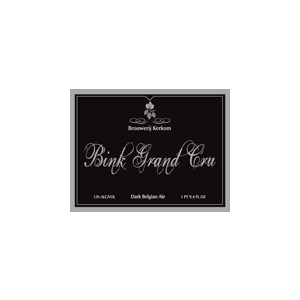
Emphasis on the “Grand”—this is the strongest beer we’ve ever featured in the club, weighing in at a pretty monstrous 13% ABV. We’ve been hunting for some pretty high ABV beers to push the envelope a bit, but they’ve got to be refined, not just powerful. We were thrilled when we tasted the Bink Grand Cru, as it is just the type of beer we’ve been searching for. Pours the deepest possible shade of mahogany, dressed with a toasted marshmallow colored head that fades relatively quickly, but that’s to be expected in a beer of this alcoholic caliber. There’s quite a bit going on in the nose, though you have to get past the aroma of alcohol to pull it all out. Letting it breathe for about five minutes will allow it to air out a bit. Look for notes of sweet maple syrup, maraschino cherries, tawny port, dough, yeast, oats and an herbal note, similar to juniper, which, coupled with the alcohol, provides a gin-like quality. Pretty intense stuff here. This beer has a little brother called Winterkoninkske, which is spiced with juniper, but this beer is not—everything you smell and taste comes from just malt, hops, and a pretty muscular strain of yeast. On the palate, look for some of the port-like qualities to be fully realized, with quite a bit of grape character coming through. Expect notes of orange marmalade, currants, figs, plum wine, overripe cantaloupe and suggestions of bitter dark chocolate. Also notice an undercurrent of herbal characteristics, ranging from leafy bitterness to savory sage. The beer has been hopped exclusively with Belgian hops, and quite heftily so, as there is a firm bitterness even against the massive sweetness and alcoholic thunderclap. Finishes with the warmth and suppleness of aged port wine, grape stem-like woodiness, orange peel bitterness and afterbreaths of alcohol. Overall, this is a very port-like beer that should be served as an after dinner drink, on its own or with a few bites of dark chocolate, as brewer Marc Limet prefers it. It will age for some time to come—and is very difficult to come by, so consider ordering up some additional bottles, because this is one that will stand the test of time. We recommend checking in on a bottle every 12 months or so, for at least the next four years. And do share the stuff—it packs quite a wallop—bear in mind, until less than 20 years ago, 13% was about as strong as a beer could possibly be.
Note: If you’re wondering what the word “Bink” means, you’re not alone—we had the same thought. Essentially it’s a colloquial term of endearment for the inhabitants of Sint-Truiden (akin to the word “dude”, but specific to the people of this area). Many of the beers from the Kerkom Brewery have the term in the name. These Bink beers have clearly been designed to embody local spirit, and these Binks have become a member of the local citizenry themselves.
Serving Temperature: 43-50° F
Alcohol by Volume: 13.0%
Style: Belgian Extra Strong Dark Ale
Suggested Glassware: Snifter