The Microbrewed Beer of the Month Club

Past Newsletters

May 2007

Brewery
Beers Featured
Victory Brewing Company Sunrise Weissbier
Duck-Rabbit Craft Brewery Amber Ale
Victory Brewing Company Hop Wallop
Duck-Rabbit Craft Brewery Porter
Brasserie Duyck (France) St. Druon de Sebourg
Brasserie Duyck (France) Jenlian Blonde

Victory Brewing Company

Let's just call it like it is; the Victory Brewing Company of Downingtown, Pennsylvania is one of America's Best Breweries. But don't take our word for it, Malt Advocate Magazine selected Victory as their Brewery of the Year for 2001. Still not convinced—well, we've got two more ways to assure you (try the beers we've sent you!) We're immensely pleased to be featuring beers from this hugely respected brewery.

Founders Ron Barchet & Bill Covaleski met in 1973 in Montgomery County, PA; both were 10 years old. They remained close friends, though academic pursuits took them to different places during college. Ron headed out to Southern California to earn his degree in Political Science and Economics, while Bill obtained his Bachelor of Fine Arts from Temple University in Philadelphia. Not long after college, both became disenchanted with their chosen trades and picked up the hobby of homebrewing to "drown" their sorrows. In time, the hobby became a new career for both—Ron secured an apprenticeship at the Baltimore Brewing Company and then headed out to Germany to continue his studies; Bill quickly picked up Ron's position at the brewery once he left for Germany. Both became well-versed in the art of German brewing, with Bill earning numerous awards for domestic interpretations of German beers that he developed.

Ron returned from Germany and joined the production staff at Old Dominion Brewing Company in Virginia, and using his newfound knowledge of European brewing techniques & styles, saw production soar 1000% in four years! During their 10 years of homebrewing and commercial brewing for other breweries, they dreamt up a brewing operation that would combine an on-site restaurant and bar serving up freshly brewed beer. In 1996, after earning many accolades for their brewing efforts, and confident in their abilities to set up and run their own brewery & restaurant, they opened the Victory Brewing Company.

We encourage you to visit their website which is jam-packed with info, including details about upcoming events, such as their annual tour in which founders and brewmasters Ron & Bill lead vacationing beer cognoscenti on a 10-day European Pils tour through Germany, the Czech Republic and Austria, along a brewery route that inspired their own brewing careers. They've also got an entire site devoted to cooking with beer and beer & food pairing, complete with podcasts, cooking tips and recipes—you've got check it out at www.victorybeer.com/cooking/. Cooking with beer can be great as a hobby, for bonding with your spouse, or just a creative outlet. Not only that, it's down right addictive!

Speaking of addictive, we've tried something like 15 of Victory's different beers over the years, and we haven't found one that wasn't top notch. If you ever find Victory brews on your beer store shelf (or while traveling to a region that has them), buy them. They're one of the finest breweries in the nation—you will not be disappointed.

For more information about the brewery, restaurant & scheduled tours, call (610) 873-0881 or check out their web site at www.victorybeer.com.

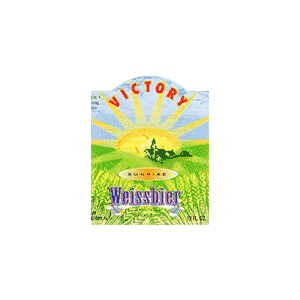
Sunrise Weissbier

Victory Brewing Company Sunrise WeissbierSunrise Weissbier hits the mark exactly; a right-on, true-to-style Bavarian-style hefeweizen. Note the spot-on appearance, including the brilliantly white frothy head. Expect big, yeasty notes on the nose, with bold fruity esters—notably orange, with a hint of banana—as well as cloves and some lemony, slightly herbal noble hop notes. The nose implies ample sweetness, but it's toned down in the flavor to preserve drinkability, another true to style element of this brew. Wheat beers are a bit unlike other brews in that they tend to balance sweeter malt influences by gentle sourness rather than bitterness—which is what we find in this brew. Note a citrusy interplay between orange and lemon tanginess that lingers a bit in the finish. We're on the verge of summer folks, and this is a great beer to have on hand for warm weather, BBQs, and getting that lawn back into shape—truly refreshing, and highly tasty, the brewery recommends pairing with soft, creamy cheeses and juicy summer grapes, or green salads with light vinegar dressings and fresh herbs. Truly, a Victory for Your Taste! Remember, leave off the lemon wedge garnish on this one—it's full of all natural BEER flavor, no help is needed from wedges, of any sort.

Serving Temperature: 38-45° F
Int'l Bittering Units: 15.0
Alcohol by Volume: 5.4%
Suggested Glassware: Weizen Glass
Malts: Wheat, Pilsner
Hops: Hallertau, Mittelfruh

Hop Wallop Ale

Read the left panel of the label for some background on the legend of Horace 'Hop' Wallop. Truth be told, this beer is a legend in its own right. One of the earlier examples of an emerging style known as Imperial IPA, or Double IPA, this beer maintains a unique flavor profile among other such DIPAs (or I2PAs, as they are sometimes abbreviated), due mainly to their proprietary blend of whole hop flowers. In case you didn't already know, hops are a close cousin of cannabis, and if you've been to college, er, we mean, ever smelled cannabis, and certain fresh-picked hop varietals, the aromatic similarities can be striking. Victory uses massive amounts of fresh vibrant hops, and the resulting nose gives the impression of cannabis, as well as pungent citrus, pine sap, and even slight notes of ammonia. Yes, the hops are just massive! Note the thick, sappy head with large bubbles that have a multi-colored, oil-slick-like appearance under good light—them's the hop oils folks—you can literally see the hop content! These sticky oils help foster an extraordinarily long-lasting head. Now, somehow the folks at Victory balance this hops explosion with massive malt content, giving a note of grains, coupled with a distinct German-brew mustiness on the nose. The flavor curve presents a grainy offset that balances the tremendously bitter hops insurgence. But sweet malts are just beaten into submission by the hops. However there are some softer influences coming from the hops, in addition to the sharp bitterness—floral, perfumy evergreen notes soften the edge. Despite the massive hop content and 8.5% ABV, Hop Wallop Ale maintains a refreshing drinkability. Pair with strong flavored foods to match this big beer. We suggest an ultra-spicy Caribbean pulled pork sandwich.

Serving Temperature: 50-58° F
Int'l Bittering Units: 70.0
Alcohol by Volume: 8.5%
Suggested Glassware: Pint Glass, Snifter, or Oversized Wine Glass
Malts: Pilsner
Hops: Undisclosed blend of American & European Whole Flower hops

The Duck-Rabbit Craft Brewery

Farmville, North Carolina is home to one of the newer microbreweries in the country. Founded in 2004, the Duck-Rabbit Craft Brewery is the brainchild of founder Paul Philippon. Before becoming a professional brewer, he taught philosophy at the university level. One of his favorite philosophy texts, Philosophical Investigations by Ludwig Wittgenstein, contains a Gestalt-style image referred to as the Duck-Rabbit diagram. Depending on the viewer's perspective, the diagram looks like, you guessed it, a duck or a rabbit. Now, we're not really sure what it means if you see a duck or if you see a rabbit, but we do know that if you're looking at one of Paul's Duck-Rabbit beers, you're in luck—before you is a guaranteed small-batched brewed, extremely tasty beer. This is the 2nd time we've featured Duck-Rabbit brews, and we are consistently impressed—Paul is one hell of a brewer!

We've surmised that the meaning behind the Duck-Rabbit duality is essentially that 'what one sees depends on your state of mind.' This idea can be applied to one of the brewery's unique features: they're one of very few microbreweries to exclusively brew "dark" beers. Sure, some might see this as a limiting factor for a new brewery, reducing their market potential, while others might be quick to highlight this valuable quality as a conduit for connecting with a niche market within the already niche market of microbrewed beer. Wow, we're getting all philosophical over here… but that's Paul for ya—always trying to make you think! A curse or an advantage? Another dichotomous duality similar to the whole Duck-Rabbit diagram philosophy. Oh man, get these freggin' ducks, no wait, rabbits, no wait, definitely ducks—whatever—out of our heads! (and into our pint glasses where they belong!)

For more information about the brewery and scheduled tours, call (252) 753-7745 or check out their web site at www.duckrabbitbrewery.com.

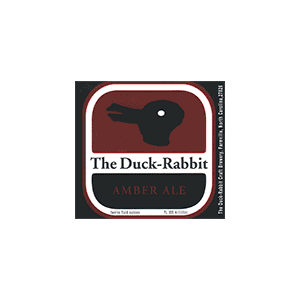
The Duck-Rabbit Amber Ale

The Duck-Rabbit Craft Brewery Amber AleThis medium brown brew is the lightest-colored beer in the Duck-Rabbit line up, and is quite dark for an amber ale. They live up to their motto as "The Dark Beer Specialists"—this is another dark, delicious brew. Expect a sweet nose with some brown sugar and very roasty notes. Look also for notes of fresh grist (brew-speak for grains) and a slight Belgian-candy like sweetness. This beer begins sweet on the palate, with some citrus notes quickly replaced by a firm bitterness that grabs at the back and sides of the tongue, ultimately transitioning to a roasty, peppery hop finish with subtle chocolate notes in the aftertaste. Notably "fresh-tasting", this highly complex beer is sweet & bitter, and is so malty it's close to being a Scotch Ale, but that's the Duck-Rabbit duality workin' on ya. Great with Braised lamb or a traditional Greek Gyro.

Serving Temperature: 43-50° F
Int'l Bittering Units: Not available (medium bitterness)
Alcohol by Volume: 5.5%
Suggested Glassware: Pint Glass or Mug
Malts: "Several Delicious Caramel Malts" (per the brewery)
Hops: Nugget, Fuggle

The Duck-Rabbit Porter

Porters can range in color from medium brown to nearly black, and this one is an example of the latter—it's darker than many stouts out there! This porter has a complex nose with notes of dark chocolate, roasty sweetness, chicory and a woody, fresh-cut pine note. The rich, creamy mouthfeel helps this beer go down easily—this beer has body, and honestly, many porters these days are a bit thin for our liking. The flavors evolve as it warms, developing additional coffee & chicory notes, with a slight citrus & pine twang in the middle, and subtle fruit notes of plum and raisins in the end. Good with bread pudding, chocolate desserts, & coffee cake. A tip of the hat to brewer Paul Philippon for yet another knock out brew.

Serving Temperature: 45-52° F
Int'l Bittering Units: Not available (low to moderate bitterness)
Alcohol by Volume: 5.7%
Suggested Glassware: Pint Glass or Mug
Malts: "Some Oats and Lots of Dark Roasted Malts!" (per the brewery)
Hops: Nugget, Fuggle

Brasserie Duyck—Jenlain, France (Northeastern France, a.k.a. French Flanders)

Now here's a twist… French beer. Sure, we at the club are accustomed to featuring products from France, a nation that provides some of the most wonderful gourmet and culinary resources for our clubs; we regularly feature the finest handmade French cheeses in our Gourmet Cheese of the Month Club, delicious boutique wines from vineyards throughout France in The International Wine of the Month Club, and sumptuous artisanal French chocolates in our Gourmet Chocolate of the Month Club. But beer from France? It's certainly not what the French are known for when it comes to their exported libations. And admittedly, the French do not hold the custom of beer drinking anywhere near the same regard as the imbibing of their cherished wines. Notwithstanding this however, the French have created some exceptional beers over the years, particularly in the northeast of the country where they have taken a lesson from brewing culturists in the nearby Flanders region of Belgium. Truth be told, these neighboring cultures have borrowed from each other—the Flemish have incorporated wine- and champagne-like features in their beers, and the French in turn have 'borrowed back' these traditions and characteristics in theirs. Which is not to say the French lack originality in their beers, for in fact, a unique style of beer referred to as bière de garde originated in northern France. Bière de garde remains today the only original, traditional beer style indigenous to the country.

Literally translated, bière de garde means "beer for storage." The style is somewhat similar to the Belgian Saison style (farmhouse beer) not only in flavor, but also in its pastoral origins. Originally brewed in French farmhouses either during winter or spring and stored for drinking in the summer as a refresher for farmhands, farmers, and their families. It remains one of the best kept secrets of France, due in part to the eclipsing nature of their vast wine export market, and is one of the least available styles of beer worldwide. Though wine is not the only culprit here—the vastly popular beers of next door neighbor Belgium have also cast a shadow upon the adjacent beers of French Flanders. With such giants in their company, it's no wonder the style remains largely unknown.

Thankfully there are a few breweries in northern France, in the region that is known by a few titles—French Flanders is one, Nord-Pas de Celais is another—that still produce this rare style. Our featured brewery, Brasserie Duyck, is the second largest independent brewery in France, and is by far the largest one making bière de garde. The brewery, founded in 1922 on a site that was once a farm, is credited with reviving the style as well as encouraging countless smaller bière de garde breweries in northern France.

Duyck is the surname of a family of French brewers who settled in the hamlet of Jenlain in 1922 (hence the name of our second featured beer). Léon Duyck was the first member of the family to take up the trade of brewing. He passed his passion for brewing fine beer down to his son Félix, who set up his farmhouse brewery in Jenlain, near Valenciennes, where he produced his first matured beer which would become the famous Jenlain. The name of the village was not adopted as the name of his famed beer until 1968, many years after it was first created. At that point, the brewery had been under the control of Félix's son Robert for eight years. Robert held the helm of the family business for thirty years before passing it on to his son Raymond (great grandson of the family's brewing patriarch, Léon). That's four generations of family brewing, and you just can't underestimate the value brought to a brewery by having the same family controlling the process for over 80 years—guaranteed excellence in brewing!

In keeping with the times and increased demand for their beers, Duyck has pursued an active development policy since the beginning of 2002, adding eight new vats for their filtered beers, five others for the top-fermentation process, as well as a new kettle and a cleaning unit to increase the brewery's production capacity and to meet new market demands in terms of quality and protection of the environment. Despite their brewing scale and recent expansions, Duyck remains a traditional farmhouse brewery, complete with traditional pantiled buildings and rustic atmosphere. If you ever find yourself in the Northeast of France, visit Jenlain and enjoy this fantastic beer at its absolute freshest.

If you'd like more information about the Brasserie Duyck, check out their website at http://www.duyck.com.

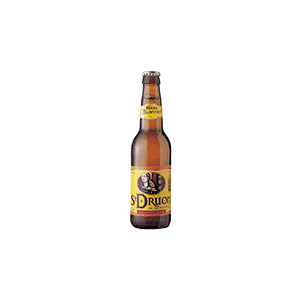
St. Druon de Sebourg

Brasserie Duyck St. Druon de SebourgBrasserie Duyck's brewing traditions have remained unchanged since the time Félix Duyck founded the brewery in 1922. In making their beers, only the finest ingredients are selected, and meticulous attention is paid to all stages of the brewing process. The mash (the early mixture of crushed barley and water) is brewed traditionally and allowed to filter naturally with no mechanical pressure. Then, for a period of 40 days, it's just the beer and time, left to work its magic with top fermenting yeast during the maturation period. Not to mention the water, an essential ingredient in the brewing process, drawn fresh from the well beneath the brewery and mixed with malted barley selected from the best varieties, or the 20 controls performed on each brew to guarantee its purity, or Raymond Duyck who tastes each brew himself, or the hops, grown in Alsace, that give the beer its aroma and bitter flavor, or finally the Beauce-grown wheat used in some of Duyck's recipes.

St. Druon, formerly known as Sebourg beer, is an abbey-type beer with 6.0% alcohol by volume. It was rechristened "Saint Druon de Sebourg" in 2000 as a tribute to Saint Druon and the little church in Sebourg, a village next to Jenlain. Druon, a homeless but pious orphan, wandered the roads until he settled in the village, and is still honored and revered by pilgrims each year. The brewery is now one of the church benefactors and has contributed to the cost of renovating the main edifice.

Malted barley and three varieties of hops grown in Alsace form the basis of this beer's recipe, which, unlike Duyck's other beers, also contains wheat from the Beauce region of France, milled in the traditional way by Sebourg's miller. And to give it an even more distinctive flavor, the Duyck family uses a specific strain of yeast exclusive to this beer. This beer is the French equivalent of a blonde abbey ale, similar in style to those found across the border in nearby Belgium, though it also retains quite a bit of the flavor characteristics of the style that made the brewery famous, bière de garde. We found it to be spicy and effervescent, and brimming with herbal/resinous hops. Begins with a medium bitterness, moving toward a sweetish note of pears, apple skins and raisins, with a lemony zest and mineral-like, earthy hoppiness in the champagne-like finish. Try with a pecan crusted chicken and spinach leaf salad.

Serving Temperature: 48-55° F
Alcohol by Volume: 6.0%
Suggested Glassware: Tulip

Jenlain Blonde

The best known example of the bière de garde style, the source of Brasserie Duyck's renown is a beer called Jenlain Ambrée. This style originated before the age of refrigeration, so the cooler winter and early spring months were used advantageously as an ideal time to brew the beer. However, as it was intended as a beer to enjoy during the hot summer months, this style required a beer sturdy enough to age in the bottle, yet refreshing enough to enjoy in warm weather. The resulting beer accomplished both ends. Unique not only in its flavor, this was the first beer to be bottled in 750ml champagne-style bottles with a wire-fastened cork. When it was first created, beers were typically sold in wooden barrels and sold only in local taverns and village fairs. After the second World War, people's lifestyles began to change and large, spring-fastened bottles appeared on the scene, enabling people to drink in their homes. This gave Duyck's the idea of using empty champagne bottles to bottle their beers. Thus began their campaign of recovering empty champagne bottles after village fairs, as well as from restaurants and bars. As Brasserie Duyck's fourth generation family owner Raymond Duyck recalls, "when we were children, we were given the job of scraping off the aluminum collars before the bottles were washed, filled, corked and a wire fastener attached."

In 2005, a new addition to the Janlain family was born. Considered the little sister of their flagship ale Jenlain Ambrée, Jenlain Blonde, modeled after a Belgian Strong Pale Ale, became very popular. Its name was changed to Jenlain No. Six, and another version of Jenlain Blonde was released. This version, which has become hugely popular, is an amped up interpretation of traditional bière de garde. Highly drinkable, this beer somehow manages to mask its big 7.5% ABV with a clean, crisp herbal hoppy profile. The Jenlain beers are known for their very earthy hop characteristics—this is no exception. Look for vibrant notes of summer fruits, including cassis, some musty yeastiness and earthy hops. Flavor profile closely mirrors the nose, with a grassy, spicy hop bite in the flavor and finish. Partner this with shellfish or London Broil.

Serving Temperature: 43-48° F
Alcohol by Volume: 7.5%
Suggested Glassware: Oversized Wine Glass

C&H Internationals Logo Since 1994
Join Our Club
Gift Memberships

Membership Renewals
Reorders
Home Page
More Information
Current Selections
Past Selections
Testimonials
Other Gourmet Clubs
Corporate Gifts
Wedding Gifts
Brewery Search
Style Guide
Beer Fun Section
Industry Resources
Festivals
Print a Gift Card
Send a Virtual Brew
Refer a Friend
Send a Hint
E-Promos
Contact Us
Link to Us

1 - 800 - 625 - 8238
(Outside US call: 949-206-1904)
P.O. Box 1627, Lake Forest, CA 92609