The Microbrewed Beer of the Month Club

Past Newsletters

June 2007

Brewery
Beers Featured
Sprecher Brewing Company Special Amber Lager
Mercury Brewing Company Ipswich Dark Ale
Sprecher Brewing Company Black Bavarian
Mercury Brewing Company Ipswich Origional Ale
Williams Brothers Brewing Company (Scotland) Grozet
Brauerie Dinkelacker (Germany) CD-Pils

Sprecher Brewing Company

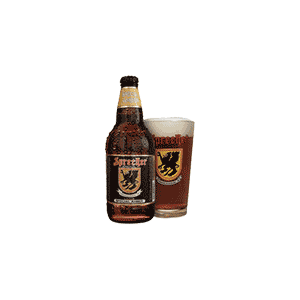
We've been fans of the Sprecher Brewing Company for some time, but this is their first appearance in the club. And with 20 beers in their cumulative brewing portfolio, we're sure it won't be their last. We're excited—and know you will be too—these are some fine brews! The first thing you'll likely notice is, based on the beer label, their brews give the impression of being an import, what with the griffin-like emblem and type-face (& the name Sprecher (meaning "speaker" in German), implying a German brewery). Then closer examination reveals the bannered line "Established in Milwaukee – 1985"—it's almost jarring to discover this beer isn't brewed by a 200+ year old brewery from Bavaria (and that's before even tasting the stuff—you'll really question it after you try them!).

Sprecher Brewing Co. was founded in 1985 by Randal Sprecher, a former brewing supervisor at Pabst Brewing Company, in Milwaukee, Wisconsin. Within 10 years the company had outgrown their first location and in 1994 they moved to their current location in Glendale, Wisconsin. The new, larger brewery enabled the company to continue growing; today they remain proud contributors to Milwaukee's great brewing tradition—and by Milwaukee's great brewing tradition we don't mean the current macro-behemoth based there—this city was, in the late 1800s, home to more than 80 breweries—but prohibition changed all of that in 1919. Still, it can be spoken of historically as a brewing town.

And the Sprecher beers certainly speak to us—they tell us these guys know what's up—these are great beers indeed. If you're ever in the Milwaukee area, drop in to Glendale, Winconsin for a visit and buy what ever Sprecher beers you can get home with you (helpful hint: bring an extra suitcase)! For more information about the brewing and scheduled tours, visit their website at www.sprecherbrewery.com or call them at call (414) 964-7837.

Special Amber

Sprecher Brewing Company Special AmberThis lager recently picked up the Gold Medal at the increasingly prestigious 2006 L.A. County Fair (they also took home another 5 Golds, 3 Silvers and 2 Bronzes!). This is essentially a Vienna lager, but with a slightly amped up hop bitterness, and has been Sprecher's best seller since they opened 22 years ago. Five weeks in the lagering tanks smoothes out the bitterness and melds the caramel malt & fruitier flavors together. On the nose, expect fresh-bread and a characteristically German mustiness from the yeast, with woody hops, toffee, mild citrus tones and a hint of roastiness. The flavor presents far more sweet caramel presence than implied by the nose, with faint grains, ripe apples, and a hint of apple cider, all cleansed and balanced by a late-breaking moderate bitterness. Very nice, and surprisingly excellent with baked ham and mac & cheese.

Serving Temperature: 50° F
Int'l Bittering Units: 22.0
Alcohol by Volume: 5.0%
Suggested Glassware: Mug or Pint Glass
Malts: 2-Row Pale, Munich, Belgian, Caravienna, Caramel
Hops: Cascade, Mt. Hood

Black Bavarian

This strikingly dark German-style schwarzbier is so dark and hearty, it has to enter US brewing contests as a robust porter. Contrary to the name, most schwarzbiers (translated as "black beers") are more of a dark brown; but this is quite nearly black and is the darkest example we've ever seen. Expect deeply roasted malts on the nose, with some lightly charred, smoky notes, burnt chocolate, charred marshmallow and roasted coffee beans. The beer is velvety smooth in the mouth thanks to 8 weeks of aging in the brewery's lagering tanks, with smoky notes, flourishes of plum, coffee, dark chocolate and a latent but firm bitterness in the finish, through which most of these flavors persist. Pair with a well-done, deeply charbroiled steak or a handful of figs.

Serving Temperature: 60° F
Int'l Bittering Units: 32.0
Alcohol by Volume: 5.8%
Suggested Glassware: Pint Glass, Stein or Mug
Malts: 2-Row Pale, Caramel, Black Patent, Chocolate
Hops: Cascade, Mt. Hood, Tettnanger & Chinook

Mercury Brewing Company

The Mercury Brewing Company was founded in 1999 when the former brewmaster of the Ipswich Brewing Company, Rob Martin, took over the outfit from the original founders (1991) Paul Silva & Jim Beuvais. While the brewery's name may have changed, the Ipswich line of beers has been around for 16 years—and what's perhaps most intriguing about these beers is how darned good they are, considering that between these three guys, their previous vocations had little to do with beer; one was an architect (Rob), another a psychologist (Paul) and the third was working in the software industry (Jim). Bringing these roles together just screams good beer, right? Well perhaps it does make sense, as these beers are well-designed (thanks Rob!), well-thought out and thought provoking (thanks Paul!), and up to technical snuff if you will (thanks Jim!). It just goes to show you, if you have a passion for brewing beer (and you're at least a good homebrewer like these fellas were when they started) then it makes no difference what your day job or trade is—in fact, most domestic brewery owners weren't brought up in brewing families or originally trained as brewing professionals—most found their calling after spending tens of thousands of dollars on college and then realizing they hate their day jobs! (just kidding… sort of… it's actually kind of common).

The brewery is located in Ipswich, Massachusetts, located in the area known as the "North Shore", which is north of Boston right along the water. It is an area known for its great microbreweries and many of them have the Ipswich & Mercury Brewing Companies to thank for that reputation. And it's certainly worth a visit—especially considering that you'll have plenty of fresh beer from the Mercury Brewing Company available to you. Named after the Roman messenger to the gods, the brewery lives up to its name by delivering the message that those who seek out "good beer" really are gods on Earth! (well, that's how we look at it). Turns out the gods also like soda—these guys brew a bewildering variety of hand-crafted soda pop as well.
For more information about the brewery, their beers and sodas, and scheduled tours, call (978) 356-3329 or check out their web site at www.mercurybrewing.com.

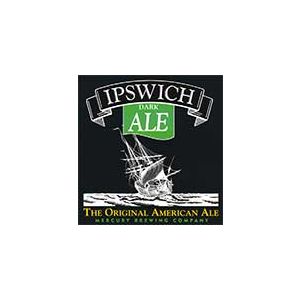
Ipswich Dark Ale

Mercury Brewing Company Ipswich Dark AleLook for slightly roasty notes on the nose, with an emphasis more toward toasted biscuits, and a deep orange character accented by spicy hops nipping gently at the nostrils. Also expect some chocolate in the background. The flavor has some roastiness, but overall this beer is incredibly smooth, with a dose of cocoa and bitter, rind-like hops. Panel members also picked up a trace of nuts and a distinct flavor reminiscent of whole-grain bread. Pair with pastrami on pumpernickel, heavy on the mustard, or sauerkraut & brats—talk about ideal food pairings; either combo is utterly fantastic!

Serving Temperature: 45-53° F
Int'l Bittering Units: 40
Alcohol by Volume: 5.8%
Suggested Glassware: Pint Glass
Malts: Canada Pils, Franco-Belges Caramunich, Baird Roasted Barley
Hops: Warrior, Tettnang, Cascade

Ipswich Original Ale

Named one of the World's Ten Best Beers by Wine Spectator Magazine, Ipswich Original Ale is widely regarded as one of the finest American-brewed English-style pale ales, ever. Expect notes of apples & caramel with a slightly grassy hop profile on the nose. As it warms, the hop aromatics further develop, offering a scent somewhere between grapefruit peel and orange rind. We found the taste complex, full of malty sweetness with a honeyish accent that complements the subtle toastiness. Extraordinarily well-balanced, the thickly bitter hops are somehow massive yet subdued as they completely cleanse the palate and stick to the back of the tongue & throat for a finish that is on the order of minutes rather than a fleeting few seconds. Overall, very flavorful and satisfying. Pair with some English Stilton cheese, or a Welsh-style rarebit.

Serving Temperature: 45-50° F
Int'l Bittering Units: 30
Alcohol by Volume: 5.4%
Suggested Glassware: English Pint Glass
Malts: Canada Pils, Franco Belges Caramunich
Hops: Horizon, Willamette

Williams Bros Brewing Company (Heather Ale, Ltd.)—Alloa, Scotland (South Central Scotland)

Beer has been brewed in Scotland long before hops were used to act as the bittering agent in beer. As beer is principally derived from boiling malted grains in water, it is inherently sweet due to the sugars released by those grains. To balance the beverage, a bitter flavor counterpoint is needed to offset this sweetness. Today, that's done almost exclusively with hops, but until fairly recently in the grand history of beer, beer's natural sweetness was offset by many other ingredients from roots to flowers to bark to fruit. But the first documented use of hops in brewing dates back to 1079, and they weren't widely introduced to UK beers until the early 1500s. And since beer has been brewed for thousands of years B.C., and because groups of people were rather isolated from one another, that meant cultural and agricultural influences played a huge part in creating many regional differences in beer. Many of the indigenous beers of Scotland, with their unusual, pre-hop ingredients, showcased varied flavors—but largely slipped away into obscurity ages ago. But one man had a plan to reclaim these ancient beers from the deep vaults of time.

Bruce Williams, a brewer and homebrew shop owner in Scotland, began in 1986 to make batches of a unique "Heather Ale" using an astonishingly old recipe. Don't ask us how, but in 1986 Bruce uncovered an ancient recipe for "leann fraoich" (Gaelic for heather ale). Heather of course is the flower responsible for the purple hues in the mountains of Scotland. It was used to make beer long before the first hops were ever added to ancient brewing vessels. Beer made with heather is among the oldest beer styles produced in the world (traces of a fermented beverage made with heather flowers have been found dating back to 2,000 B.C.!). Since brewing his now famous Heather Ale, Bruce has triumphantly resurrected additional traditional Scottish beer styles through a partnership with Heather Ale, Ltd., a company dedicated to the resurrection and preservation of authentic Scottish beers. Included in their intriguing and tasty line up are revived concoctions similar to those which once passed the lips of Welsh Druids, Vikings and Celtic tribesmen. Each contains unconventional ingredients—anything from bog myrtle, meadowsweet & Scottish gooseberries (all used to create this month's featured ale, "Grozet Gooseberry & Wheat Ale"), meadowsweet, Scots pine, spruce shoots, elderberries, bladderwrack seaweed and of course, the famed heather. This month, we are proud to offer you an authentic taste of Scotland's tasty malted heritage by bringing you another of their ancient ales of distinction.

For more information about Williams Bros Brewing Company or their sister company, Heather Ale, Ltd., including their many interesting & historic libations, check out their web sites at http://www.williamsbrosbrew.com & http://www.heatherale.co.uk/

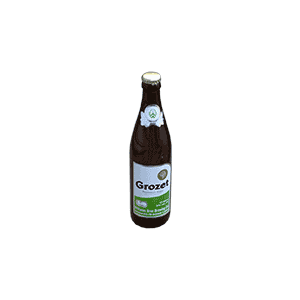
Grozet

Williams Bros Brewing Company GrozetA most interesting brew, brewed with wheat, bog myrtle, meadowsweet and secondarily fermented with Scottish Gooseberries. Is this a recipe from Harry Potter's magic class or a beer? Most definitely, it's a beer—but that's not to say there's no magic in it. The term Grozet is Auld Scots for Gooseberry and comes from the Gaelic "Groseid". Since at least the 16th century, Scots monks and alewives brewed indigenous drinks from cereals, wild herbs and ripe fruits. This is a modern day re-creation, with a notable difference being there are hops used in the recipe, giving the nose and flavor a mellow peppery hop note. Of course, berry notes are present, and come off very natural, not "extracty" like many of today's fruit beers which simply add fruit extracts rather than fermenting with the real thing. The gooseberry flavor is subdued when this beer is cold but blossoms as it warms, and when coupled with the wheat, provides an increasing tartness in the finish. So a bit of advice: if you don't like the sour/tart kick that comes from many wheat beers, drink this on the cooler side of our suggested temperature range. But we encourage you to drink it on the warmer side to truly experience the gooseberry flavor—come on, how often do you get to try gooseberries? The berry flavors are tough to describe, but are quite like the flavor you get when you eat watermelon and bite into the green/white section near the rind—slightly acidic, nearly bitter, but still mildly sweet. Overall, a well-crafted balanced brew—great with rising summer temperatures. Recommended with light foods, pastas and salads.

Serving Temperature: 45-53° F
Alcohol by Volume: 5.0%
Suggested Glassware: Stange or Tom Collins Glass

Brauerei Dinkelacker—Stuttgart, Germany (Southwestern Germany)

Aficionado or novice, you've no doubt encountered the terms Bavaria and Oktoberfest, two words that have made their way onto many a beer label. Bavaria is, of course, the German heartland of beer brewing and drinking, producing more beer per capita than any other region in the world.

The word Oktoberfest has become synonymous with high-quality German beer and brew drinking enthusiasm. The Oktoberfest celebrations began in Munich in 1810 to honor the Bavarian Queen Theresia (wife of King Ludwig). Originally a country fair, Oktoberfest has grown to draw worldwide patronage. The primary rival to the Oktoberfest is the autumn fair of Stuttgart, held in the riverside district of Cannstatt. This event was started in 1818 by the King of Württemberg. Our second featured international beer comes to us from Stuttgart, the capital of Baden-Württemberg, Germany's largest southwestern state. Brauerei Dinkelacker was founded there in 1888 by Carl Dinkelacker, though records dating back as far as the 1500s allude to brewing in the region by the Dinkelacker family. So what's in a name? Dinkel is the German word for spelt, an early form of wheat (often used in beers of southern Germany) and Acker is German for field. So with a name like "Carl Wheatfield", brewing was a destined calling.
Coincident with the industrial revolution that swept the world in the early 1900s, Brauerei Dinkelacker also underwent major technological changes. A consequence of industrialization was a population boom in metropolitan areas. More people meant more workers, which in turn fueled technological advancement, but also required implementation of automation in the brewing process in order to satisfy the demand of the growing populous. Thus, as industrialization begat industrialization in Stuttgart, Dinkelacker added automated brewing and bottling components in 1903. The following sixty years brought tremendous growth for the brewery as they gained international appeal. In 1963, major technological updates were again performed at the brewery. Because of their reputation of constantly being on the forward cusp of brewing technology since their founding, founder Carl Dinkelacker is regarded by many to be the father of the modern day brewery. Their brewery is today considered one of the most modern and environmentally friendly in the world.

If you'd like more information about Brauerei Dinkelacker (and can read German) check out http://www.dinkelacker.de.

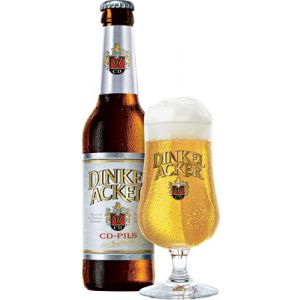
CD-Pils

The interestingly named CD-Pils is one of Dinkelacker's first. Still bearing the initials of its creator, Carl Dinkelacker, this beer is light and delicately tart. It is brewed using hand selected Bavarian Hallertau hops—the most renowned hop cultivating region in the world—and is still made in the heart of Stuttgart as it has been for more than 100 years. Note the pale straw color and crisp, clean taste bursting with floral, spicy hops and pale malts. This is a nice example of the German Pilsner style that is well-balanced and flavorful, medium-bodied and very dry in the finish. Fresh beer and strict quality control methods are key in Dinkelacker's brewing policies, with each freshly-brewed batch taste-tested by their Masterbrewers. From traditional recipes to technical precision, these guys have a science meets art approach to brewing. And international judges dig the stuff too; the Dinkelacker CD-Pils took home the Bronze in the Pilsner Lager category at the 2003 World Beer Championship. A very versatile style when it comes to food partnering, feel free to experiment with anything from pizza to lobster to eggs benedict (but for your sake and those around you, not all at once please).

Serving Temperature: 48° F
Alcohol by Volume: 5.0%
Suggested Glassware: Pilsner Glass

C&H Internationals Logo Since 1994
Join Our Club
Gift Memberships

Membership Renewals
Reorders
Home Page
More Information
Current Selections
Past Selections
Testimonials
Other Gourmet Clubs
Corporate Gifts
Wedding Gifts
Brewery Search
Style Guide
Beer Fun Section
Industry Resources
Festivals
Print a Gift Card
Send a Virtual Brew
Refer a Friend
Send a Hint
E-Promos
Contact Us
Link to Us

1 - 800 - 625 - 8238
(Outside US call: 949-206-1904)
P.O. Box 1627, Lake Forest, CA 92609