The Microbrewed Beer of the Month Club

Past Newsletters

August 2006

Brewery
Beers Featured
Odell Brewing Company Levity Amber Ale
Waimea Brewing Company Waimea Bay Pale Ale
Odell Brewing Company Cutthroat Porter
Waimea Brewing Company Luau Lager
EKU Brauerei (Germany) EKU Pils
De Struise Brouwers (Belgium) Struisse Witte

Odell Brewing Company

The Odell Brewing Company is one of the relatively few trailblazing microbreweries founded at the start of the microbrewery renaissance to still be brewing strong! Founded back in 1989—rather early considering that most microbreweries in the country today are less than 10 years old—they're well into their second decade of success. Family-founded and owned since day one, the company was only the second microbrewery to open in the state of Colorado; those of you who know how densely populated with microbreweries Colorado is will understand how impressive this really is!

So, what's their secret? Well, it comes down to the beer, and these guys craft some greats. Owners Doug Odell, wife Wynne and sister Corkie have their good family name on every product, which certainly helps ensure that what they deliver is top notch. Combine this element of family pride with the finest and freshest English and Domestic ingredients, throw in equal parts adherence to English-style ale-making tradition and American microbrew ingenuity, and you've got a true recipe for success. Speaking of their ingredients, they're the only American brewery that imports malt directly from Thomas Fawcett and Sons, a seventh generation family malter located in Castleford, England—talk about going traditionally English!

While the brewery has expanded several times, one of the most important additions was in 1997; their 5-barrel pilot system. One tenth the size of their commercial brewing vessels, this small scale production set up was introduced for experimentation. Every few weeks, they create a new specialty beer to share only in their on-site tasting room. If they're particularly well-loved by the brewers and guests, then they make their way to the bottling line for distribution.

This month we're happy to offer you two of their fine malty nectars: Levity Golden Amber Ale and Cutthroat Porter. Very different styles with one thing in common: great taste. Perhaps they'll inspire you to want to run out and start your own microbrewery! Just remember, these guys have been at it for a while now, so if your early homebrews aren't up to par, well then, don't be surprised, it takes years to get beers this good. If you do manage to concoct something that even comes close to the flavor and body of their Porter, however, get to work starting that microbrewery (and send us a few bottles while you're at it!)

For more information about the brewery and scheduled tours, call (970) 498-9070 or check out their web site at www.odellbrewing.com

Levity Golden Amber Ale

Levity Golden Amber AleRenamed from its original title of Festivale, it was obviously recognized early on that this ale has a lighter feel to it. Look for a citrus-accented hoppy nose laced with floral undertones. Hops are prominent, with smooth, peppery notes that mingle nicely with the sweetish malts. Expect a slight hop bitterness at the finish, impeccably balanced with the fruity notes and hints of toasted caramel. As with many citrus-heavy ales, this beer gets even better as it warms slightly. Balanced and very easy going, not to mention appropriately named. We enjoyed this beer with grilled veggie shish kabobs.

Serving Temperature: 42-50° F
Int'l Bittering Units: 15.0
Alcohol by Volume: 5.1%
Suggested Glassware: Pint Glass or Glass Mug
Malts: 2-Row Pale, Honey, Munich, Caramalt
Hops: Northern Brewer, Saaz, Mt. Hood

Cutthroat Porter

Aye Matey, this brew was originally formulated in 1993 as a house beer for a local tavern and named by the fisherman—or perhaps, pirate?—proprietor. This is a smooth, robust porter in the classic London porter tradition. In 2002 this creamy dark ale won the Silver medal at the Great American Beer Festival and in 2005, it took home the Gold at the Stockholm Beer & Whiskey Festival. This beer has a flavor profile that falls somewhere between a standard porter and a stout. Note the excellent sweet chocolate nose, also present as the main component of the flavor, along with some roasty coffee notes and very subtle hints of raisins. Expect a velvety-smooth mouthfeel that's the envy of many porter brewers, anchored by a dry, nearly chalky finish characteristic of old world porters. We agree with the Odell's that this is indeed perfect as an after dinner sipping beer.

Serving Temperature: 52-58° F
Int'l Bittering Units: 43.0
Alcohol by Volume: 4.8%
Suggested Glassware: Goblet, Oversized Wine Glass or Pint Glass
Malts: Chocolate, Roasted Barley, Amber, Pale, Crystal, Caramalt, Munich
Hops: Magnum, Goldings, Northern Brewer

Waimea Brewing Company

"Go West Young Man..." (or woman). There's some real merit to this old saying, and we've got the proof! Head about as far west as you can get to The Waimea Brewing Company (or as we like to call it "paradise found"). Known as the world's westernmost brewpub, this wonderful little island microbrewer is set in one of the most idyllic landscapes of any beer-making facility in the world. On the west side of the isle of Kauai you'll find the small town of Waimea, located at the mouth of the Waimea River (aka Waimea Bay). On your way west across the island, you'll be in close proximity to Waimea Canyon (described by Mark Twain as "the Grand Canyon of the Pacific"), Kokee State Park—a great place for island hiking, and Polihale State Beach—the longest white sands beach in all the Hawaiian islands. Aahhhhh... We're relaxed just picturing it!

Their 125 seat brewpub is located in a 100 year old coconut grove where the ancient trade winds continue to sweep through the treetops today just as they did when first planted by Waimea Sugar Mill owner Hans Peter Fayè. OK, we're no longer just relaxed picturing the place, we're downright jealous! Their location is ideal for a brewpub—situated on the sunny side of Kauai where the average annual rainfall is a mere 25 inches compared to Mt. Wai'ale'ale (pronounced 'why-ah-lee-ah-lee') where the average rainfall is an astonishing 460 inches per year! Known as "the wettest spot on Earth", this overabundant rainfall provides ample pure island water for the production of their local brews.

Given the aesthetic appeal of Kauai, it's no wonder Captain Cook chose to land here in 1786 during his explorations of the Pacific Ocean (rumor has it he brought his own IPA along with him on his journey—the inspiration for Waimea B.C.'s own interpretation of the style). It's also not surprising that Hans Peter Fayè, or "H.P." as he was known to his closest associates, chose to settle here. H.P. was integral to the economic drive-train—sugar plantations and sugar production—that helped create what Waimea is today. His legacy lives on in another sweet creation harvested from the island: microbrew! In fact, his great-great-grandson, Robert Fayè, is the CEO of Waimea Brewing Company. With the help of founding brewer and president Bret Larson, the company has grown to see distribution beyond the Hawaiian islands. Mostly available only on the western coast of the mainland, we're happy to be bringing their brews to beer fans throughout the country! It's just our way of saying "Mahalo."

For more information about the brewery or brewpub, call (808) 338-9733, or visit their website at www.waimeabrewing.com.

Waimea Bay Pale Ale

Waimea Bay Pale AleReflecting its tropical origins, this beer pours a pineapple yellow hue with a glint of copper, capped by a creamy off-white head. Now we're not sure how they do it, but the nose lends particularly juicy notes, with scents of passion fruit (much like guava) and pineapple, along with a subtle creaminess and lightly toasted malts. It's like there's a little bit of Hawaii in every bottle! The flavor leaves similar notes on the palate, with a gentle pepperiness coming from the hops. Expect the fruity notes to blend wonderfully with the malty sweetness, which fades as an orange-peel-like hoppy bitterness rounds out the finish. Also in line with its Hawaiian heritage, there's a very subtle floral quality quite like hibiscus that lingers in the finish. Overall, a beer that blends complexity with superb drinkability. We found it went exceptionally well with braised pork chops served with stewed pineapple chunks (though honey-glazed ham would also work well).

Serving Temperature: 42-50° F
Int'l Bittering Units: 40.0
Alcohol by Volume: 5.4%
Suggested Glassware: Pint Glass
Malts: 2-Row Pale, Caramel, Munich, Wheat
Hops: Chinook, Simcoe

Luau Lager

Summer's the perfect time to host your own Luau—and you don't have to be in Hawaii; just serve up some Luau Lager and let Hawaii come to you! The westernmost example of an American interpretation of classic, pre-prohibition pilsner, this beer pours a rich golden color and showcases a fluffy white head. The nose presents characteristic pilsner scents with crisp, lightly lemony hop notes and impressions of fresh-baked bread and crushed grains & caramel. Expect a sweeter beer than you may be accustomed to in your pilsners, with distinct notes of honey and a very subtle, nearly peach-like note. The finish is crisply bitter and just dry enough to cleanse the palate and prepare you for your next sip. Versatile by nature, pilsners go great with most foods. Try it with chicken or beef teriyaki or orange-glazed Mahi Mahi (both entrées just happen to be offered at the Waimea Brewing Company's Brewpub).

Serving Temperature: 35-42° F
Int'l Bittering Units: 20.0
Alcohol by Volume: 5.3%
Suggested Glassware: Pint Glass or Pilsner Glass
Malts: 2-Row Pale
Hops: Cluster, Hallertauer, Simcoe

EKU Brauerei—Kulmbach, Germany (Northern Bavaria, a.k.a. Franconia)

So you may have noticed—if you were a member of the club in February—that we have selected another beer from the Northern Bavarian town of Kulmbach, Germany. The fact is there are so many amazing beers from this town that we could literally spend an entire year featuring brews from this region of exceptional brewing prowess. The town is known for a variety of beer styles, but the most notable is indigenous to Kulmbach: "eisbock". This unique style of beer is based on a variant of the traditional bock style initially made famous in the town of Einbeck, Germany, located about 175 miles northwest of Kulmbach. Einbeck's unique beer was not originally known as "bock" beer. Through years of Bavarians requesting "Einbeck Bier" the name became corrupted to "Ein Bock Bier" (sounding like "one bock beer" in German), and ultimately just "Bock Bier".

The "doppelbock" is a variation of bock beer that rose to popularity after the creation of the original doppelbock, Salvator. According to local lore, a wooden barrel of doppelbock bier (in the 6.5-7.5% ABV range) was accidentally abandoned in the yard of a Kulmbach brewery in the dead of winter. Snowfall covered the barrel and it was forgotten until uncovered by thawing in early spring. By the time it was found, the contents were partially frozen, and the barrel had split open enough to expel some of the original contents, but leaving behind a fair amount of the original brew. The ice that encased it was chipped away, and the residual beer left inside was tasted (crazy brewery staff—they'll drink anything), whereupon it was discovered to be much richer and more concentrated than the original. The reason behind this phenomenal discovery is a matter of simple physics; water freezes before alcohol, thus, some of the beer's water content was forced out of the brew and froze, eventually being removed as it was chipped away when they discovered it. The contents remaining inside therefore underwent a relative increase in the proportion of alcohol to the remaining beer volume. This "technique" was refined, and today gives us one of the beers the region is famous for: Eisbock (eis means ice in German). Here we have the union of physics and beer history—what an educational newsletter this month, huh?

The Kulmbach beer we featured back in February is the original Bavarian Eisbock, known simply as Kulmbacher Eisbock and brewed by the Kulmbacher Brauerei. A similar beer is EKU 28, brewed by the Kulmbacher Brewery's long time nemesis, the EKU Brauerei (also located in Kulmbach). EKU stands for Erste Kulmbacher Union, which translates to "First United Brewery" (read the review of EKU 28 below if you want to know where the "28" comes from). It was founded in 1872 and for nearly 125 years competed fiercely with the Kulmbacher Brauerei, as well other Kulmbach breweries such as Reichelbrau, Sandlerbrau and Mönchshof.

Remarkably, the 'miracle' of corporate ownership has helped these breweries reconcile their differences—in 1996, these independent breweries became part of the same company, adopting the title of the simplest among them, the Kulmbacher Brauerei AG (or Kulmbacher Brewery Ltd.). While today united under the same name, each brewery continues to operate independently. That is, the original Kulmbacher Brauerei still makes the beers they built their reputation on, and the EKU Brauerei still makes the EKU 28 and EKU Pils that they've been brewing for a combined 170 years!

If you'd like more information about the EKU Brewery (and like spending your time deciphering German-only websites) check out http://www.kulmbacher.de.

EKU Pils

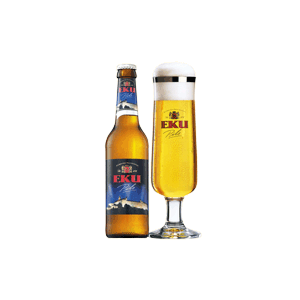
EKU PilsEKU Pils is, as you may have guessed, a Pilsner, which since its inception as a style of beer in 1842 has become the single most popular style of beer the world has ever known. Golden in color, it originated in the Czech Republic town of Pilsen. Up until that time, all beer was dark and cloudy. The Czech pilsner was the first beer to be brewed clear and golden. The Germans quickly proved to be the most passionate devotees of the new style and the name of the style was soon shortened to "Pils." The German contribution was to make the beer a bit lighter in body—better suited to everyday drinking—and to add an extra dose of hops for a refreshingly bitter zing. Expect a massive, brilliant white head to top this lucent gold, well-carbonated beer. Look for a characteristic pilsner maltiness with notes of floral and spicy hops. We found it to be remarkably refreshing, easy-drinking, with a crisp, clean, dry finish and slightly bitter hop-driven aftertaste. A very food-friendly beer that will partner nicely with anything from light fish to Chicken Kiev to pizza to spicy Thai cuisine.

Serving Temperature: 48° F
Alcohol by Volume: 5.0%

De Struise Brouwers—Vleteren, Belgium (Western Belgium)

While Belgium is known for its well-established breweries whose years of experience are counted in the centuries, there are a number of up-and-coming brewers in Belgium. It's not hard to understand why, with all the amazing beers available in their own backyards; it makes perfect sense that folks who have grown up on some of the best beer their side of the Atlantic would gravitate toward the brewing industry. But despite the brewing infrastructure that exists there, it's still no easy feat getting one's own brewery assembled and running. That's where contract brewing, what might seem like a domestic, outsourced-happy export from the states, comes in to play. The key difference being the breweries that make their services available on a pay-to-brew basis aren't the young, money-hungry, fly-by-night entrepreneurial capitalists that you might expect in the US... They're breweries that have been around for decades if not centuries.

The folks behind the De Struise Brouwers have made use of the local brewing infrastructure since deciding to get into the brewing business. For about the past three years they've been doing their brewing at the Brasserie Caulier in Péruwelz, Belgium. This brewery, though well-respected and abundantly capable of producing great beer, was a bit of a drive for them to get out to. This distance meant that some of the brewing and post-brewing steps that were overseen by the contract brewery owners/workers couldn't reliably be quality-controlled by De Struise Brouwers. In early 2006 they moved their production base to the old Brouwerij Deca in the famed Belgian brewing Mecca of Flanders (specifically, Vleteren). Only a 10 minute drive from their homes, it makes their brewing process that much more convenient, and permits them to faithfully oversee all of the brewing, aging and storage processes from the moment the grains are milled to the time the beers are loaded onto palates for delivery to thirsty folks through the EU (and now the US—consider yourself lucky—you're one of the first US citizens to enjoy this beer domestically!)
The old Deca Brewery is a stone's throw away from the legendary Sint Sixtus Brewery (brewers of the incomparable Westvleteren Trappipst Ales, considered by many aficionados to be the best beers in the world). Deca's cast-iron mash and infusion kettles were pressed into service in 1917 and their brew kettle is an old, authentically Flemish one, complete with brick mantle.

De Struise Brouwers is a group of friends who started to brew beer at an ostrich farm (hence the name: struisvogel means ostrich but struis in colloquial language is a strong, tall guy).Considering these humble beginnings only hammers home the point that, without exaggeration, the De Struise Brouwers are brewing in the shadows of giants, but being in such good company certainly works in their favor. We had the pleasure of tasting four of their commercially available beers, and have selected Struise Witte as our second international feature. We expect to bring you more in the coming years, as we're particularly fond of their fine brews.

For more information about the brewery, check out their web site: http://www.struisebrouwers.be.

Struise Witte

So, if you're like us, you wondered what the Ostriches on the label represent. Turns out "Struise," when translated, is an indirect reference to ostriches, and given that they got their start on an Ostrich farm, brewers Carlo, Urbain and Philippe have selected a perfectly appropriate name. Each of them has their day jobs; Carlo is in the wine business, Philipe sells cars, and Urbain, well... According to Carlo, he has seven jobs from computers to construction to the good ol' ostrich farm. Just a bunch of regular guys brewing great beer! But their beers are way beyond 'regular'. We found their Struise Witte to be a particularly flavorful witbier. This is a bière vivant, or "live beer"—notice the thick yeast sediment at the bottom of the bottle (it's alive!). We say rouse it completely when pouring, but the choice is yours. The nose on this beer is extraordinarily floral—a good whiff is quite like walking into a florist shop. We're pretty sure if there was a flower called "beer" this would be what it smelled like. The floral quality is offset by an orange and champagne-like mix of scents. Expect it to start bitter and aromatic with some mellow citrus flavors atop a creamy note. Toward and through the finish the flavor is rounded out by slightly sour-tones with distinct notes of pear and herbs (coriander). As it warms, banana evolves as a prominent note on the nose and in the flavor profile. Enjoy!

Serving Temperature: 43-50° F
Alcohol by Volume: 5.0%
Suggested Glassware: Weizen Glass, Flute or Tulip

C&H Internationals Logo Since 1994
Join Our Club
Gift Memberships

Membership Renewals
Reorders
Home Page
More Information
Current Selections
Past Selections
Testimonials
Other Gourmet Clubs
Corporate Gifts
Wedding Gifts
Brewery Search
Style Guide
Beer Fun Section
Industry Resources
Festivals
Print a Gift Card
Send a Virtual Brew
Refer a Friend
Send a Hint
E-Promos
Contact Us
Link to Us

1 - 800 - 625 - 8238
(Outside US call: 949-206-1904)
P.O. Box 1627, Lake Forest, CA 92609