The Microbrewed Beer of the Month Club

Past Newsletters

January 2007

Brewery
Beers Featured
Shipyard Brewing Company Prelude Special Ale
Brooklyn Brewery Brooklyn Brown Ale
Shipyard Brewing Company Bluefin Stout
Brooklyn Brewery Brooklyn Lager
Okocim Brewery (Poland) Okocim O.K. Beer
EKU Brauerei (Germany) EKU 28

The Shipyard Brewing Company

Occupying a large chunk of the northeastern U.S. coast, Maine's ports have long been critical to the shipping trade that has been a vital component of the state's economy since the 1700's. But over time, shipping methods have changed, and some of the great old ports and surrounding realty have fallen into disrepair. In 1992, an entrepreneurial real estate consultant, Fred Forsley, was hired to explore new options for one such troubled retail development in Kennebunk, Maine. The complex was located on the site of three historic 19th century shipyards. Fred felt he could successfully develop and sell a brew pub concept, linked to the shipbuilding history of the town. Never planning to enter the brewing business, he originally set out to sell the developed property to an interested investor. But fate intervened when Fred was introduced to British Master Brewer Alan Pugsley. Schooled and trained in the art of English ale brewing at the renowned Ringwood Brewery in Hampshire, England, under the tutelage of its founder, the legendary Peter Austin, Alan had designed breweries and formulated beers for over 65 well-known brew pubs and microbreweries worldwide, being referred to as "the Johnny Appleseed of Brewing".

In the hopes of bringing true English-style ales to America, Alan had recently settled in Maine, bringing with him his extraordinary knowledge of English-style beer making, true English ingredients, and English brewing processes which he had perfected during his tenure with Peter Austin. Realizing the strengths that Alan could bring to a brewing establishment, and seduced by the appeal of the brewing industry, Fred hired Alan as a consultant, and they set sail into brewing history, founding Federal Jack's Brew Pub, the birthplace of The Shipyard ales.

Federal Jack's, named for one of the most famous ships built on the site in 1908, quickly rose to local fame, with Fred and Alan seeing consumer demand for The Shipyard's beer soar. Eager to meet the challenge of expansion, they acquired four acres on Portland's historic working waterfront in 1994, with Alan moving out of his consulting role and joining The Shipyard as Master Brewer and part owner. On April 24, 1994 they brewed their first batch of fine hand-crafted ale at their Portland brewery, and have since become the largest brewery in the state of Maine, currently celebrating their 12th year of producing fantastic beers.

For more information about the brewery and scheduled tours, call (800) 789-0684 or check out their web site at www.shipyard.com.

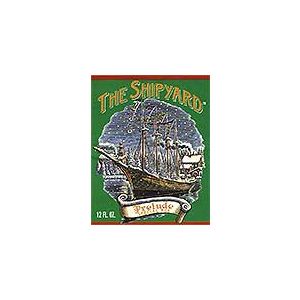
Prelude Special Ale

Shipyard Brewing Company Prelude Special AlePrelude Special Ale is a great example of a style of beer that has come to be known as Winter Warmer. The style has fairly broad definitions; for example, winter warmers can be either ale or lager, though most often they are ales. In general, these beers tend to be medium amber to deep brown in color, are sweet with a malty emphasis, present little hop presence (though hop character is one of the more variable characteristics of the style) and range from 6-8% ABV (the higher alcohol level is part of what gives the style its name, as the alcohol tends to 'warm' the belly). Some traditional examples also feature spices like cinnamon, cardamom or nutmeg. The Shipyard's version is more prominently hopped than many, yet is still malt-focused. It has a biscuit-like aroma with citrusy highlights and some fruity esters that evoke banana and hints of plum and pear. Expect notes of nutty malts with hints of rum and a firm hop bitterness that nicely balances the sweet side of this beer. Aftertaste is floral and bitter, and finishes with a toasty edge. Good with grilled chicken, Caesar salad, or stuffing with raisins (and surprisingly, grapes off the vine).

Serving Temperature: 45-50° F
Int'l Bittering Units: 45.0
Alcohol by Volume: 6.6%
Suggested Glassware: Pint Glass
Malts: Pale Ale, Crystal, Chocolate
Hops: Cascade, Tettnang, Fuggles, East Kent Goldings

Bluefin Stout

Appearing off Maine's coast by early summer are the majestic migratory Blue fin tuna. These famed fish can grow to an enormous size, with the largest examples weighing over 1,500 pounds and measuring close to 12 feet in length. Fish of this size can fetch more than $20,000 apiece. Like its namesake, this beer is big-bodied, sought after, and quite the catch. Expect a dark, jet black-colored brew with a dark tan head. Note the enticing aroma; full of chocolate, roasted malts, and hints of apple and plum. A slightly floral hop aroma cuts through the roasted chocolate malts and also contributes a lightly bitter aroma to the slightly vinous scent. Upon tasting, prominent notes of chocolate wash over the palate, leaving behind a light coffee flavor. Bitter hops rush in toward the finish and drive the interplay between dark chocolate flavors, coffee notes and tangy hop bitterness. Minor notes of peat contribute to its earthy character, but despite full-flavors, this beer is extremely smooth. Note a clean, crisp and dry finish with moderate complexity and hefty duration—enjoy over a smoky porterhouse steak, then with any chocolate-based dessert.

Serving Temperature: 45-50° F
Int'l Bittering Units: 40.0
Alcohol by Volume: 4.9%
Suggested Glassware: Pint Glass or Mug
Malts: Pale Ale, Crystal, Chocolate, Black, Roasted Barley
Hops: Warrior, Cascade, Tettnang, East Kent Goldings

Brooklyn Brewery

Great food, culture, fashion, Broadway, not to mention America's pastime—baseball—and of course, attitude. New York City has a lot to offer. But as far as top notch brew? Well, it hasn't exactly been known as a homestead for great beers until fairly recently, when the Brooklyn Brewery hit the scene. True, Brooklyn was once a great place for beer—but from the mid-70s through the mid-90s, there weren't many outfits dedicated to brewing distinctive ales and lagers. Enter the Brooklyn Brewery, founded in 1987 upon the laurels of Brooklyn's past brewing glory. One hundred years ago, there were approximately 50 breweries operating in Brooklyn. A large component of the immigrant population was German, and we all know of the German zeal for great beer. Taverns were places of civic decision-making, and brewers themselves were civic and social leaders. Sadly, this era ended in 1976 when the last of the Brooklyn-based brewing families, Schaefer and Liebman, closed down, succumbing to the competition imposed by the massive Midwest macrobreweries.

So then, whom do we have to thank for bringing the brew back to Brooklyn? In 1978, Associated Press correspondent Steve Hindy traveled to the Middle East on assignment where he befriended a few diplomats who homebrewed in such countries as Saudi Arabia and Kuwait where Islamic law forbade the sale of alcohol. He picked up a few tricks of the homebrewing trade and upon his return to the states, where he settled in Brooklyn's Park Slope neighborhood, he continued to hone his craft. His downstairs neighbor Tom Potter, a former loan officer at Chemical Bank became very interested in Steve's brews and, while watching Mets ball games together, came to appreciate the beers in Steve's repertoire which were brewed in authentic, German, pre-prohibition style once found throughout Brooklyn. Tom became convinced that there was a market for this sort of beer and together with Steve they founded the Brooklyn Brewery in 1987. With the help of fourth-generation German-American brewmaster William M. Moeller, their first official beer was brewed: Brooklyn Lager.

For the next nine years, their brews were contract brewed up in Utica, NY. In 1994 they hired highly respected New York brewmaster Garret Oliver to design their own Brooklyn plant and oversee production at the Utica facility. On a momentous day in 1996, mayor Rudy Giuliani cut the ribbon in Williamsburg, Brooklyn, and their new plant was opened. Since then, Oliver has created some of the most well-known, well respected brews to come out of the east coast.

There's much more to be said of Tom's and Steve's success story (and the many hardships along the way)—all of which can be read about in their book BEER SCHOOL—Bottling Success at the Brooklyn Brewery, published by John Wiley & Sons. It's a book we recommend—after all, this is one of our favorite breweries! And check out the brewery web site for updates on where their brewmaster Garret Oliver will appear next—he regularly conducts gourmet beer and food tastings to educate consumers on the virtues of good beer with good food (www.brooklynbrewery.com). In fact, his book, The Brewmaster's Table: Discovering the Pleasures of Real Beer with Real Food is a must have for those interested in making beer a prominent part of their culinary fare. For more information about the brewery and scheduled tours, call (718) 486-7422 or check out their web site.

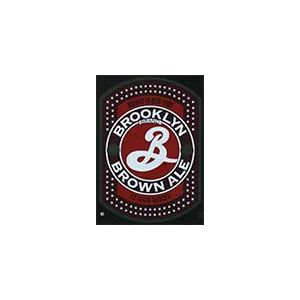
Brooklyn Brown Ale

Brooklyn Brewery Brooklyn Brown AleBrooklyn Brown Ale is modeled after the famous brown ales of Britain, but with a more robust hop character than its British counterparts. This beer was first brewed back in 1990 as a holiday beer, but has since found its way onto the year-round menu. The nose presents a fantastic blend of malty sweetness and citrusy hops, almost like a watered-down Barleywine. This beer is remarkably smooth, and slightly vinous, with hints of chocolate and coffee in the flavor and finish and the slightest possible note of a clean, mint-like character. This beer is particular good with steaks, burgers, stews and barbeque, where it can put its caramel flavors to work with the caramelized flavors in the meat. Also great with well-aged cheddar, Gouda and Gruyere cheeses.

Serving Temperature: 44-50° F
Int'l Bittering Units: 28.0
Alcohol by Volume: 5.6%
Suggested Glassware: English Pint Glass
Malts: British 2-Row, Belgian Aromatic, American Roasted
Hops: Willamette, Cascade, American Fuggle

Brooklyn Lager

Their first brew, this is a Brooklyn original, created in the Vienna Lager style. And it is a classic! The nose is amazing—stunningly well balanced. Note how the sweet malty tones are perfectly offset by the grassy, lemony hop notes. This is THE definition of aromatic balance, and this beer single-handedly resurrected Brooklyn's pre-prohibition era beer greatness. The beer goes down with a touch of sweetness, and a distinctly lager-like cleanliness and crispness. The grassy hop notes gently usher in the finish, with a lemon zest quality rounding out the finish. Absolutely delicious, this beer seriously goes with just about anything you can cook up. Great with sashimi or fried fish.

Serving Temperature: 36-42° F
Int'l Bittering Units: 30.0
Alcohol by Volume: 5.2%
Suggested Glassware: Pilsner Glass or Pint Glass
Malts: American 2-Row
Hops: Hallertauer Mittelfruh, Vanguard, Cascade

Okocim Brewery—Brzesko, Poland (Malopolska Province; Southern Poland)

Poland has an enduring tradition of beverage brewing, going back just about as far as Polish history itself. Common citizen and noblemen alike have downed their share of local beers. Even Polish Pope Klemens was said to be a fan—right to the end. As the story goes, while on his deathbed, he made a desperate declaration that went something like "O, Santa Piva di Polonia!" Those at his bedside mistakenly thought he had just created a new saint—Saint Piva—but it was soon realized that he just wanted a beer (Piwo means beer in Polish). And who could blame him? Hops were brought to Poland from Bavaria in the 1200s, where they have since become quite prized for their unique aromatic qualities. Brewers here have made use of the natural resources of the Polish countryside for more than a millennium, and with that much experience under their belts, you can bet that they know a thing or two about making world class beers.

The Malopolska province, located in southern Poland, borders the Ukraine to the east and Slovakia to the south. It is home to Poland's third largest city, Krakow—which escaped much of the tumult of World War II and retains its original charm and beauty. Visitors relish the opportunity to visit its many historical medieval towns and picturesque castles which dot the hillsides that lie at the foot of the Carpathian Mountains. To the east lies the portion of the country that is home to the world renown hop-growing regions of Pulawy and Lublin. These southern areas, and in fact, the entire southern half of Poland (south of Warsaw) are of particular importance to the country's brewing industry, with notable brewing areas in Wroclaw, Katowice, Krakow, Zywiec, and Okocim.

The district of Okocim (pronounced: Oh-KOTCH-eem) is in the town of Brzesko, to the east of Krakow, and is home to two of the region's very valuable architectural structures: the palace of baron Jan Goetz and the Okocim brewery which he founded in 1845, when this region was still a province in the Austrian Empire. A mere three years earlier, the first Pilsner was born in Pilsen, Bohemia (also an Austrian province at the time, in what is now the Czech Republic), and Okocim followed suit by creating their famous Okocim Pilsner. The brewery itself is well preserved, though recent additions have expanded it and seen the introduction of a few modern pieces of equipment. There are at least three brewhouses, all still in use. The brewery still retains its original 1845 chimney, and as one of relatively few remaining "Austrian" breweries of this period, it represents a classic site in the modern history of beer-making. Today it is one of the biggest and best breweries in the country.

The brewery currently produces at least six different brews—Okocim O.K. Beer, which is a great example of the "Polish-Pils" style of beer; Okocim Beer (yes, they do seem to gravitate toward the simpler names), which is an intensely hopped pilsner; Okocim Malt Liquor, not to be confused with the domestic malt liquors in the states, is their strong (7.8% ABV), pale beer; Okocim Porter, a world-recognized classic in the Baltic Porter style; Okocim Palone, an intensely roasty dark beer; and Okocim Karmi, considered a "near beer" with its low alcohol content of 0.5%—it is the only dark, low-alcohol beer available in the States and is often given to nursing mothers (in Poland) as an energy drink—it has an abundance of sweet malt flavors. An interesting assortment to select from—we encourage you to try them all if you are ever in Poland (or check out their U.S. distributor's web site at www.stawskidistributing.com/polishbeers.html to find out where to find the Okocim beers in your area).

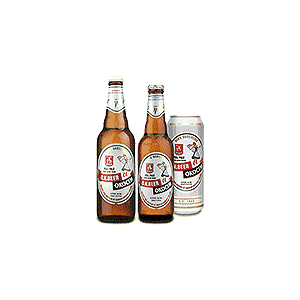
Okocim O.K. Beer

Okocim Brewery Okocim O.K. BeerOkocim O.K. Beer is more than just "O.K. Beer". It derives its quality from a recipe which incorporates the best of the indigenous Polish hop varieties, malted barley and pure spring water from the Tatra mountain range. The beer itself reflects the purity of these ingredients in its taste and is one of a handful of Polish brews that defined the "Polish Pils" style, which in turn separated Polish beers from the many other European brands. It is a light-to-medium-bodied beer that actually carries quite a bit of alcohol (6.2% ABV), though its aroma of floral Polish hops nicely masks this fact.

Expect to experience a hop aroma profile that is probably unlike anything you are used to unless you often partake of the Polish brews. Look for a balanced flavor of lightly sweet malts with a spicy hop bite and, as it warms—a slight kick from the alcohol content and increasing spiciness. This beer finishes with a superbly dry crispness that is stern and unique among many of the European lagers. A great beer to drink with traditional Polish cuisine, such as a plate full of hot potato and onion Pierogies, Barszcz (red beet soup) served with stuffed dumplings, or roasted carp. And be sure to admire the vintage beer label while you're chowin' down on your Polish grub—it has remained virtually unchanged since it was first designed over 40 years ago!

Serving Temperature: 40-45° F
Alcohol by Volume: 6.2%
Suggested Glassware: Pilsner Glass

EKU Brauerei—Kulmbach, Germany (Northern Bavaria, a.k.a. Franconia)

A-hem, brew-students, please take your seats. Grab yourself a snifter or similar drinking vessel and pour your 2nd featured international beer. Class is now in session. Let's begin with a brief history of the glorious German beer we've sent you this month.
The Northern Bavarian town of Kulmbach is known for a variety of beer styles, but the most notable is the unique beer style indigenous to Kulmbach: "eisbock". This unique style of beer is based on a variant of the traditional "bock bier" initially made famous in the town of Einbeck, Germany, located about 175 miles northwest of Kulmbach. Einbeck's unique beer was not originally known as "bock" beer. Through years of Bavarians requesting "Einbeck Bier" the name was colloquially corrupted to "Ein Bock Bier" (which in German sounds like "one bock beer"), and ultimately just "Bock Bier".

Many years after bocks hit the scene, a variation called "doppelbock", first brewed by monks in Bavaria, rose to popularity after the creation of the original doppelbock, named Salvator (and you can still find this beer on specialty beer store shelves!) Yet another variation on the theme developed some time later; according to local lore, a wooden barrel of doppelbock bier (in the 6.5-7.5% ABV range) was accidentally abandoned in the yard of a Kulmbach brewery in the dead of winter. Snowfall covered the barrel and it was forgotten until uncovered by thawing in early spring. When it was discovered, the contents were partially frozen, and the barrel had split open enough to expel some of the original contents, though a fair amount of the original brew remained in the barrel. The encasing ice was chipped away, and the residual beer left inside was tasted (crazy brewery staff—they'll drink anything), whereupon it was discovered to be much richer and more concentrated than the original. The reason behind this phenomenal discovery is a matter of simple chemistry; water freezes before alcohol, thus, some of the beer's water content was forced out of the brew and froze, eventually being removed as it was chipped away. So basically, the remaining beer underwent a relative increase in the proportion of alcohol to the remaining beer volume. This "technique" was refined, and today gives us one of the beers the region is famous for: Eisbock ("eis" means ice in German).

The Kulmbach beer we featured back in October is THE original Bavarian Eisbock, known simply as Kulmbacher Eisbock, brewed by the Kulmbacher Brauerei. A similar beer is EKU 28, brewed by the Kulmbacher Brewery's long time nemesis, the EKU Brauerei (also located in Kulmbach). EKU stands for Erste Kulmbacher Union, which translates to "First United Brewery" (read the review of EKU 28 below if you want to know where the "28" comes from). It was founded in 1872 and for nearly 125 years competed fiercely with the Kulmbacher Brauerei, as well other Kulmbach breweries such as Reichelbrau, Sandlerbrau and Monchshof.

Remarkably, the 'miracle' of corporate ownership has helped these breweries reconcile their differences—in 1996, these independent breweries became part of the same company, adopting the title of the simplest among them, the Kulmbacher Brauerei AG (or Kulmbacher Brewery Ltd.). While today united under the same name, each brewery continues to operate independently. That is, the original Kulmbacher Brauerei still makes the beers they built their reputation on, and the EKU Brauerei still makes the EKU 28 and EKU Pils that they've been brewing for a combined 170 years!

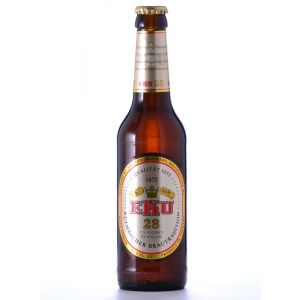
EKU 28

EKU 28 walks the line between a true eisbock and a fortified doppelbock. Its recipe remains a secret, but it is known that while lagering for an astounding nine months, its temperature is dropped until it begins to freeze. However, the brewery claims that the amount of ice left behind is not regarded as being a significant factor in its potency. And while the recipe is under wraps, we do know that the "28" subtitle is a reference to this brew's 'degrees Plato', the German system of 'original gravity' (a measurement of the density of fermentable sugars in a mixture of malt and water with which a brewer begins each batch of beer). In order to achieve its high alcohol levels, a lot of malt has to be used in order to supply the sugars that yeast will use as fuel in order to create alcohol. By comparison, your average beers have original gravities that range from about 8 to 10 degrees Plato.

EKU 28 presents a huge, caramel-heavy nose. The flavor is remarkable as it slides across the tongue with notes of chewy caramel, fresh bread, very light hints of fruit, and inevitably, some alcohol (which gives a nice, belly warming effect that really hits the spot this time of year). The finish is expertly crafted using a healthy dosing of hops which nicely balances this beer's overall sweet flavor. This is a beer for special occasions. Then again, anytime you open one, you're in for a special occasion! It is so rich that we don't recommend it with food—but after dinner as a digestif, like a port wine, is just fine. Also great with a variety of fuller-bodied cigars.

Serving Temperature: 50-55° F
Alcohol by Volume: 11.0%
Suggested Glassware: Snifter

C&H Internationals Logo Since 1994
Join Our Club
Gift Memberships

Membership Renewals
Reorders
Home Page
More Information
Current Selections
Past Selections
Testimonials
Other Gourmet Clubs
Corporate Gifts
Wedding Gifts
Brewery Search
Style Guide
Beer Fun Section
Industry Resources
Festivals
Print a Gift Card
Send a Virtual Brew
Refer a Friend
Send a Hint
E-Promos
Contact Us
Link to Us

1 - 800 - 625 - 8238
(Outside US call: 949-206-1904)
P.O. Box 1627, Lake Forest, CA 92609