Past Newsletters - December 2010
DOM = Domestic Beer Club; INT = International Beer Club; VAR = Domestic International Variety Beer Club; RBC = Rare Beer Club
Woodstock Inn Brewery (North Woodstock, NH)
Nestled in the heart of New Hampshire’s impressive White Mountains lies the Woodstock Inn Station & Brewery, one of the state’s most popular country inns. In addition to two in-house restaurants serving a wide-ranging fare, including their famous “Best Breakfast in the Valley,” this 33-room inn also brews its own beer – a feature that places it at the top of our list of places to consider staying at when traveling to New Hampshire.
The Woodstock Inn had been in the hands of the Clement family, who enjoyed it as their private home, for almost 100 years. When the last family heir moved away in the early 1960s, the inn stood vacant and unused for about two decades. Finally, the Rice family bought the property in the early 1980s and set about renovating the traditional New England style building. During Christmas of 1982, the inn was opened for guests, and it wasn’t long before success came – along with and a need for more space. To augment their original six guestrooms (each one furnished with a variety of period antiques), the family bought another historic property on the other side of the street and remodelled it in the Victorian style. Over the years, as the popularity of the Inn continued to grow, additional properties were acquired, and the Inn is now made up of multiple buildings, each offering its own unique charm and character. Another addition is the authentic train station building that dates back to the mid 1800s which has been converted to a bar and eatery (the Station).
It was in 1995 that the Woodstock Inn Brewery and Brew Pub opened for business, which of course is our favorite aspect of the Inn’s expansion. The brewery offers thirteen craft brews (eight main beers and five seasonal offerings), in addition to their old fashioned, handcrafted, K&M Root Beer. The brewpub features a seven-barrel system, and all beers are brewed with pure NH deep-well water and the highest quality malts and freshest hops available.
We think New Hampshire’s a great place to visit in any season, so for more info on the Woodstock Inn Station & Brewery, take a look at their website at www.WoodstockInnNH.com and check out their Brewer’s Weekend package in which you learn how to brew your own beer! Or visit the brewery’s website at www.WoodstockInnBrewery.com. Or just call ‘em up at 800-321-3985.
Named after the local Pemigewasset River, Pemi Pale Ale pours an attractive amber copper color with a foamy head that retains well and leaves good lacing. On the nose look for moderate pale and caramel malt aromas with a note of buttered biscuits. The hop profile leans toward grassy with a light citrus rind zing. Take a sip and you’ll find light biscuity malt notes with a bit of caramel, and with some warmth a touch of candied fruit can be discerned on the midpalate. The hops offer a spicy earthiness and an assertive bitterness on the finish. All in all this pale ale offers a bit more body, malt, and hops than many others of the style, and approaches IPA territory without fully crossing the border. Cheers!!
Serving Temperature: 45-50°F
Alcohol by Volume: 5.7%
Int’l Bittering Units (IBUs): 56
Suggested Glassware: Pint Glass or Mug
Malts: Pale, Crystal, Torrified Wheat
Hops: Fuggles, Cascade, East Kent Goldings
The term “rack” can have wildly different meanings depending on the context, but in this case, as the label clearly shows us, it refers to moose antlers. Now that we’ve got that out of the way, this brew pours a crystal clear amber with a fluffy cream colored head. There’s a deep maltiness on the nose, offering notes of freshly baked bread overlaid with a hint of caramel sweetness and a fruity impression that’s released by a good swirl of the glass. That light fruity impression comes through a bit stronger on the palate as it opens with some fruit esters (natural byproducts of the yeast during fermentation) amidst moderately sweet toasted barley malt flavors and a very mild buttery hint. Finishes with some bready notes that well up in the fade and a mild to moderate lingering hop bitterness. We really enjoyed this smooth, medium-bodied brew. If you like a tasty, straightforward, malty session ale with enough hop bitterness to keep it crisp and balanced, Red Rack Ale hits the spot.
Serving Temperature: 45-50°F
Alcohol by Volume: 5.5%
Int’l Bittering Units (IBUs): 23
Suggested Glassware: Pint Glass or Mug
Malts: Pale, Crystal, Caramalt, Torrified Wheat, Chocolate
Hops: Cascade, Willamette, Fuggles, Mt. Hood, East Kent Goldings
Boulder Beer Company (Boulder, CO)
The history of Boulder Beer Company goes all the way back to 1979, when it became the first microbrewery in the state of Colorado. Two professors at Colorado University, David Hummer and Stick Ware, founded the brewery, which at first was located on a small farm outside Boulder. In fact, the small one-barrel brewing system was forced to share space with a few goats! (The brewery itself notes that “When a company is founded by guys named “Hummer” and “Stick” in a goatshed, you kow it’s gonna be crazy.”) But, success would eventually change that rather unconventional situation, and five years later a new brewhouse in Boulder was built to house the expanding Boulder Brewing Company operations.
After being a publicly traded company since 1980, the brewery came into the private ownership of Gina Day and Diane Greenlee in 1990, who changed the name subtly to Boulder Beer Company and convinced Brewmaster David Zuckerman of Portland, Oregon’s esteemed Bridgeport Brewing Company to come out to the blue skies and snowy mountains of Colorado and join their operation. Upgrades to the entire brewery followed, including transforming their small tasting room into a full brewpub restaurant. Now boasting a 50-barrel brewing system, the brewery can churn out 43,000 barrels of awesome craft beer annually.
There was another name change in 1993, when they adopted “Rockies Brewing Company,” but in 2005 they went back to their roots and switched it back to Boulder Beer Company while also establishing their annual “Goatshed Revival” outdoor summer beer festival, which is one part birthday bash and one part charity fundraiser and pays homage to their humble origins as one of the country’s first craft breweries.
To learn more about the brewery, the brewpub, and scheduled tours, call (303) 444-8448 or check out their web site at www.boulderbeer.com.
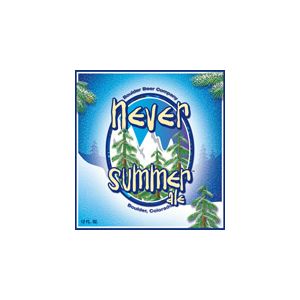
This winter seasonal from Boulder’s Looking Glass Series was a Gold Medal winner in the Strong Ale category at the 2004 World Beer Cup, and once you’ve sampled it, it’s easy to see why. Look for a clear, deep-amber/reddish color on the pour with a medium khaki colored head. Moderately sweet aromas of light caramel are apparent, along with an apple and berry-like fruity note. There’s a subtle spicy quality along with a faintly grapefruit-like hop note and an impression of brown sugar. On the palate, Never Summer Ale opens quite complex; look for the fruitiness on the nose to come through in the mouth, evolving into a deep toasted grain flavor with a moderate caramel undertone. There’s a delightful and hard-to-pin-down spiciness throughout, as well. We enjoyed the bold, sweet malts in perfect balance with the very firm hop bitterness, and though this winter brew is fairly warming at 6.5% ABV, it’s a bit more sessionable than some other fuller-bodied and more alcohol-laden winter brews. Perpetual winter? Well, if they’re serving this, sign us up!
Serving Temperature: 45-50°F
Alcohol by Volume: 6.5%
Int’l Bittering Units (IBUs): 40
Suggested Glassware: Pint Glass or Mug
Malts: Domestic Pale Malt, English 70/80 Caramel
Hops: Galena, Willamette, Cascade
Flashback India-Style Brown Ale
“What’s an India-Style Brown Ale?” you might be wondering. Well, in recent years brewers across the country (and across the world, in fact) have been experimenting with merging the bold, fresh, aromatic hoppiness of the India Pale Ale (IPA) style with darker, maltier brews (with varying degrees of success). Some of the resultant beers have used the terms Black IPA, Cascadian Dark Ale, or India Black Ale. Flashback is Boulder’s twist on this trend, and is a brownish dark amber ale that’s been amped up on a big-ass dose of Cascade hops. Another Looking Glass Series beer, Flashback was first brewed to celebrate Boulder Beer Company’s 30th anniversary, and we think it’s quite worthy of holding that distinction. On the nose you’ll notice the citric, piney, and floral volatile hop oil aromas normally found in an IPA, but there’s something a little different. The malt character is not only more pronounced, but also of a different character than an IPA, with a toasty, lightly chocolate, and deep caramel attitude. Opens on the palate with big hops right away, along with toasty grains, some chocolate malt, and a light candied fruit component that emerges a bit more as you swish it around. With five sizable Cascade hop additions during brewing, the hop flavors are naturally quite prominent and citric, and last well into the lingering finish along with a toasty, almost nutty, grain-like note. Congrats on 30 years and a great anniversary brew, Boulder. Cheers!
Serving Temperature: 45-50°F
Alcohol by Volume: 6.8%
Int’l Bittering Units (IBUs): 60
Suggested Glassware: Pint Glass or Mug
Malts: Belgian Biscuit Malt, Chocolate Malt, Pale Malt, Gambrinus Honey Malt
Hops: Cascade
To us, there is perhaps no better sign of the growth and expansion of the craft beer movement beyond our American borders than Turkey’s TAPS Brewery. Opened as Turkey’s first brewpub in 2002, TAPS’s goal was to bring an American-style brewpub experience to the country’s largest, and arguably most cosmopolitan, city: Istanbul. The idea caught on, and by 2006 they relocated brewing operations to a new, larger, central brewery location that not only provides keg beer to their own restaurants and other locations throughout Turkey, but also bottles beer in their distinctive branded bottles for export and domestic consumption. As of this writing, bottled TAPS beer has begun flowing to Japan, Sweden, and the U.S.
TAPS’s lineup includes over twenty full-time and rotating seasonal beers including several German-style lagers like this month’s club selection, Smoke Lager, as well as plenty of American-style ales such as Chocolate Stout and Red Ale. The food menu is very much a reflection of traditional American brewpub fare, with a bit of an Italian tilt and an occasional Turkish flare. Burgers, brick-oven pizzas, and pasta dishes abound, with delectable desserts like cheesecake and tiramisu thrown in for good measure. The formula has met with impressive success; in 2008, TAPS’s first franchise location opened in the capital of Ankara, and in the short period since then four additional locations have opened throughout the country, with at least two more on the way soon.
If you find yourself in Turkey and you’re thirsting for some good, all-malt, craft beer, check out TAPS. There are two locations in the very modern (yet extraordinarily old and historically rich) city of Istanbul: one in Yesilkoy, near the airport, and the other in Bebak, along the shores of the Bosphorus, on the European side. For more info on TAPS, check out their website at www.tapsistanbul.com.
TAPS’s Smoke Lager is a German-style rauchbier (literally “smoke beer”), and is a great choice for pairing with barbeque and other complementary smokey meat dishes. It pours a golden straw color, somewhat hazy, with a fluffy head that leaves a persistant collar as you go. Lean in and take a smell, and it announces itself as a rauchbier with the distinct aroma of the beechwood-smoked malts that define this style. Underneath the smoked malts is a light, clean, hint of straw or hay. Take a sip and TAPS’s Smoke Lager doesn’t destroy the palate like some of the most aggressive smoked lagers from Germany. Instead, the malt profile is simple and pleasant, with pale grains, straw, and a light sweetness supporting the moderate smokiness, with a mild hop bitterness providing a balancing counterpoint. Barbequed smoked sausage makes a great pairing, or, a simple snack of sharp cheddar and gouda works great as well, with the beer lending a great smoked flavor to the cheese.
Serving Temperature: 48-53° F
Alcohol by Volume: 4.5%
Suggested Glassware: Mug, Stein, Stange, or Pilsner Glass
Hofbrauhaus Wolters—Braunschweig (Brunswick), Lower Saxony, Germany
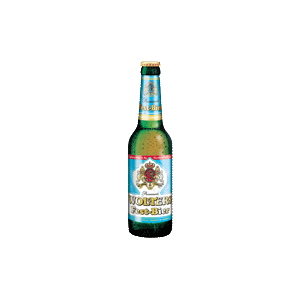
The origins of Hofbrauhaus Wolters can be traced back as far as 1627, when Zaccharis Boiling received the rights to begin brewing and selling his beer in Brunswick, Germany. The Wolters name came into the picture in 1734 when Heinrich Levin Wolters took over control of the brewery, beginning a family dynasty that would continue for six generations. The brewery has been a fixture of the city for literally hundreds of years, with the Duke of Brunswick even appointing Wolters as official beer supplier to his court (in fact, Wolters adopted the Dukedom of Brunswick’s coat-of-arms as their logo which you can see on their beers’ labels).
As was the case for so many breweries throughout Europe, World War II proved a very dark time for Wolters. Much of the city of Brunwick was destroyed by Allied air bombardment, including the brewery which suffered significant damage. Luckily for the brewery, Brunswick was located in West Germany after the war, and as such it was able to not only get back on its feet, but grow and modernize significantly. 1947 saw the reconstruction of the brewery, and a significant renovation and modernization occurred in 1976 to make Wolters a world-class brewing facility.
A long-established regional brewer and supporter of local beer festivals, Wolters has traditionally focused their growth and marketing within the area around Brunswick and within the greater Lower Saxony area. However, they’ve recently begun exporting, and in just two short years they’ve established export markets in diverse countries around the world including U.S., China, Lithuania, Ireland, Romania, and Mexico. Their success is testament to the quality of traditional, all-malt, German beer, and proves there’s a thirsty public out there that demands the good stuff. Prost!
Wolters Fest-Bier pours a light coppery-amber color with a nice looking foamy head from an aggressive pour. On the nose, the very distinctive aroma of German noble hops offer a prominent herbal/grassy character. Underlying the hops you’ll find a mildly sweet-smelling pale malt base with lightly toasty notes of crackers and biscuits. These crackery notes carry through on the palate, with hints of paper, bread, a somewhat dusty and earthy lager yeast quality, and a very mild tart note in the finish. This is a perfect beer for a beer festival; some versions of the style lean more toward a fuller-bodied caramel malt character, but Wolters brews their Fest-Bier a bit lighter with a moderate noble hop profile of grassy, herbal, spiciness that is emblematic of so many great German beers, and a great change of pace from the citric and piney hop varietals that we are so used to with American craft beer. Enjoy!
Serving Temperature: 45-50° F
Alcohol by Volume: 5.4%
Suggested Glassware: Pint Glass, Mug, or Stein
Brouwerij De Ranke—Wevelgem, Belgium (Western Belgium, near the French border (a.k.a. West Flanders))
Beers from Belgium are certainly not a rarity these days—in fact, Belgians have invaded many better beer venues for at least the past 7+ years, to the delight of better beer drinkers. In so doing, these beers have converted some who previously preferred wine, and inspired domestic brewers to explore the immense range that Belgium’s beers offer. There are just so many world-class beers produced in this part of the world that beer from Belgium is by no means scarce. But there are rarities, especially when it comes to those from tiny breweries that don’t export all (or any) of their beers to the US. One such example comes to us from the Brouwerij de Ranke out of West Flanders. Their production quantity is quite limited, and you’d be hard pressed to find the beer we’ve selected for you elsewhere in the US. Secondly, it’s one of Belgium’s darker beers, and is more heavily hopped than most examples of the style, so it suits many of the craft microbrew fans in the US who have come to appreciate a heavy dose of our precious little green friends.
Brouwerij De Ranke was founded in 1994 by two good friends, Nino Bacelle and Guido Devos. Their story is a classic in Belgium, where the very best craft brewing usually begins as a passionately pursued hobby, not an occupation (a similar tale is told again and again among US brewers as well). For Nino and Guido, brewing was literally a weekend obsession. For a few hours on Friday and Saturday each week, the historic, turn-of-the-century Deca Brewery in West Flanders was turned over to the De Ranke brewers, who made small batches of what many consider the best specialty beers of Belgium. Their beers are robust and flavorful, and known for their atypically (in Belgium) massive hoppiness, which comes from the best varieties available.
In 2005, after 11 years of brewing at the Deca Brewery, they built their own in Dottignies, about 12 miles to the south. Not bad for a weekend hobby—building a brewery represents no small feat (or fee!). Their story of dedication and quality is told in each bottle of beer that they put out. It is, indeed, a great tale, so pour yourself a glass of this month’s featured beer and get acquainted.
For more information about the brewery, check out their website at www.deranke.be
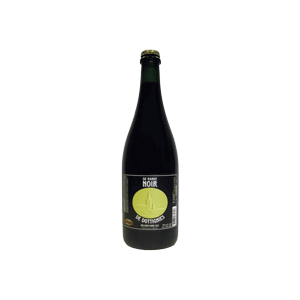
Named after their proud new home, Noir de Dottignies fills the glass with a tall plume of creamy head that is a toasty, off-white color, but in contrast to the deep brown burgundy beer, it initially may seem white. This is De Ranke’s darkest beer, and it features more varieties of malt than any of their other brews (six in fact). Despite the name, it’s not black. That being said, in contrast with all other De Ranke beers to date, this beer definitely plays ‘night’ to the rest of the lineup’s ‘day.’ Swirl the glass after the massive head has retreated (give it about 10 minutes) and up comes an aroma that is as heavenly as it is complex. Expect notes of lilac, rosewater, caramel, dough, chocolate, citrus and alcohol. There’s a noticeable spiciness to it, leaving a tingle in the nostrils (think cloves and pepper, with a flash of mint leaves and menthol). Once it has fully warmed up, notes of port wine surface. The flavor is unobtrusive yet weighty, layered yet uncluttered. Look for a hefty dose of chocolate malt, providing a rich depth of flavor, spiked with a phenolic, clove-y kick. There are no spices used in the recipe, so the nipping at your palate is all from the very active yeast strain used to ferment this beer, and from the heavy-handed addition of whole leaf Challenger and Saaz hops (as far as we know, De Ranke is the only Belgian brewery to use only whole leaf hops, all the time—so enjoy this rarity!). With so much happening in the flavor profile, it’s actually quite tricky to break this down—but we had a few bottles handy, and purely out of devotion to our members, went through ‘em all and gave it our damndest to get things right for these tasting notes (the things we do for you!). Once warmed, even more flavors emerge. We got flourishes of cantaloupe, toffee, orange blossom, dates and even coffee and chicory. There is a bitterness from the dark malts (more of an acridity) as well as from the hops, which carries into the finish and dries things up quite nicely as the hoppy earthiness fully blooms, balancing the richer, sweeter elements of the beer. It’s a bit raw and untethered right now, being young, but we loved it that way. However, it’s clear that this beer will age very nicely, and we’re looking forward to checking in on a bottle in about 12-24 months—we encourage you to do the same (the best before date gives you about a four-year window for aging). As for the foodies out there, get retro and try pairing with date nut bread smothered in cream cheese. Got any of those holiday peanut butter cups lying around from the holidays? Throw them at this beer—they work quite nicely together. Peanut butter cups and refined dark Belgian beer? Hey, if it works, it works. Enjoy!
Serving Temperature: 45-55° F
Alcohol by Volume: 9.0%
Style: Belgian Strong Dark Ale
Suggested Glassware: Tulip, Snifter or Oversized Wine Glass
Brasserie Pietra (Pietra Brewery)—Furiani, France (Northeastern mainland tip of the Island of Corsica)
The island of Corsica, in the Mediterranean, located between Italy and France, has been claimed by both nations—along with quite a few others—during its constant human habitation since the Mesolithic age. Let’s put that into context. Mesolithic means the “middle stone,” wedged between the Paleolithic (old stone) and Neolithic (new stone) ages. We’re talking about an area that’s been populated for seven to ten thousand years! Not surprisingly, there’s great national pride among native Corsicans, fostered in no small part by having been “claimed” by various outside nations, a brief historical stint as a sovereign nation from 1755 to 1768, and the secret sale of the island to the French by the Republic of Genoa in 1764. The announcement that it was a French territory was not made until 1768, and it triggered a civil war. Imagine if you opened the paper and read that your country was owned by and integrated into another, secretly, and there was nothing you could do about it. That’s a national-pride fosterer if we’ve ever heard one. Thankfully, the conflict didn’t last terribly long, and the result seems to have been a lingering, strong Corsican pride regardless of which country they were formally declared a territory of.
All of this history makes it a bit surprising that, until about thirteen years ago, Corsica did not have its own beer or brewery. Why? Location, location, location. Being wedged between Italy and France, the country’s people prefer wine over beer, and there’s also a relatively high proportion of sobriety. With no beers being made locally, coupled with reluctance on the part of a proud people to import beers from other nations, there was little drive to get a brewery based on the island. It was, therefore, a bold move for Corsican natives Dominique Sialelli and his wife, Arnelle, to decide in 1992 to found a brewery that would brew distinctly Corsican beers. Research and fundraising (and with it, lots of “convincing”) took place for the next four years. Their first beer, Pietra Amber, began to flow in 1996.
The word “pietra” is Italian for stone. So, literally, their name translates to “The Stone Brewery.” A nod to the highly regarded microbrewery from Southern California? Despite its world renown, that’s not the story behind the name. Is it a reference to the history of a human presence there since the Stone Age, or a proclamation that this young brewery plans to be around for the long term? Perhaps that’s buried in there somewhere; but, actually, it comes from the name of Dominique’s tiny native village, Pietraserena (meaning “serene stone”).
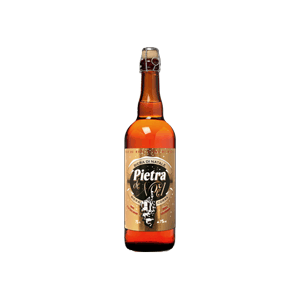
The brewery has since added a Corsican Cola to their lineup, as well as a lemonade currently in development, at least two more year-round beers, and a whisky. They’re a relatively young brewery, but in keeping with European brewing tradition, they have recently started brewing a fortified beer released once a year. It’s based on their Pietra Amber, which is a very unique beer with a distinctly Corsican heritage (for more on this, consult this month’s tasting notes). The beer has not been available in the US before—so it is a rare holiday treat that we’re pleased to bring you.
It would seem the dawning of a new age in Corsica’s history has begun, one full of inspiring and impressive concoctions that suit the palate, and sense of pride, in this age and beyond. Which makes us wonder . . . in 1762, famed philosopher Jean-Jacques Rousseau wrote in his work, The Social Contract, that Corsica would one day astonish Europe. Seven years later, Napoleon Bonaparte was born in Corsica. Did Rousseau’s prognostication refer to Napoleon’s legacy? That’s what many think. We submit that perhaps it was the birth of Brasserie Pietra and their expansion into Europe. A beer-centric way of thinking on our part, but what did you expect?
For more information about the brewery, visit their website at www.brasseriepietra.com.
“From birth till death, a Corsican’s whole time is lived under the influence of the chestnut tree.”
This old saying illustrates perfectly the Corsicans’ fondness for this splendid tree. Corsica has even been called “the civilization of the chestnut tree.” The island is one of the last regions in Europe where the dried fruit of the chestnut tree is still made into flour, which is then used in many different dishes. Pietra Amber, Brasserie Pietra’s first beer, is made with chestnuts picked by hand and brought down from the mountains of Corsica. Some, picked from trees located in rough hillside terrain, are transported the same way today as they have been for centuries: on the backs of donkeys. The chestnuts are then crushed to make a flour which is introduced to the brewing process during the mashing and boiling of the grains, instead of later as a flavoring or sweetener. This means that the beer itself is in part derived from the chestnuts, not just supplemented by them. The result is a bouquet that is truly unique. Expect malty notes, but don’t be surprised if the beer doesn’t smell quite like chestnuts; a consequence of using this key ingredient so early in the brewing process, the chestnut character is transformed by fermentation into the very makeup of this beer, alcohol and all. Instead, expect notes of marzipan, a slight woody zestiness, minor notes of overripened (soft) Clementine oranges, the faintest suggestion of bubblegum and clove-y phenolics, lemon, honey and a delicate nutty character. And alcohol—the booze makes its presence known in this souped-up holiday version. Interestingly, this beer is fermented colder than most ales, and as a result, there are some lager-like notes contributing suggestions of pilsner yeast (a mild musty, sulfury note). Take note of the look of this beer—it’s quite attractive; clear, brassy, coppery amber, adorned with a sticky, oily, off white head. Oils in the head diffract the light, creating changing colors on the sheen—and the head is indefinitely recharged by ample levels of carbonation; notice the jets rising from the bottom of the glass. The beer crosses the palate with an initial earthy bitterness, leaving an impression of faintly smoked wood, followed by notes of sweet oak, nougat, caramel and fruit. Expect nips from the alcohol to shadow the flavors most of the way through. Red apples and apple skins are quite prominent on the palate, as is a leafy character. Also look for a suggestion of honey wine toward the finish, with a lingering impression of grapes. Bitterness is long lasting and assertive, but not at all abrasive as it coats the tongue with leafy hop notes. Enjoy at least one glass on its own to fully experience this unique Corsican brew. Later, try pairing with lemon-pepper chicken, steamed mussels, or rosemary mashed potatoes.
Serving Temperature: 40-45° F
Alcohol by Volume: 7.0%
Style: Holiday Amber Farmhouse Ale
Suggested Glassware: Pint Glass or Pilsner Glass