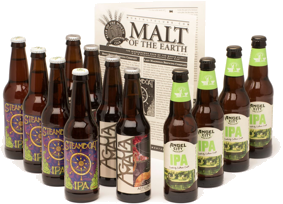
Past Newsletters
Vol. 2 No. 6
| Brewery | Beers Featured |
| New Knoxville Brewing Company | Swanky English Ale |
| New Knoxville Brewing Company | Old Pal Porter |
| New Knoxville Brewing Company | English Mountain IPA |
| North Coast Brewing Company | Christmas Belgian Ale |
| North Coast Brewing Company | Acme Pale Ale |
New Knoxville Brewing Company
The New Knoxville Brewing Company, which first brewed in Knoxville, TN under the same name beginning in 1896, has recently christened their new 25 barrel brewhouse and is now producing beer for the first time in that region since 1907. The brewery’s flagship beer, Swanky English Ale, derives it’s name from the same brew that ultimately caused the demise of the original brewery in 1912. As early as 1908, the brewery was producing "Swanky Temperance Brew", a supposed non-alcoholic beer, the operative word being, "supposed"! When Uncle Sammy discovered that the beer did in fact contain nectar of the demons, he promptly revoked the brewery’s charter in 1912.
Located in downtown Knoxville, 5 blocks from the old city and less than a year old, New Knoxville is only Tennessee’s third micro and shares the state with the Bohannon Brewing Co. in Nashville and the Jack Daniels Brewing Division in Lynchburg. Their small 5 person staff are all homebrewers and led by President, Ed Vendely. Brewmaster Robert Harvey is a former Chemical Engineer who’s traded in the corporate life to bring you the three beers we’re featuring this month. They plan to introduce a stout in early 1997.
For more information about the brewery and scheduled tours, call (423) 521-7870
Serving Temperature: 50-55° F
Original Gravity: 13.7° Plato
Final Gravity: N/A
Int'l Bittering Units: N/A
Alcohol by Volume: 5.4%
Swanky is a medium-bodied English Special Bitter (ESB) brewed with a combination of two-row Pale and Crystal malts as well as a touch of malted wheat. Robert uses both English Kent Goldings and Fuggles hops both in three separate additions during the 60 min. boil and both for their bittering and aromatic contributions. A 200 year old Ringwood Ale yeast strain taken from the Ringwood Brewery in England is used, the beer is brewed using traditional British brewing methods and it’s open-fermented. The hint of apple in the finish is a result of the Ringwood yeast.
Notes From the Panel:
Immediately note a very fruity and perfume floral nose in this medium-bodied, clear, straw-colored beer. Swanky starts, as the nose would indicate, sweet with floral hop flavor evident and then moves into a medium bitter and dry finish. Overall, an excellent, clean and flavorful ESB. One of the better American representations of this classic English style that we’ve tried.
Serving Temperature: 55-60° F
Original Gravity: 13.7° Plato
Final Gravity: N/A
Int'l Bittering Units: N/A
Alcohol by Volume: 5.25%
Old Pal is a re-creation of the popular porter brewed by the original brewery in the 1890’s and is brewed with malted wheat and a combination of two-row Pale, Crystal, Chocolate roasted and Black Patent malts. Here, Robert uses English Kent Goldings hops only once up front during the 60 min. boil for bittering and Fuggles twice later on for both bittering and aroma. The same Ringwood Ale yeast strain used in Swanky is also used and the beer is also brewed using traditional British brewing methods and open-fermented.
Notes From the Panel:
Look for a slightly roasted chocolate nose and flavor profile up front and note good head retention in this medium-bodied, filtered, deep reddish-black beer. Note a full malt flavor profile in the body and a somewhat bitter-sweet finish. Overall, a flavorful, clean and very enjoyable porter.
Serving Temperature: 50-55° F
Original Gravity: 14.0° Plato
Final Gravity: N/A
Int'l Bittering Units: N/A
Alcohol by Volume: 5.6%
New Knoxville’s India Pale Ale (IPA) is brewed with a combination of two-row Pale and Crystal malts as well as malted wheat. Cascade hops are used up front and Willamette hops 30 min. into the 60 min. boil primarily for their bittering contributions. Fuggles and Tettnang hops are used at the end of the boil for their aromatic qualities. Again, an English Ringwood Ale yeast strain is used and the beer is open-fermented.
Notes From the Panel:
Immediately note a fruity, floral hop and malty-sweet nose. Look for good head retention in this filtered, copper-colored, medium-bodied beer. Note a dry aromatic, hoppy finish. Overall, a clean, flavorful, almost too-well balanced IPA. A great introduction to a normally very hop aggressive style.
North Coast Brewing Company
Beer Journalists and food critics resoundingly agree that the North Coast Brewing Company, located in the tiny fishing, logging and now brewing town of Fort Bragg, California, is a place you can go to simply feel good. Maybe it’s the isolation of the sparsely populated, rugged coastline of Northern California or that fact that, to get there, you have to drive for hours along hairpin turns that trace the Pacific Ocean. Maybe it’s the friendly reception you’ll get from a small-town kinda staff. Or maybe it’s just the damn beer! My bet’s on Brewer/Owner Mark Ruedrich’s award-winning product line up. He’s received no less than 15 brewing awards, 12 of them from either the Great American Beer Festival or the World Beer Championships.
The brewery started as a brewpub in August of 1988 and prior to being a brewpub, the building served as a mortuary, a church, and a college! Brewpub manager Merle Ruedrich mentioned that a few of the local townsfolk have never set foot in the establishment and have no intention to as, "They don’t think they can have a good time in the place where they saw Aunt Wheezy or someone else for the last time." The brewery has since expanded operations to include a separate brewery located across the street from the brewpub and currently brews Red Seal Ale, Scrimshaw Pilsener, Old No. 38 Stout, Alt Nouveau, Centennial Ale as well as several other seasonal brews.
For more information about the brewery and scheduled tours, call (707) 964-BREW.
Serving Temperature: 40-45° F
Original Gravity: 18.0° Plato
Final Gravity: N/A
Int'l Bittering Units: 25.0
Alcohol by Volume: 7.3%
Northcoast’s Christmas Ale is a Belgian Double and is brewed with a combination of two row-Pale, Munich, Caramel, Brown, and Carapils malts. Mark uses cluster hops up front during the 80 min. boil for their bittering contributions. The lion’s share of the hops used are Northern Brewer hops which are added late in the boil for both their bittering and aromatic contributions. An Abbey Ale yeast strain is used and this complex Belgian is naturally carbonated during a long secondary fermentation period.
Notes From the Panel:
First note a predominantly fruity and spicy, complex and intense nose, characteristically Belgian. Look for great head retention in this cloudy, ruddy, amber-brown colored, medium-to-full-bodied beer. This ale’s flavor profile is also complex, offering a dry fruity malt/hop profile and traces of clove also evident. Overall, a very enjoyable and complex beer as well as a refreshing style choice for a Christmas Ale.
Serving Temperature: 45-50° F
Original Gravity: 13.0° Plato
Final Gravity: N/A
Int'l Bittering Units: 17.0
Alcohol by Volume: 5.4%
Mark’s Pale Ale is brewed with a combination of two-row Pale, Carapils and Carastan malts. He adds Cluster hops up front to give Acme its bitter finish and Northern Brewer hops towards the end of the 60 min. boil for both their bittering and aromatic characteristics. A proprietary house ale yeast strain is used and Acme is tank conditioned.
Notes From the Panel:
Immediately note a malty sweet, spicy hop nose with a trace of clove esters evident. Look for great head retention in this pale, filtered, medium-bodied ale. Also note a clean, well-balanced malt and hop profile followed by a bitter-dry finish. Overall, a clean, flavorful, and exceptionally well balanced pale ale, somewhat English in its interpretation.
Ask Murl
Dearest Murl,
I know that I’m supposed to use this column to ask beer related questions, but my question is more personal in nature. You see, I own an adorable little female Australian Sheep Dog and every month I show her your photo in the newsletter and she gets all worked up and frothy. The only problem is that you always just give us a head and shoulders shot. Would it be too much to ask to have you include a few full-body snaps for my little Lizette?
Monica Poland
Laguna Hills, CA
Dear Lizette (and Monica),
I must say, when I read your letter I got a little worked up myself if ya know what I’m talking about and I think ya do. Woof! Woof! Grrrrruff! Wahooooooooo. Somebody stop me! Hey, don’t look at me that way, pal! I am a dog after all. In any case, I’m not sure how much space the publishers will allot me to strut my stuff in the place of my otherwise enlightening column, but it is the Holiday Season and maybe I could use a little Scrooge-Logic on them if they ain’t bitin’. Thanks for the support and interest and do be sure and let me know when you’re in my hometown, Lizette.
Woof!
Murl.
Norm's Corner...
As spoken by Cheers' Norm
Woody: How’s it going, Mr. Peterson?
Norm: Poor. Woody: I’m sorry to hear that.
Norm: No, I mean pour.
Appreciation and Care for your Beers
In order to fully maximize your microbrew discovery, we suggest that you first take the time to read about each style, how it was brewed and what to look for when sampling it. Remember to store it in a cool, dry, dark place. (The fridge should work just fine!) It is important not to expose microbrewed beers to any form of light while storing them to ensure their freshness.
A Brief Look at the Brewing Process
By Chuck Hiigel
The basic goal is as old as history itself... make a sweet liquid and ferment it! While this may seem like an obvious thing to do with grapes, barley has the drawback of being neither sweet nor liquid. The brewing process converts the starches in the barley into sugars, extracts them in water, and boils the resulting sweet liquid with hops which are added for flavor and aroma. Along the way, the qualities that we see in the finished product - color, strength, and balance - emerge one at a time. Only then can fermentation commence.
Below, I’ve provided a very high-level look at the brewing process that will hopefully allow you to have better understanding of how the key ingredients used in beer are used as well as what characteristics in that beer are affected by the individual ingredients.
Barley Since the time of the Sumerians, barley has been the source of beer’s body, its sweeter flavors, protein ... and the heart and soul of all good beers. The variety that grows with two rows on the stock is the best for brewing, but six-row barley may be used as well as adjunct grains like corn or rice.
Malting A slow, controlled steeping of the grain, causing germination and making the starches in the grain soluble. All grains are dried and some are roasted to produce variation in the color of the beer. The length of time roasted and the amount of moisture in the grain at the time of roasting both effect a beer’s color. Malting takes place at specialized malting plants, only rarely at the brewery itself. Upon completion, the barley is now called "malt".
Color The brewer’s first decision is selecting between various roasting levels made available by the maltster. All beers are made primarily from the palest malt, and just a small amount of colored malts are required to make the darker beers. Common words used to describe color - pale, golden, straw-colored, light amber, reddish amber, deep amber, copper, dark red, brown, nearly opaque, black - fail to do justice to the subtlety of hue that can be captured by the artist in brewing.
Water Not to be taken for granted, water is the other key ingredient in beer. Brewers can manipulate the mineral balance in their water supply to emulate conditions in historic brewing cities like Pilsen, Munich, Dortmund or Burton-On-Trent. Or they can take advantage of existing unique properties and just brew with it the way it is.
Mashing The infusion of the milled malts in hot water, triggering enzymes in the malt to convert its starches into sugars. This is the heart of the brewing process, and careful control of temperatures will affect everything from the beer’s body to its head retention. As the liquid is drawn off the grains, the amount of sugars in proportion to the water begins to establish the future strength of the beer. The grains are then discarded and the liquid, called "wort," is brought to the brewkettle.
Strength "Original Gravity" refers to the amount of sugars in the wort... roughly 1.050 in the average brew, where water equals 1.000. This may ferment out to a beer of just under 4% alcohol by weight, which gives a reading of just under 5% when measured as a percentage of the beer’s volume. Beers over this strength are not labeled "beer". Five-point-five to 6% alcohol by volume makes for a good dinner brew or a festive beer. Beers at 7% are labeled as aperitif and "session" beers.
Hops The cone-like flower of the hop vine. For the last 500 years, hops have been the ingredient used to bring balance to the maltiness of beers, nearly to the exclusion of all other spices and flavorings. Varieties abound, some best for bittering, others selected for their aroma.
Brewing Bringing the wort to a full rolling boil for one and a half to two hours. Boiling stabilizes the wort, eliminating bacteria and dropping out the malt’s proteins.Bittering hops are added early in the boil, and hops selected for their aromatic contributions are added at the end, or even after the heat has been turned off. Additional hops can be added at any time during the boil. The selection of hop varieties, their amount and when they are added to the boil each offer the brewer his greatest opportunity for creativity.
Balance While beer is primarily made from malt, and hops are just the flavoring, it is possible that hops could be added in such doses as to overwhelm the malt character of the beer. Generally speaking, dinner beers and beers brewed for refreshment should be evenly balanced with substantial levels of both malt and hops flavors. Aperitif beers and "session" beers need to be fairly dry and bitter. Desserty and strong beers may be considerably sweeter and maltier.
Yeast The miracle ingredient, always appreciated but never understood until the advent of modern microbiology. Yeast is a living organism that thrives on sugars, and in digesting them, expels alcohol and carbon dioxide (CO2). A brewery’s yeast can develop its own personality over time, and give the brewer’s beers a distinctive character.
Fermentation The fermentation process plays a part in determining which family type a beer falls under. The brewer selects the yeast type (top-fermenting or bottom fermenting) and the appropriate fermentation temperature (cool or very cold). Ales, for example, which are top-fermented, have a quicker fermentation and aging time, and retain more of the yeast character in the finished beer. Lagers, which are bottom-fermented, must be aged longer and will have a cleaner, crisper character, where the yeast is a background flavor to the malt and hops. Character Color, strength and balance can be quantified and easily described, but a beer’s individual personality or character that comes as a result of the fermentation process is more elusive and likely to defy easy description. Vague words like "fruity" or "complex" begin to appear, with "notes" of this and "overtones" of that.
The house yeast strain at a brewery becomes its signature and the entire product line will show a family resemblance. It is these intangible qualities that make evaluating beer so much fun. Enjoy!
About the Author: Chuck Hiigel founded several California beer festivals, has taught courses on "Beer Appreciation", and published numerous articles in various trade publications.
Brew it Yourself
Al’s Spiced Christmas Ale
This month’s recipe is contributed by Al Korzona of Bridgeview, Il, a proud member of the Brewers of South Suburbia (B.O.S.S.), the Chicago Beer Society and the Headhunters Brewing Club. Al recommends you allow this one to mellow for 3 months prior to tasting it and likens it to Anchorsteam’s 1991 Christmas Ale. He also suggests that you use Pure Seal (smartcaps) bottle caps to better preserve the aromatics of this tasty nectar.
3.3 lbs. Munton & Fison Old Ale Kit
1 ½ lbs. Laaglander light dry malt extract
1 ounce Hallertauer hop pellets, in boil at 60 min. 1 ounce Hallertauer
hop pellets, in boil at 10 min.
2 teas. ground cinnamon 1/2 teas. ground nutmeg
1 ounce fresh ginger,peeled and grated
Zest of 4 oranges, grated
1/3 ounce Burton water salts
Wyeast #1084 Irish Ale yeast
3/4 cup corn sugar, for priming
Bring malt extract and water treated with Burton water salts to a boil. Add 1 ounce of Hallertauer hops. Boil for 50 minutes, add 1 ounce of Hallertauer hops, and all spices. Boil for 10 minutes and turn off heat. Cool, transfer to a primary fermenter, and pitch yeast. After a single-stage fermentation, prime with 3/4 cup corn sugar boiled in 16 ounces of water and bottle.
For Members Only
Give Your Friends FREE Beer, Wine, Cheese, Chocolate,
Cigars & Flowers!
Through our Customer Appreciation Program
Your name has real value to your friends, co-workers, and family members! Every time a friend, family member, or anyone else you know joins any one of our clubs, [or gives a gift] for 3 months or longer, we'll give them 50% off of their first month, but only when they mention your name. And we'll also give you 50% off your next month too which can either be applied towards your current membership or you can try one of our other Clubs out! (We can add one more month to your order at 50% off for prepaid memberships!)
The Fine Print: Members giving gift memberships do not qualify for referral credits and you can't give yourself a gift to qualify! This Program is mutually exclusive of any other promotions.
Membership Q & A
Q: What can I do if I'm having difficulty receiving my shipment
at home?
A: You should consider having our discrete box delivered to
your work location or to a neighbor 21 yrs. of age that can receive
it for you. As your shipment requires and adult signature to receive,
it's always best to ship it to a location where someone will be there
to receive it for you. The box is brown corrugated cardboard and doesn't
say "Beer" on it anywhere.
Q: What should I do if I'm moving or want to extend my membership?
A: Please call us prior to the 5th of the month to make all
account related information changes such as address changes, membership
extensions & terminations, or gift accounts desiring to continue
their memberships. Address changes made after that time may require
a repackaging and re-shipping charge of $12.00. Additionally, if your
box is re-routed by UPS from an address different than what was originally
specified, you may incur a $5.00 re-routing charge.
Q: What happens if my shipment is damaged?
A: If your shipment arrives damaged, please call us immediately
toll free at 1-800-625-8238 and report the incident for a prompt resolution.
Q: What happens if my credit card is declined?
A: We will send you a courtesy notice asking you for an alternative
payment method and your order will be temporarily suspended until
we hear from you.
Q: What happens if I join under a special incentive program
and don't stay a member for the entire term committed?
A: Not a problem. Although we want to do everything we can
to keep you as a member, we will allow you to cancel your subscription
early; however, you will be responsible to pay for the item that was
given to you as part of the promotion. If you received a discount
based on a specific term, the amount discounted will be charged to
your card.